
Have you considered every legal angle before signing on for a piece of land you plan to live off-grid on?
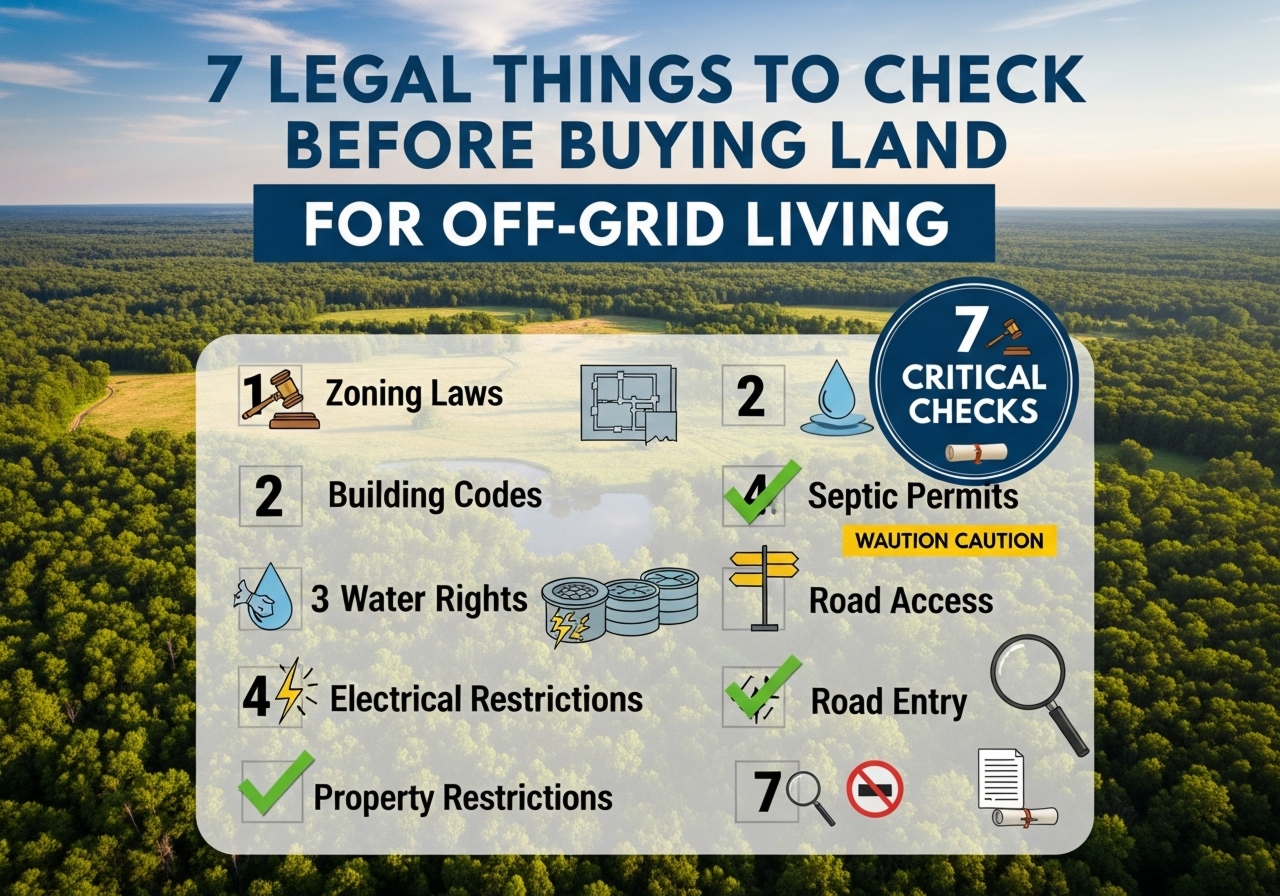
7 Legal Things To Check Before Buying Land For Off‑Grid Living
Buying land for off-grid living is exciting, but the legal side can make or break your plans. You want to be comfortable with long-term access to water, power, sanitation, and the ability to legally live in the way you plan. This guide breaks down seven essential legal checks you should make before you commit. Each section explains why the issue matters, what to verify, who to contact, typical red flags, and practical next steps.
Why legal checks matter for off-grid land purchases
Living off-grid often means relying on alternative systems and more creative solutions than typical suburban homes. Local rules and private agreements govern what you can build, how you can manage water and waste, and whether vehicles and structures will be allowed on the property. If you skip the legal checks, you may face costly retrofits, fines, forced removal of structures, or even loss of access to your land.
1. Zoning, Land Use, and Building Codes
Zoning and building regulations determine what you can build, where you can place structures, and how you can use the land. They also affect tiny homes, RVs, barns converted to housing, and alternative dwellings you might want.
Why this matters
- Zoning ordinances may prohibit residential use, limit dwelling density, or restrict temporary structures.
- Building codes and health and safety requirements can dictate foundation types, insulation, electrical systems, and approved sanitation systems.
- Setbacks and lot coverage rules will affect placement of buildings, solar arrays, and water storage.
What to check
- Zoning designation for the parcel (e.g., agricultural, rural residential, industrial) and permitted uses.
- Development density limits and minimum lot size for dwellings.
- Allowed dwelling types: Are tiny homes, mobile homes, RVs, or cabins permitted as primary residences?
- Setback, height, and lot coverage regulations.
- Local building codes (state and county) and whether they match International Residential Code (IRC) or have local amendments.
- Requirements for utility connections vs. off-grid alternatives (e.g., must be on grid connection if feasible).
- Any special overlays (historic, shoreland, critical habitat) that impose further restrictions.
Who to contact
- County or municipal planning and zoning office
- Building and permitting department
- Local code enforcement officer
Red flags
- Land zoned for non-residential use that prohibits dwellings.
- Codes that explicitly ban off-grid systems or require grid hookup if available.
- Historic district or environmental overlays with restrictive rules.
Practical next steps
- Ask for a written zoning verification letter from the planning department.
- Request building permit guidelines for the types of structures you plan.
- If the use is not permitted, ask about variance or conditional use permit procedures and success rates.
2. Water Rights, Wells, and Surface Water Access
Water is non-negotiable for living. Your legal ability to access, use, and protect water can be complicated depending on where the land sits.
Why this matters
- In parts of the western U.S., water rights are separate from land rights and follow a prior-appropriation system. You could own land and still lack legal water rights.
- Many counties require permits to drill a well; others have moratoria or depth limitations.
- Surface water (streams, springs, ponds) often involves riparian rights or public resource protections.
What to check
- Whether a permitted well exists and if its permit transfers to a new owner (often it does but verify).
- Well yields and well log records—production capacity and depth.
- Water rights attached to the parcel, including recorded adjudications or water use permits.
- Local groundwater regulations and well permit requirements.
- Surface water rights and any riparian easements.
- Quality of water (lab tests for contaminants like nitrates, arsenic) and whether treatment will be needed.
- Seasonal reliability and whether sources are subject to drought restrictions.
Who to contact
- State water resources department or water rights office
- County health department (well and septic)
- Local water district or watershed authority
- Licensed well driller or hydrologist for testing and evaluation
Red flags
- No water rights in a jurisdiction that separates water from land ownership.
- Well logs with poor yields or contamination.
- Shared wells without clear maintenance and access agreements.
- Water bodies labeled as protected or subject to environmental restrictions.
Practical next steps
- Order a professional well test and review well permit records.
- If no well exists, get a well feasibility study and estimates for drilling costs.
- Verify transferability of any water rights and whether transfers require state approval.
3. Septic, Wastewater, and Sanitation Regulations
Off-grid living usually requires independent wastewater solutions. Local health departments regulate septic systems, composting toilets, and alternative systems.
Why this matters
- Septic approval often depends on soil types, percolation (perc) tests, and minimum distance to water sources or property lines.
- Some jurisdictions only allow specific designs or engineered systems for small lots or problematic soils.
- Improper sewage handling can lead to hefty fines and forced remediation.
What to check
- Whether the property has an existing permitted septic system and permit history.
- Perc test results and soil evaluations for septic feasibility.
- Local health department standards for leach fields, holding tanks, and alternative systems.
- Availability of approvals for composting toilets, greywater reuse, or engineered systems like mound systems or aerobic treatment units.
- Distance setbacks to wells and surface water required for septic systems.
- Regulations around greywater reuse, drain fields, and winter operation.
Who to contact
- County or state health department, environmental health division
- Licensed septic designer/engineer or soil scientist
- Local septic installers for cost estimates and feasibility
Red flags
- Failed or uncertified septic systems with no feasible repair area.
- Soils with poor percolation (clay, bedrock) and no accepted alternative systems.
- Properties within cluster/centralized sewer districts that prohibit off-grid systems.
Practical next steps
- Obtain existing septic permits and as-built drawings where possible.
- Commission a perc test and soil report before purchase.
- If septic is unlikely, get quotes and approvals for alternative systems and factor costs into the purchase decision.

4. Access, Easements, and Road Maintenance
Legal access to your property is essential. Even spectacular land is worthless if you can’t reach it legally year-round.
Why this matters
- Some parcels have only informal or historical access across private land; these may not be recorded public rights-of-way.
- Easements determine who can use and maintain roads, whether you can improve them, and whether access can be blocked.
- Seasonal access (e.g., winter-closed roads) affects livability.
What to check
- Whether the property has recorded legal access to a public road or highway.
- Easements shown on the title, including recorded rights-of-way, shared access, or utility easements.
- Maintenance agreements for private roads: who pays, repair rights, and plowing responsibility.
- Whether there are gates, cattle guards, or other physical barriers and whether keys/locks transfer.
- Road classification (public, private, county road) and any history of disputes.
Who to contact
- County recorder or assessor for recorded easements
- Title company for title search and plat maps
- Neighboring landowners and sellers for practical access information
- County public works or roads department
Red flags
- Oral promises of access with no recorded easement.
- Easements that favor others (e.g., the easement owner reserves rights that interfere with your use).
- Shared roads with no formal maintenance plan, high anticipated costs for upgrades.
Practical next steps
- Obtain a current abstract of title and recorded easement documents.
- Commission a land survey to confirm legal access lines and ingress/egress.
- Negotiate written maintenance agreements if the road is private, and factor future maintenance costs into your budget.
5. Title Issues, Deed Restrictions, Covenants, and Homeowner Associations (HOAs)
Title problems and private restrictions can place heavy constraints on how you use your land.
Why this matters
- Covenants, conditions, and restrictions (CC&Rs) can prohibit off-grid systems, livestock, or types of buildings.
- Homeowner associations can levy fines or demand compliance with aesthetic, building, and connection rules.
- Unclear title, liens, or encumbrances can make financing and development difficult.
What to check
- Title search results and any recorded liens, mortgages, judgments, or easements.
- Recorded CC&Rs, covenants, and deed restrictions that apply to the parcel.
- If the property is in an HOA, review bylaws, assessment schedules, and enforcement policies.
- Any historical use agreements or unrecorded restrictions that could be enforced.
- Whether any conservation easements are recorded that limit future development.
Who to contact
- Title company or real estate attorney for a full title report
- County recorder’s office for recorded documents
- HOA management (if applicable) for current rules and fees
Red flags
- CC&Rs that explicitly ban off-grid systems, RV living, or certain structures.
- Liens or back taxes that could become your responsibility.
- Conservation easements that restrict building or require public access.
Practical next steps
- Obtain title insurance and read the title commitment carefully for exceptions.
- Have a real estate attorney review CC&Rs and advise on enforceability and potential for amendment.
- If restrictive covenants exist, ask whether variances, amendments, or buyouts are feasible.
6. Environmental Constraints, Wetlands, and Protected Species
Environmental laws may prevent you from building where you want, affect water use, or require mitigation.
Why this matters
- Federal, state, and local environmental protections can restrict development near wetlands, in floodplains, or within critical habitat.
- Unpermitted impacts to wetlands or endangered species habitat can trigger fines and mandatory restoration.
- Floodplain designation increases insurance costs and may require elevated building practices.
What to check
- FEMA flood maps for floodplain designations and risk levels.
- Wetlands mapping and whether the property contains regulated wetlands.
- Presence of protected or threatened species and habitat assessments.
- Local environmental overlay zones or critical area ordinances.
- Timber harvesting restrictions, if you plan to clear wood for building or fuel.
Who to contact
- U.S. Fish & Wildlife Service (for federal endangered species)
- State natural resources or environmental protection agency
- Local planning department for environmental overlays
- Wetlands specialists, ecologists, or environmental consultants
Red flags
- Property lying mostly within a regulatory wetland or high-risk floodplain.
- Known presence of endangered species that precludes development in key areas.
- Restrictions on removing timber or altering land that conflict with your plans.
Practical next steps
- Commission environmental assessments (Phase I or habitat surveys) where appropriate.
- Consult FEMA flood maps and consider flood elevation requirements when siting structures.
- If environmental restrictions exist, identify buildable areas and mitigation requirements early.
7. Permits, Inspections, and Local Approval Processes
Even if an activity is generally allowed, you may need permits and inspections to proceed legally.
Why this matters
- Permits provide legal authorization and trigger inspections that protect public health and safety.
- Building without required permits can lead to stop-work orders, fines, and expensive retrofits or demolition.
- Some permits have long lead times and public notice requirements.
What to check
- Types of permits you’ll need: building permits, electrical, plumbing, well permits, septic permits, land-use permits, and special use permits.
- Whether permits are required for solar, batteries, generators, propane tanks, and off-grid energy systems.
- Inspection schedules and certification requirements for occupancy or final approval.
- Permit fees, timelines, and any community notification or public hearing requirements.
- Grandfathering: whether existing structures or systems have legal nonconforming status.
Who to contact
- County building and planning departments
- Local health department for septic and well permits
- State energy or utility agencies for renewable energy connections
- Licensed contractors familiar with local permitting procedures
Red flags
- Frequent enforcement actions or long permit backlogs indicating inconsistent local enforcement.
- Permit requirements that effectively prohibit off-grid systems (e.g., bans on battery storage or off-grid solar).
- Existing unpermitted structures that would be costly to bring up to code.
Practical next steps
- Get a list of required permits in writing from the permits office for your intended uses.
- Factor permit timelines into your project schedule—some approvals can take months.
- Work with local, licensed contractors who are experienced with the permitting process.

Practical Checklist: Quick Actions Before You Buy
Use this compact checklist to guide your due diligence. It lists documents to collect and early contacts to make.
| Item to Verify | Documents/Actions | Who to Contact |
|---|---|---|
| Zoning & permitted uses | Zoning verification letter, parcel zoning map | County planning department |
| Water availability & rights | Well logs, water permit records, water quality tests | State water office, well driller |
| Septic feasibility | Perc test, septic permit history | County health department, septic engineer |
| Legal access | Recorded easement, survey, road maintenance agreement | Title company, county recorder |
| Title & CC&Rs | Title report, CC&R copies, lien searches | Title company, real estate attorney |
| Environmental constraints | FEMA map, wetland delineation, species survey | Environmental consultant, state agencies |
| Permits & inspections | Permit checklist and timelines | Building/permitting office, licensed contractors |
Costs and Timeframes to Expect
Planning off-grid living requires realistic budgeting for legal compliance. Here are typical ranges and timelines you should anticipate:
- Title search and insurance: $300–$1,500; 1–3 weeks for report.
- Survey (boundary + topo): $500–$5,000 depending on acreage and terrain; 2–6 weeks.
- Perc test and soil report: $300–$1,500; same-day to 2 weeks.
- Well drilling & permit: $5,000–$25,000+ depending on depth and region; 2–8 weeks for permit, drilling weather dependent.
- Septic design & permit: $1,000–$10,000+ (engineered systems cost more); 2–12 weeks for approvals.
- Permit fees: small for simple permits, several thousand for complex builds; local variation.
- Environmental assessments: $500 for basic checks; $2,000–$20,000 for extensive studies or mitigation.
These are ballpark figures; always get local estimates. Factor in seasonality—winter access can delay surveys, drilling, and inspections.
How to Reduce Legal Risk: Practical Strategies
You can reduce the chance of surprises by following these steps:
- Start with a pre-offer due diligence: request copies of title, surveys, CC&Rs, and permit history before making an offer.
- Use contingencies in your purchase agreement for key tests: “contingent upon satisfactory perc test,” “contingent upon acceptable title search,” “contingent upon ability to obtain well permit.”
- Hire local professionals: real estate attorney, land surveyor, septic designer, and a contractor familiar with off-grid systems in that jurisdiction.
- Obtain written confirmations from authorities rather than oral assurances. A zoning official’s written letter about permitted uses is far more defensible than a casual phone call.
- Consider title insurance and escrow arrangements that protect against hidden liens or title defects.
- Build relationships with neighbors and municipal staff for practical insight into local enforcement and common issues.
Sample Questions to Ask Sellers and Officials
When you talk to sellers, officials, or neighbors, ask targeted questions that reveal practical realities:
- Seller/neighbors:
- Has there ever been an issue with access? Who does road maintenance? How much does it typically cost?
- Are there seasonal limitations to using the property (e.g., snow blocking access)?
- Have there been any enforcement actions or complaints about building or waste systems?
- County planning / building:
- What is the zoning classification and what uses are permitted?
- Can a tiny home or RV be used as a primary dwelling on this parcel?
- Are there any pending zoning changes or proposed developments in the area?
- Health department:
- Does this site pass perc tests? What alternative septic options are permitted?
- What distance is required between septic drain fields and wells/surface water?
- State water office:
- Does this parcel have recorded water rights? Can a new well be permitted here?
- Are there any groundwater restrictions or water-use curtailments anticipated?
Common Pitfalls and How to Avoid Them
Avoid costly mistakes by being aware of common pitfalls:
- Mistake: Assuming “rural” equals freedom. Rural areas can have strict covenants or county codes.
- Avoidance: Get CC&Rs and zoning verification early.
- Mistake: Buying land without confirming water or septic feasibility.
- Avoidance: Require perc tests and water well feasibility as purchase contingencies.
- Mistake: Relying on oral promises for access or use.
- Avoidance: Insist on recorded easements and written agreements.
- Mistake: Underestimating permit timelines.
- Avoidance: Request permit checklists and timelines from the county and budget accordingly.
When To Walk Away
There are situations where you should seriously consider not buying a parcel:
- No recorded legal access and the owner or neighbors refuse to grant or formalize an easement.
- Water is unavailable, unreliable, or legally unacquirable.
- Fixed private restrictions (CC&Rs, conservation easements) that conflict with your essential living plans and cannot be feasibly changed.
- Environmental or endangered-species restrictions that exclude the only buildable areas.
- Title clouds (unpaid liens, unresolved disputes) that pose significant legal risk.
You can often negotiate pricing based on challenges, but some issues are deal-breakers for off-grid plans.
Final Practical Steps Before Closing
Before you close, confirm these items:
- Title insurance is in place with acceptable exceptions.
- Signed and recorded easements and road maintenance agreements are finalized.
- Permits that must be acquired at closing (if any) are at least in the application or approval stage.
- All contingencies in your purchase agreement are satisfied in writing.
- You have a plan for emergency access and utilities during initial development (e.g., temporary generator, portable toilet permitted).
- Access to records: ensure you get as-built drawings, well logs, septic permits, and survey plats from the seller.
Summary
Choosing land for off-grid living means balancing your vision with the legal reality. By checking zoning and building codes, water rights, septic feasibility, access and easements, title and deed restrictions, environmental constraints, and permit requirements, you significantly reduce risk and increase the likelihood your off-grid life will be sustainable and compliant.
Take it step by step: gather documents, talk to the right local offices, commission tests that matter, and use contingencies to protect yourself during the purchase. Investing time and a bit of money up front to verify the seven legal areas outlined here can save you from far larger expenses, headaches, and heartbreak later.