
? Are you certain the parcel you’re looking at will legally let you live off‑grid the way you want?
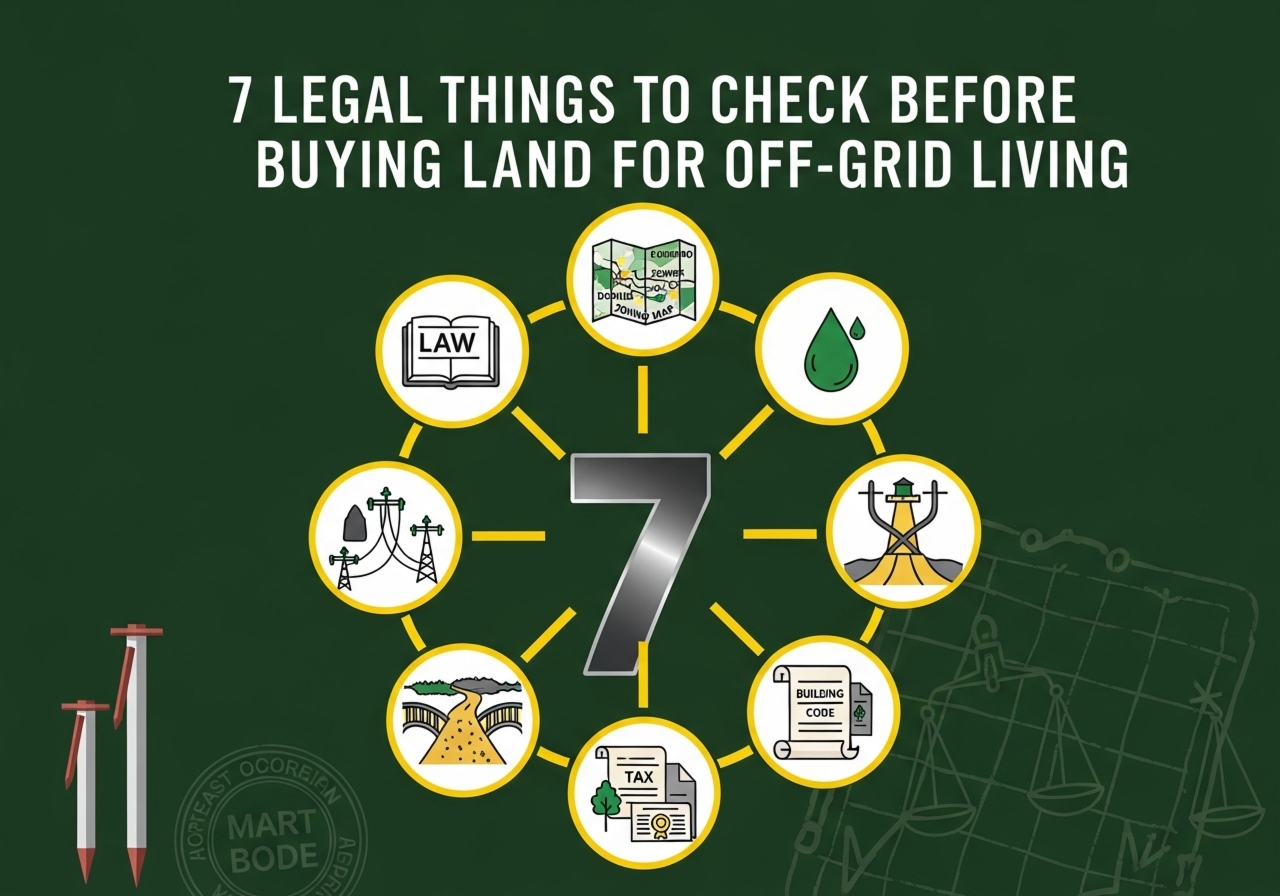
7 Legal Things To Check Before Buying Land For Off‑Grid Living
How to Choose Off‑Grid Land: Water, Access, and Red Flags to Avoid
Choosing land for off‑grid living means balancing freedom, cost, and a lot of legal realities. This guide walks you through the seven legal checks that matter most, explains why each one matters to you, and gives practical steps and red flags so you can buy with confidence.
Why legal checks matter for off‑grid land
You can design the perfect off‑grid setup, but if local law, title issues, or unrecorded restrictions stop you, you could face fines, forced connections, or even losing the property. A little legal homework before purchase prevents expensive surprises later.

Quick checklist (at a glance)
Use this table as a reference before you dig into the details. It summarizes the seven legal items and the basic action for each.
| # | Legal Item | Basic action you must take |
|---|---|---|
| 1 | Title & ownership history | Get an updated title report and title insurance |
| 2 | Zoning & land use | Check county/city zoning and permitted uses |
| 3 | Access & easements | Confirm legal access and recorded easements |
| 4 | Water rights & well permits | Verify water rights, well permits, and sources |
| 5 | Wastewater & septic rules | Confirm septic/drainfield approvals and restrictions |
| 6 | Building permits & code compliance | Check permitting process and off‑grid allowances |
| 7 | CC&Rs, conservation easements & HOA rules | Review covenants and any recorded restrictions |
Now let’s unpack each of the seven legal checks with details, how to verify, typical costs, who to contact, and red flags to avoid.
1. Title, ownership, and encumbrances
You need to be certain the seller actually owns the parcel and that there aren’t hidden claims against it.
Why it matters Title problems — like liens, unclear ownership, boundary disputes, or judgments — can stop a sale or leave you liable for debts or litigation after closing.
What to check
- Current deed showing legal owner.
- Chain of title for past 20–30 years if possible.
- Recorded liens, mortgages, tax liens, judgments, or bankruptcy notices.
- Any pending litigation affecting the property.
- Title insurance commitment and exceptions.
How to verify
- Order a title search from a reputable title company or attorney.
- Purchase owner’s title insurance (recommended).
- Ask for a preliminary title report and review the exceptions section.
Who to contact
- Title company or real estate attorney.
- County recorder/registrar of deeds for recorded documents.
Red flags
- Lots of recorded liens or judgments.
- Name discrepancies between seller and deed.
- Clouded title or missing links in chain of title.
Practical tip If a seller can’t produce a clear chain of title or the title company flags substantial exceptions, walk away until those problems are fixed.
2. Zoning, land use, and local ordinances
Local zoning and land‑use law determines what you can build, where you can build, and whether off‑grid systems are permitted.
Why it matters Zoning may restrict residential use, minimum lot size, accessory structures, renewable energy installations, or prohibit septic systems. Some jurisdictions require connection to utilities where available.
What to check
- Zoning designation and permitted uses for the parcel.
- Setbacks, building envelopes, and height restrictions.
- Minimum lot size for dwellings.
- Rules on accessory dwelling units (ADUs), tiny homes, cabins, and RVs.
- Permitted sources of power (solar, wind, generators) and propane storage rules.
- Whether mandatory utility connection ordinances exist.
How to verify
- Contact county or municipal planning and zoning department.
- Request zoning maps and the zoning code sections that affect the parcel.
- Ask if there are recent or pending zoning changes or variances affecting the lot.
- Confirm whether septic and well systems are allowed for residential use.
Who to contact
- County planner, zoning officer, or building department.
- Local planning commission records.
Red flags
- Zoning that lists “agricultural only” or “no residential structures” unless rezoning is feasible.
- Minimum lot sizes too large/too small for your plans.
- Mandatory connection ordinances that require tying into a utility line already installed.
- Prohibitions on renewable energy equipment or off‑grid wastewater systems.
Practical tip If your ideal parcel needs a variance or a rezoning, ask the planner about the likelihood of approval and typical timelines and costs — this often takes months and may be denied.
3. Legal access, right‑of‑way, and easements
Driving to your land and allowing emergency access both rely on legal rights, not just a farm trail.
Why it matters Property without recorded legal access can be landlocked. Verbal promises from neighbors don’t replace recorded easements. Access disputes can prevent you from using your property or getting services.
What to check
- Recorded legal access to a public road (ingress/egress easement).
- Maintenance agreements for private roads.
- Utility easements that may run through buildable areas.
- Whether access is seasonal (e.g., only passable in dry months) and whether the county will maintain the access.
How to verify
- Obtain and review the plat map and recorded easements at the county recorder.
- Ask for a title insurance commitment that includes easement details.
- Inspect county road records and maintenance schedules.
Who to contact
- County recorder and public works department.
- Neighboring landowners if private roads or shared driveways are involved.
- Title company for recorded easements.
Red flags
- No recorded legal access to a public road.
- Access through property owned by someone unwilling to grant a formal easement.
- Easements that are too narrow, obstructed, or shared with heavy traffic uses.
- Seasonal or unimproved roads that the county won’t maintain.
Practical tip If the seller says “it’s always been fine,” insist on a recorded easement or a documented maintenance agreement. Consider a survey to confirm the actual location of any declared access.
4. Water rights, wells, springs, and surface water rules
Your water source is one of the most critical legal items for off‑grid living.
Why it matters In many Western states water rights are separate from land title and are tightly regulated. In others, well permits and groundwater use are controlled. Surface water and spring usage can also have restrictions. You need enough reliable legal water for domestic use, livestock, and irrigation.
What to check
- Whether water is included with the parcel or if it requires a separate water right.
- Existing well: well log, permit number, depth, yield tests, contamination results.
- Springs or streams: whether you have riparian rights or must obtain water rights.
- Local groundwater permitting regime and well drilling rules.
- Water district or irrigation district affiliation and rules.
How to verify
- Request copies of well permits, well logs, and any yield test reports from seller.
- Check state or county water resources department records for water rights and permits.
- If there’s no well, ask about drilling permits, depth to water, and typical drilling costs in the area.
- Hire a hydrogeologist or well driller for a site visit if water is uncertain.
Who to contact
- State water resources agency or groundwater management district.
- Local well drillers and water testing labs.
- Regional water district or irrigation district.
Red flags
- No recorded water right in water‑law states when surface water or irrigation is necessary.
- Wells without permits or missing well logs.
- Known contamination issues (e.g., nitrates, arsenic).
- Extremely deep groundwater levels making drilling impractical or costly.
Practical tip Even if there’s a working well, get independent water quality and quantity testing. A good well can still fail after drought cycles, so check historic water levels.
5. Wastewater, septic, and sanitation regulations
Off‑grid sanitation is about both engineering and approvals — you can’t just install a system without permission in most places.
Why it matters Improper wastewater disposal attracts fines and health code enforcement. Septic systems require soil tests, approved drainfield sites, and permits. Some jurisdictions allow composting toilets or alternative systems; others do not.
What to check
- Whether the land is eligible for a septic system (site evaluation and percolation test requirements).
- Permits required for septic installation and who inspects.
- Restrictions on alternative systems like composting toilets, incinerating toilets, or greywater reuse.
- If the property is in a sewer district or mandated to connect to a municipal system when available.
How to verify
- Request any existing septic permits, as‑built plans, and maintenance records from the seller.
- Check county health department requirements for septic approval and percolation tests.
- Ask about setback distances from wells, creeks, and neighbors.
Who to contact
- County health department or environmental health office.
- Licensed septic installer/engineer.
- State or local environmental protection agency for protected watershed areas.
Red flags
- Soil that fails percolation tests or minimal buildable area outside setbacks.
- Properties inside protected watershed zones with strict septic bans.
- No documented septic permit for previously installed systems.
Practical tip If you plan a tiny home, cabin, or multi‑family setup, verify whether the septic system size you need is allowed — lot size and percolation rate dictate drainfield size.
6. Covenants, Conditions & Restrictions (CC&Rs), conservation easements, and HOA rules
Recorded restrictions on the deed can limit what you build, how you heat, and whether you can live off‑grid at all.
Why it matters CC&Rs and conservation easements are legally enforceable. They can ban RVs, require building standards, prevent solar panels on certain facades, or permanently limit subdivision and development.
What to check
- Any CC&Rs or deed restrictions recorded against the property.
- Conservation easements that restrict development, timber cutting, or land use.
- HOA (if any): rules, fees, and enforcement history.
- Whether restrictions are time‑limited or permanent.
How to verify
- Pull recorded documents from the county recorder’s office.
- Ask the seller for copies of CC&Rs and HOA bylaws and recent minutes.
- Confirm whether the HOA is active and financially solvent.
Who to contact
- County recorder/recorder of deeds.
- HOA management or board.
- An attorney who specializes in real estate covenants.
Red flags
- Covenants that prohibit off‑grid systems, RVs, composting toilets, or non‑permanent dwellings.
- Conservation easements that permanently block building or tree removal.
- Longstanding, aggressively enforced HOA with high fees and restrictive rules.
Practical tip If you buy land subject to an HOA, consider whether the community culture matches your off‑grid goals. Sometimes CC&Rs can be amended, but that often requires owner votes and political work.
7. Building permits, codes, and alternative energy regulations
Even off‑grid homes typically require building permits and must meet local building codes for safety.
Why it matters Unpermitted structures can be subject to fines, forced demolition, or difficulty in selling. Building codes affect electrical systems, plumbing, septic, and solar installations.
What to check
- Local building permit process and typical timelines.
- Codes for tiny homes, mobile homes, ADUs, and cabins — are they allowed as primary residences?
- Inspection requirements for electrical, plumbing, HVAC, and structural work.
- Rules for off‑grid solar, batteries, and generators, especially connection-to-grid requirements.
- Fire codes, especially in wildfire‑prone zones.
How to verify
- Discuss intended building plans with the local building department.
- Request a permit history for the parcel to see prior approvals or violations.
- Ask about inspectors’ requirements for final occupancy certificates.
Who to contact
- Local building department, code enforcement officer, or permitting office.
- Licensed contractors familiar with rural/off‑grid builds.
Red flags
- Prohibitions on using nontraditional dwellings as primary residences.
- Unwillingness of the building department to sign off on off‑grid electrical systems.
- Repeated code violations on the property or seller admitting to unpermitted structures.
Practical tip For off‑grid electrical systems, have an electrician who knows the local code draw your plans before purchase. If you eventually want grid‑tie capability, confirm net‑metering rules with the local utility.
Additional legal and practical considerations (don’t ignore these)
These items aren’t part of the top seven, but they often determine whether your off‑grid dream is realistic.
Boundary surveys and staking
Even with a title and plat, an accurate survey confirms where your usable land is.
Why it matters You need to know buildable areas, setbacks, and exact boundaries to avoid trespass and encroachment issues.
What to do Order a current boundary and topographic survey. Confirm improvements lie within your property lines.
Mineral rights and subsurface interests
In some regions, someone else may own the mineral rights, which can permit extraction activity on your land.
Why it matters Mineral owners may have rights to access or even disturb your land for mining or drilling.
What to check Title exceptions for mineral rights and any recorded oil, gas, or mining leases.
Taxes, assessments, and special districts
Property taxes, Mello‑Roos or similar assessments, and fees for fire/utility/special districts add ongoing cost.
What to check
- Latest property tax bill and history.
- Special assessments, HOA dues, or district fees.
- Whether the land is in an agricultural or timber tax program and the qualification rules.
Environmental and endangered species restrictions
Protected habitats, wetlands, or threatened species designations can drastically limit building and vegetation clearing.
What to check
- Wetland delineations and floodplain maps.
- Presence of listed species or critical habitat.
- Local environmental overlay zones.
Financing, lenders, and resale issues
Many banks won’t loan on unimproved land or non‑conforming tiny homes.
What to know
- Lenders often require a permitted dwelling with conventional construction.
- Buyer financing options include land loans, construction loans, or seller financing.
- Title insurance and escrow companies experienced with rural land are helpful.

Sample questions to ask the seller, county, and your professionals
Use this list as a practical script when you start fact‑finding.
To the seller:
- Can you provide the deed, recent title report, and any CC&Rs?
- Is there a current well permit, well log, and recent yield test?
- Are there any known boundary disputes or access issues?
- Have you had any code enforcement notices or building violations?
To the county/planning office:
- What is the parcel’s zoning and what uses are permitted?
- Is the property eligible for a septic system and are any soils tests on file?
- Is legal access recorded to a public road, and does the county maintain that road?
- Are renewable energy systems allowed, and what inspections or permits are required?
For professionals:
- Can you perform a site‑specific percolation test and topographic survey?
- Do you have experience designing off‑grid electrical systems that meet local codes?
- Is the property insurable (title, homeowners, fire) given its location and characteristics?
Common red flags and what to do if you find one
If you discover a red flag, don’t panic — get more information and estimate the cost and timeline to fix it. Here are common red flags and steps you can take.
Table: Red flags and recommended responses
| Red flag | Likely impact | What you should do |
|---|---|---|
| No recorded legal access | Landlocked or risk of future denial of access | Get a survey, insist on a recorded easement, or negotiate seller to obtain one before closing |
| Zoning prohibits residential use | Cannot live there legally | Consider rezoning, variance, or look for different parcel |
| No permitted septic or poor soils | May be impossible to install septic | Order soil tests; explore alternative systems with health department |
| Water rights separate from land | No legal water supply | Research state water law, buy water rights, or find parcel with on‑site permitted source |
| Active conservation easement | Development severely limited | Review easement terms; consider if lifestyle fits restrictions |
| Unpermitted structures | Fines, demolition, or inability to insure | Factor in costs to permit/repair or remove; consult building department |
| HOA with restrictive CC&Rs | Limits off‑grid options and adds fees | Review CC&Rs carefully and consider alternate properties |
Steps to protect yourself before closing
Follow these practical steps so the legal work is done before the sale becomes final.
- Hire a real estate attorney experienced in rural/off‑grid properties.
- Purchase title insurance and require a clean title commitment as a contingency.
- Get a current survey that identifies easements, setbacks, and buildable areas.
- Make access, water, septic, and permit approvals specific contingencies in your purchase contract.
- Order environmental reports and, where relevant, a wetlands delineation.
- Have inspections and professional assessments (hydrogeologist, septic contractor, surveyor) included as contingencies.
- Consider escrow holdbacks for items that must be resolved post‑closing, or ask the seller to cure issues before closing.
Practical examples — three scenarios
See how these checks play out in typical situations.
Scenario 1: Western ranch with a creek but no recorded water right You assume the creek gives you water, but state water law requires a prior appropriation right. You’ll either need to purchase water rights, rely on a permitted well (if possible), or accept seasonal supply. A water right issue could make the land unsuitable for year‑round off‑grid living.
Scenario 2: Forest lot in wildfire zone with HOA CC&Rs The HOA has defensible‑space and building material rules, increasing initial build costs but improving safety. If the CC&Rs ban nontraditional homes, your tiny cabin plan could be rejected.
Scenario 3: Mountain parcel with a track road and no recorded easement Driving in has always worked, but neighbors could restrict access. You must obtain a recorded access easement or negotiate legal maintenance responsibilities; otherwise, emergency access may be compromised.
Cost considerations and timelines
Legal checks add cost and time, but they’re relatively small compared to buying the wrong property.
- Title search & insurance: $300–$2,000 depending on property and loan.
- Survey (boundary + topography): $1,000–$5,000+ depending on acreage and terrain.
- Well drilling & testing: $5,000–$25,000+ depending on depth and region.
- Septic design and installation: $3,000–$15,000+ depending on system type and soils.
- Legal or zoning attorney: $150–$400/hour; fixed fee options available for document review.
- Timeframes: title search (1–2 weeks), zoning/planning responses (1–8 weeks), well permitting/drilling (weeks to months), rezoning/variance (months).
Final checklist before you sign
Make sure each item below is either complete or made a contingency in the contract.
- A clean title or title insurance commitment in place.
- Survey showing boundaries and recorded easements.
- Confirmation of legal access to public road.
- Water source confirmed with permits, logs, or credible well data.
- Septic/onsite wastewater eligibility or approved alternative system.
- Zoning permits the intended use or variances are feasible.
- Review of CC&Rs, conservation easements, and HOA rules.
- Building permit and code requirements understood for your build.
- Plan for emergency access and fire safety compliance.
- Financing and insurance options vetted for the parcel and proposed structures.
Closing thoughts
Buying land for off‑grid living is very achievable if you do the legal groundwork. Take the time to verify title, access, water, septic eligibility, zoning, and recorded restrictions. Use professionals where needed, and make key findings contingencies in the purchase contract. That way you preserve your freedom to design life off‑grid while staying on the right side of the law.
If you want, I can help you draft a list of questions tailored to a specific county or state, or a contingency clause you can use in an offer. Which parcel or state are you looking at so I can make the guidance more specific?