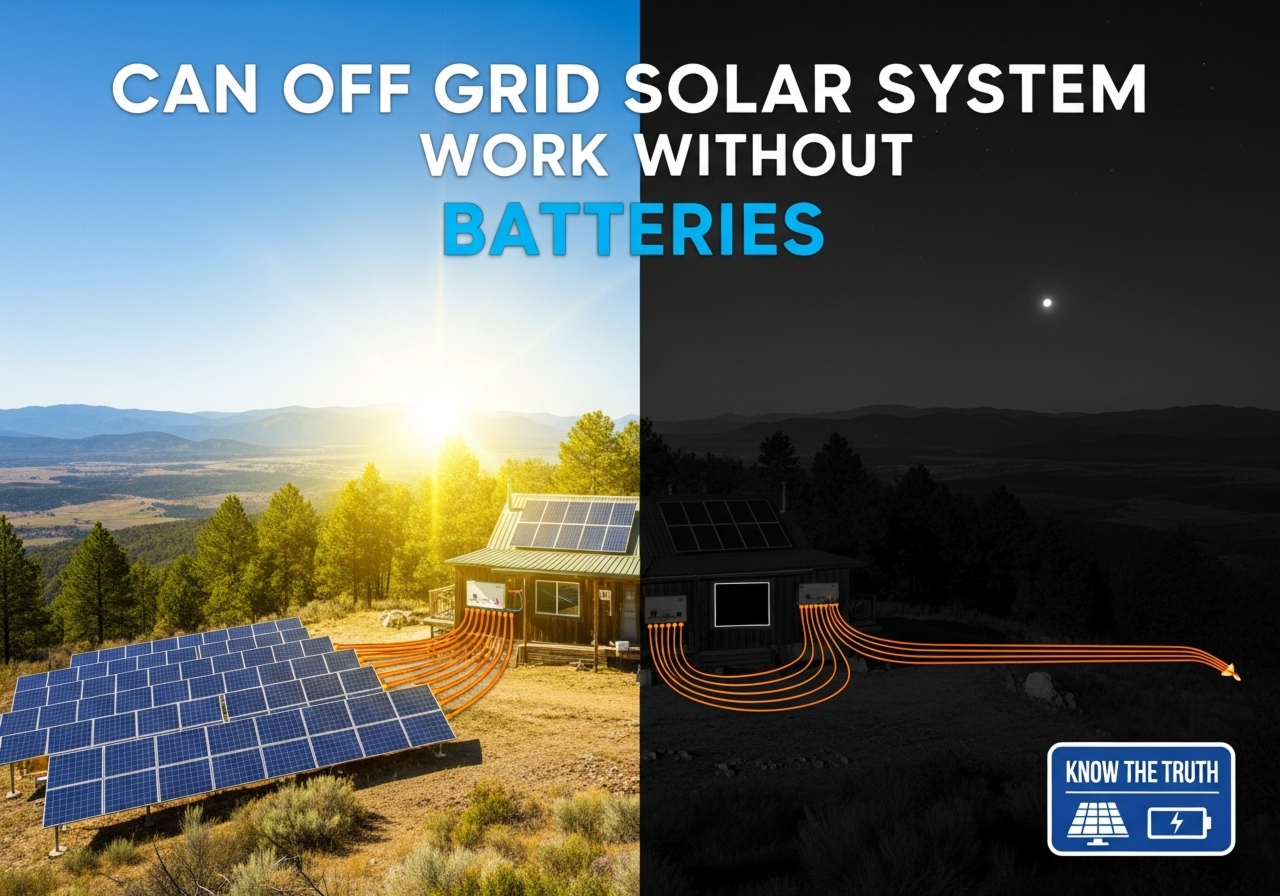
Can an off-grid solar system truly function without batteries, and what would life look like if it did?
Introduction: The question that stays with you
You might imagine a solar setup as panels on a roof and a bank of batteries humming quietly in the corner, but that image is only one version of a larger story. You live in a world where energy choices shape daily rhythms: when you cook, when you work, when lights come on. Removing batteries shifts those rhythms. This article is meant to answer whether an off-grid solar system can work without batteries, how it would behave, and what compromises or innovations you’d need to accept to make it practical.
What does “off-grid” mean to you?
Off-grid means you are not connected to a utility’s electrical network. You generate your own electricity and you are responsible for the balance between generation and consumption. That responsibility matters more when you choose to remove energy storage from the equation.
Why batteries are usually part of the picture
Batteries act as your household’s memory. They store energy when the sun shines and return it when it does not. Without that memory, your system becomes an immediate-response system: production and consumption must align in real time. Batteries smooth variability, provide backup, and improve power quality. Removing them forces you to manage intermittency, timing, and reliability in different ways.
Quick answer up front
Yes, an off-grid solar system can work without batteries in specific circumstances, but it requires careful design, load discipline, or supplemental generation (like a generator or other storage method). It’s not a simple swap; it changes how you live with energy.
Table: At-a-glance comparison
| Feature | With Batteries | Without Batteries |
|---|---|---|
| Nighttime power | Yes (if charged) | No (unless alternative supply) |
| Peak shift | Easy | Requires load timing or curtailment |
| Power reliability | Higher | Lower, dependent on generation/backup |
| Cost upfront | Higher (batteries add cost) | Lower hardware cost, but other costs may rise |
| Maintenance complexity | Battery maintenance, replacement cycles | More reliance on generator or controls |
| System responsiveness | Smoother | Must balance real-time supply/demand |
How a batteryless off-grid system could operate
You can think of a batteryless system as a living conversation between your appliances and the sun. When sunlight is available, certain appliances run. When it’s not, they stop. There are a few architectural models that make this feasible:
1) Direct-coupled systems (daytime-only setups)
Direct-coupled—or DC direct—systems power loads directly from PV panels during sunlight hours. They are straightforward and low-cost.
- What you get: Simple equipment, low losses when panels are producing, minimal maintenance.
- What you give up: Power when the sun isn’t producing, limited flexibility, and difficulty with variable loads.
This is the kind of system that’s been used for decades in water pumping: a pump runs only when the panels produce enough power.
2) AC-coupled systems with synchronous generator backup
You can run an inverter that converts PV output to AC in real time and pair it with a generator that starts when solar output falls below demand.
- What you get: More familiar AC loads, immediate supply switching with a transfer controller, continuous power if generator is available.
- What you give up: Generator fuel costs, noise, maintenance, and carbon emissions.
A transfer switch or a sophisticated controller manages the handover between solar and generator.
3) Grid-tied inverter with “self-consumption” (microgrid with no storage but with export limits)
If you have a nearby grid in principle but choose off-grid physically (for example, you’re on a property that has a local microgrid or a neighbor’s inverter that can accept your input), you might export excess power or draw in deficits. Strictly off-grid this is less common, but hybrid community systems sometimes allow batteryless strategies.
4) Alternative energy storage: thermal, mechanical, chemical
Instead of electrochemical batteries, you might store energy in a different form:
- Thermal storage: Heat water or a thermal mass during the day for later use (space heating or domestic hot water).
- Mechanical storage: Flywheels or pumped hydro (if site conditions permit).
- Chemical storage: Systems that use hydrogen to store energy (electrolysis → storage → fuel cell).
These systems replace battery functions but come with their own complexity, costs, and efficiencies.
Technical components you still need
Even without batteries, you still need a thoughtful combination of components to control voltage, provide safety, and manage loads.
Solar panels and mounting hardware
The panels are your primary energy source. Quality and orientation matter because, without storage, every kilowatt-hour you lose due to shading or poor orientation is a kilowatt-hour you can’t use later.
Inverter(s)
You need inverters that can convert PV DC to AC for household loads. For batteryless systems, you’ll want an inverter that can operate without a battery—some grid-tied inverters do this by requiring a stable grid frequency, which you lack off-grid; so you need inverter models designed for standalone operation or hybrid inverters with generator support.
Charge controllers, if using DC loads
If you run DC loads directly, a charge controller or DC-DC converter can regulate voltage and protect equipment.
Transfer switches and controllers
If you use genset backup, transfer switches safely connect or disconnect the generator from your circuits. Load controllers or energy managers balance PV output and generator input to avoid conflicts.
Mechanical or thermal storage elements, if used
If you choose thermal storage, you need insulated tanks, heat exchangers, and controllers. For mechanical storage, you need pumps/tanks or flywheels and the associated controls.
Safety devices
Overcurrent protection, grounding, surge protection, and disconnect switches remain essential.
When batteryless systems are most practical
You should consider a batteryless off-grid system in a few specific scenarios:
1) Daytime-only use
If you use most of your electricity during the day—running pumps, workshop tools, or irrigation—batteryless systems can be ideal. You align consumption patterns with generation.
2) Minimally powered sites
If your loads are modest and intermittent—such as remote cabins that are only used for short daytime periods—you can manage without batteries.
3) Application-specific loads
Devices like DC water pumps, solar lighting with individual small batteries, or heaters that store thermal energy during the day can work without central battery banks.
4) Sites with reliable, efficient backup generation
If you’re willing to run a generator occasionally and your fuel logistics are straightforward, you can maintain operation without batteries.
When batteryless systems are risky or impractical
You should avoid batteryless designs if you require:
- Continuous nighttime power (lighting, refrigeration, medical devices).
- High reliability and power quality for sensitive electronics without additional conditioning.
- Frequent periods of cloud cover or long nights (e.g., high latitude winters).
Balancing loads to live without batteries
Living without batteries pushes you into active energy management. You’ll find yourself scheduling and automating.
Load prioritization
Decide which circuits must have power continuously and which can wait for sunlight. For example, essential refrigeration or medical devices may require backup, whereas water heating can be timed.
Load shifting and timers
Timers and smart controllers let you run appliances during peak solar hours. Programmable thermostats for thermal systems or smart plugs for certain appliances can reduce the stress on the system.
Demand response strategies
Automatic load-shedding controllers can turn off nonessential loads when solar output drops. This prevents overloads and keeps essential systems running.
Table: Example load prioritization
| Priority | Example loads | Suggested action |
|---|---|---|
| High | Medical devices, refrigeration | Provide generator backup or ensure local battery backup |
| Medium | Lighting, cooking (electric) | Run during day; manual or automatic timers |
| Low | Laundry, EV charging (if batteryless) | Schedule midday operation or use generator |
Efficiency and design considerations
Without batteries you’ll want to maximize the usefulness of every watt your panels produce.
Panel sizing and orientation
Oversizing panels for peak daytime demand makes sense where night use is minimal. A larger PV array means more daytime capacity and less need for generator runtime.
Inverter efficiency and power factor
Choose efficient inverters and correct sizing to minimize energy losses. If you have inductive loads (pumps, motors), consider power factor effects.
MPPT vs. PWM controllers
Maximum Power Point Tracking (MPPT) controllers extract more energy from PV arrays, which can be critical when you have no buffer to make up for losses.
Minimizing standby loads
Devices with vampire power (standby consumption) steal what little energy you have; eliminate or manage them.
Financial trade-offs: cost vs. lifestyle
Going batteryless reduces initial capital cost (batteries are expensive), but it may increase operating costs and lifestyle costs.
Upfront vs. ongoing costs
- Upfront: Lower if you omit batteries, but you still pay for extra panels, inverters, and controls.
- Ongoing: You may incur fuel costs for a generator, higher maintenance, or opportunity costs from lifestyle constraints.
Lifespan and replacement
Batteries have finite life and replacement cycles; avoiding them delays that expense but shifts costs elsewhere.
Cost table: simplified comparison
| Item | Battery-based system | Batteryless system |
|---|---|---|
| PV array size | Moderate | Often larger to meet daytime peaks |
| Batteries | High capital & replacement costs | Zero |
| Generator usage | Lower | Higher (if used as backup) |
| Maintenance | Moderate (battery care) | Moderate-high (generator & controls) |
| Lifestyle cost | Lower constraints | Higher constraints on timing |
Real-world examples and use cases
You can picture places where batteryless solar is already practical.
Remote water pumping
Irrigation systems often use direct PV-powered pumps. The pump runs when sun is present, which is typically when irrigation needs are highest.
Daytime workshops and construction sites
Tools run during daylight hours; generator backup is used only for off-hours or heavy intermittent demand.
Solar air heaters and thermal stores
A house that uses solar collectors to heat a thermal mass can store daytime heat and use it at night without batteries.
Telecommunications and repeater sites with fuel cell or alternative storage
Some remote telecom sites use hydrogen or thermal storage rather than batteries, but these are specialized and expensive.
Practical design examples
Here are three simplified configurations to help you imagine concrete systems.
Example A: Cabin used on weekends (daytime use)
- PV array: 2–4 kW
- Inverter: single-phase stand-alone inverter
- Storage: none
- Backup: small generator for occasional night use
- Load profile: lighting, small appliances, cooking during days
This is a low-complexity, low-cost option. Discipline is required at night.
Example B: Farm pump and barn
- PV array: sized to pump during peak sun (e.g., 5 kW equivalent)
- Direct-coupled DC pump or AC pump via inverter
- Storage: none
- Backup: none or portable generator for overcast periods
- Load profile: pump runs only when sun is available
Reliability is tied to weather patterns but often acceptable for irrigation needs.
Example C: Off-grid microgrid with diesel backup
- PV array: oversized to cover daytime loads
- Inverter: hybrid stand-alone inverter that can operate without batteries
- Storage: thermal storage for heating; no electrical batteries
- Backup: diesel genset controlled with automatic transfer switch
- Load profile: mix of daytime commercial operations and some 24/7 needs covered by genset
This is a pragmatic commercial solution when batteries are undesirable.
Technical challenges and how to manage them
You’ll face technical challenges that must be solved through design or lifestyle.
Grid-forming and frequency control
Standalone systems usually require inverters that can form a stable AC grid with proper frequency and voltage regulation. In batteryless systems, you need an inverter capable of grid-forming without relying on a battery buffer—or you must accept a generator doing this job.
Voltage and frequency stability with variable loads
Rapid changes in solar output (passing clouds) can create voltage or frequency swings. Fast-acting controllers and load-shedding schemes reduce the risk of sensitive devices being damaged.
Power quality for electronics
Sensitive electronics expect steady voltage and low harmonic distortion. Use high-quality inverters, line conditioners, or isolated circuits to protect them.
Synchronization with generators
Automatic synchronization between PV inverters and generators is necessary to prevent generator trips or inverter shutdowns. Proper controllers manage ramping and sharing.
Safety, codes, and permitting
Even if you’re outside the grid, safety standards apply. You must comply with local electrical codes, building codes, and fire safety regulations. Inspectors will want to see proper disconnects, grounding, and overcurrent protection.
Insurance and liability
Your insurer may require certain safety measures or prohibit unconventional systems. Inform them and get any required documentation.
Environmental considerations
Removing batteries reduces concerns over battery disposal and toxic materials, but increasing generator use increases emissions. If you replace batteries with hydrogen, thermal, or mechanical storage, consider the full lifecycle impacts.
Pros and cons summary
Pros of going batteryless
- Lower initial cost (no batteries)
- Simpler to maintain in some respects
- Good for day-use, specific loads, or where batteries pose environmental or logistical problems
Cons of going batteryless
- No electricity during the night unless you use a generator
- Less tolerance for cloudy or variable weather
- More active energy management needed
- Potentially higher operational costs from fuel or replacement parts
Decision checklist for you
This checklist helps you decide if batteryless is the right path.
- Do you use most electricity during daylight hours?
- Can your critical loads tolerate interruptions or be run on generator backup?
- Do you have access to reliable backup fuel or alternative storage?
- Are you willing to adopt stricter load management and timing?
- Is continuous, high-quality power non-negotiable for certain devices?
- Does your budget favor lower upfront cost over higher operational or lifestyle costs?
If you answered “yes” to most of these, batteryless becomes plausible.
Steps to implement a batteryless off-grid system
- Conduct a detailed load audit. Know exactly when and how much power you use.
- Prioritize loads and identify what must always be on.
- Design PV array size to meet daytime demand with contingency for cloudy periods.
- Select inverters capable of standalone operation or with generator synchronization.
- Choose backup method: generator, thermal storage, hydrogen, pumped storage, or none.
- Build control logic: timers, load-shedding modules, transfer switches.
- Plan for safety: protective devices, disconnects, grounding, permits.
- Test under a range of weather conditions and revise.
Frequently asked questions
Will my lights go out at sunset?
If you don’t have storage, yes—unless you have a backup generator or alternative storage. You’ll need to plan lighting use during daylight hours or on stored heat/light solutions.
Can I charge devices like phones and laptops reliably?
Yes, during daylight when panels produce. For continuous use at night, you need backup or a small separate battery system for those devices.
How does a generator integrate with a batteryless system?
A generator can start when solar output drops. Transfer switches and controllers ensure safe handover. Frequent generator starts increase fuel and maintenance costs.
Are hydrogen or thermal systems greener than batteries?
They have different trade-offs. Hydrogen involves energy conversion losses and infrastructure; thermal storage is efficient for heat but not for electrical needs. Batteries remain one of the most energy-dense and efficient electrical storage solutions.
Are there inverter models that don’t need batteries?
Yes. Some inverters are designed to be grid-forming or to work with generators and can operate without batteries. Check manufacturer specs for “batteryless” or “stand-alone” capability.
Final thoughts: living with fewer margins
Choosing to live with a batteryless off-grid solar system is a design of priorities as much as it is a technical choice. You give up the cushion that batteries provide—those quiet hours of stored freedom—to simplify and reduce certain costs. In doing so, you accept a life more attuned to the rhythm of daylight, one that asks you to plan, prioritize, and sometimes wait.
If you appreciate the discipline of scheduling clothes washing, running pumps during the brightest hours, and relying on a generator only when necessary, batteryless solar may offer you a cleaner, simpler path. If uninterrupted power and flexibility matter to your daily life—especially for critical medical equipment or refrigeration—then batteries are likely indispensable.
You don’t have to make this choice purely on cost. Think about how you want your days to flow, the trade-offs you’re willing to accept, and the local conditions that will shape your system. Energy is practical, but it’s also personal—your choices will influence how you live in small, meaningful ways.
If you want, I can help you run the numbers for your specific load profile, suggest inverter models, or sketch a few system configurations tailored to your lifestyle and location. Which part would you like to look at next?