
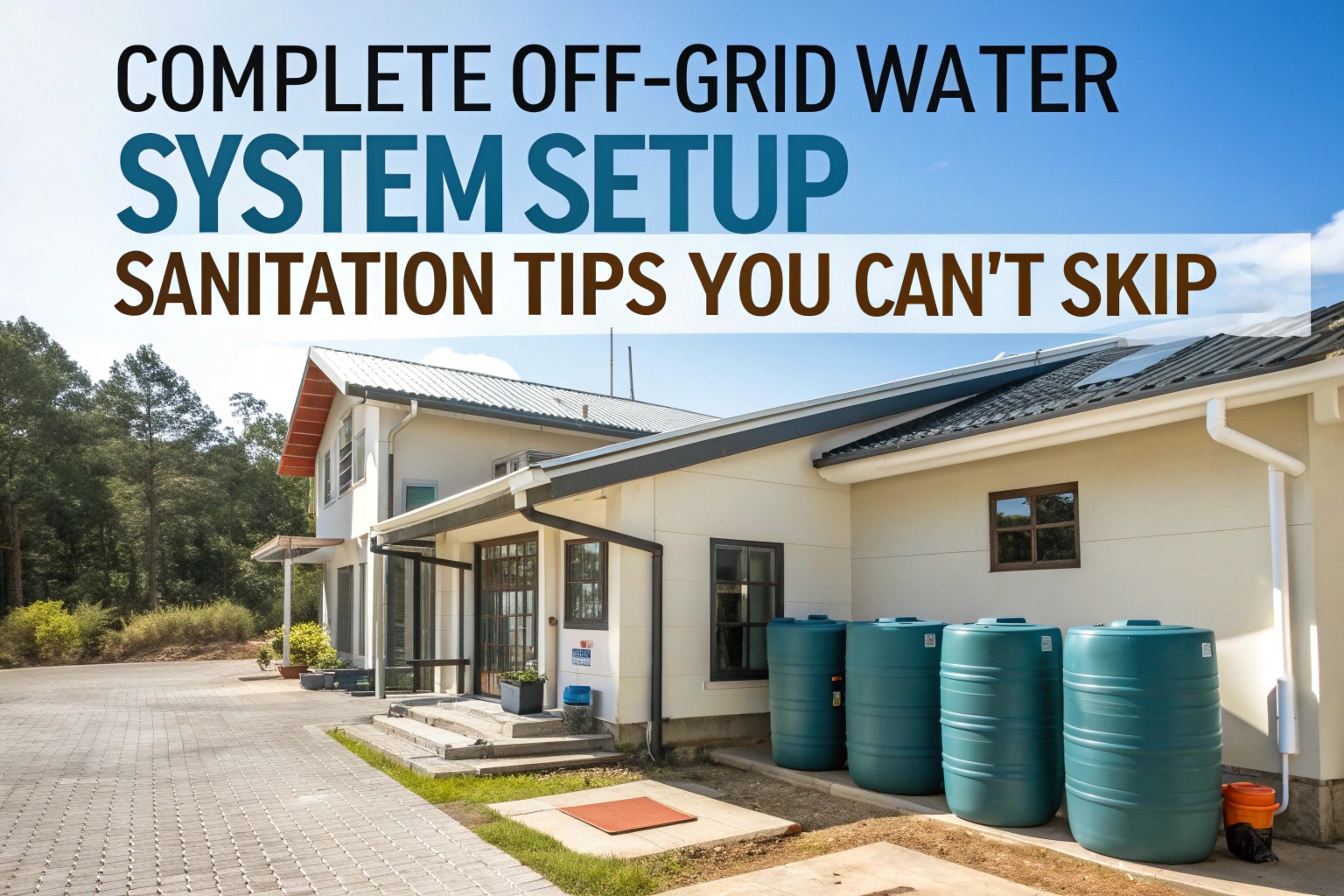
Are you ready to set up an off‑grid water system and want to make sure your water is safe, reliable, and sanitary?
Complete Off‑Grid Water System Setup: Sanitation Tips You Can’t Skip
You’re building a system that must perform reliably with limited outside support, so sanitation and preventive steps are as important as the hardware. This guide walks you through source selection, system components, treatment options, sanitation practices you can’t skip, testing and maintenance, and emergency actions you’ll need to keep your household healthy.
Why sanitation matters for off‑grid water systems
You control the entire water chain, from catchment to tap, so contamination risks are in your hands. Proper sanitation minimizes illness, protects equipment, reduces maintenance, and extends system life. Think of sanitation as preventive maintenance for health as well as plumbing.
Planning your water supply
Planning early saves time and expense later. Each potential source has strengths and risks that affect how you design treatment and sanitation.
- Identify available sources: well (groundwater), rainwater catchment, springs, surface water (streams, ponds).
- Evaluate reliability: seasonal flows, freeze risk, drought sensitivity.
- Consider water quality baseline: natural contaminants, agricultural runoff, wildlife presence.
- Budget for treatment and maintenance based on source risk.
Choosing the right source for your needs
You’ll balance volume, quality, permit requirements, and the complexity of treatment. Groundwater often needs less treatment for pathogens but can have dissolved minerals; surface water requires robust pathogen removal; rainwater is relatively clean but can carry roof contaminants.
Siting and legal considerations
Your system must comply with local regulations and be placed to minimize contamination risks. Check local rules on rainwater harvesting, well permits, setback distances, and septic system requirements before you commit.
- Keep wells at recommended distances from septic systems, livestock areas, fuel tanks, and manure—typically hundreds of feet depending on local codes.
- Position storage tanks where they won’t freeze if possible, or plan insulation/heat tracing.
- Ensure access for maintenance, sampling, and emergency vehicles.
Core components of an off‑grid water system
A robust off‑grid water system typically has five core elements: source, conveyance, storage, treatment, and distribution. Each element requires sanitary design to prevent contamination.
Source protection
Protecting the source is the most effective sanitation measure. You’ll save money and reduce downstream treatment needs by excluding contaminants at the start.
- For wells: use sanitary well caps, seal annular space, proper casing, and surface drainage that diverts runoff away.
- For springs: build a spring box that captures water through screened intakes and prevents animal access.
- For rain catchment: choose safe roof materials, keep gutters clean, and install insect screens and first‑flush diverters.
Conveyance
Pipes, gutters, and hoses should be food‑grade where they contact potable water, sloped to drain, and protected from sunlight to avoid algae growth. Avoid flexible garden hoses for potable water unless rated for drinking water.
Storage tanks
You’ll use storage to buffer supply and provide pressure. Storage design influences sanitation: sealed tanks with screened vents prevent contamination.
Table: Common Storage Tank Materials – Pros and Cons
| Material | Pros | Cons |
|---|---|---|
| HDPE (poly) | Lightweight, affordable, corrosion‑resistant | Can degrade in UV if unprotected; permeable to odors if poor quality |
| Stainless steel | Durable, long‑lasting, inert | Expensive; can corrode in certain chemistries |
| Fiberglass | Durable, UV resistant | Can be brittle; may leach gelcoat chemicals if low quality |
| Concrete | Stable, fireproof | Heavy, can crack, potential for biofilms; requires lining for potable use |
Sizing guidance: plan storage based on supply variability and your water needs. For emergencies, keep at least 1 gallon (3.8 L)/person/day for 3 days as a bare minimum, but for off‑grid living plan for daily consumption and contingencies:
- Drinking/cooking: 2–4 liters per person/day (conservative)
- Minimal hygiene and basic cooking: 5–10 gallons (19–38 L)/person/day
- More comfortable off‑grid living with showers and laundry: 20–50+ gallons (75–190 L)/person/day
Aim to size storage for several days to several weeks depending on reliability of supply and access for maintenance.
Treatment trains: stages and roles
A treatment train stacks technologies to address different contaminants. Design the train to match the source risk—don’t overuse RO where simple filtration and disinfection are sufficient.
Typical treatment stages:
- Pre‑filtration (sediment) – removes turbidity and particles.
- Activated carbon – removes taste/odor, some organics and chlorine.
- Pathogen barrier (UF/ceramic/microfiltration/RO) – removes bacteria, protozoa, viruses (depending on method).
- Disinfection (chlorination, UV) – final polish to inactivate pathogens and maintain residual.
Table: Treatment Methods at a Glance
| Method | Removes Pathogens | Removes Particulates | Removes Chemicals/Taste | Maintenance |
|---|---|---|---|---|
| Sediment filter (5–50 μm) | No | Yes | No | Replace cartridges periodically |
| Activated carbon | No | Some | Yes (chlorine, organics) | Replace cartridges |
| Ceramic/UF | Yes (bacteria, protozoa) | Yes | Limited | Clean/replace elements |
| Reverse osmosis | Yes (incl. viruses) | Yes | Yes (TDS) | High maintenance; pretreatment required |
| UV disinfection | Yes (pathogens) | No (needs low turbidity) | No | Lamp replacement & cleaning |
| Chlorination | Yes (bacteria, some viruses) | No | No (oxidizes some organics) | Monitor residual; dosing control |
Sanitation tips you can’t skip
These are non‑negotiable steps you must include to keep water safe across the system lifecycle.
Protect your source from contamination
Protecting the source is the single best sanitation measure you’ll take.
- Keep livestock and wildlife away from catchment areas.
- Ensure roof catchments are free of overhanging trees and bird roosts if you use rainwater.
- Maintain a sanitary perimeter around wellheads; install gravel pads and sloped surfaces to divert surface runoff away.
Use first‑flush devices for rainwater
First‑flush diverters remove the initial runoff that carries most rooftop contaminants (bird droppings, dust). Install a properly sized diverter and empty it regularly.
Secure and vent storage tanks properly
Tank lids must be childproof and sealed. Vents should be screened to prevent insects and vermin. Algae growth is prevented by using opaque tanks or painting them.
Prevent cross‑connections
Never connect potable lines to non‑potable systems (irrigation, livestock). Install backflow prevention valves and clearly label non‑potable outlets.
Maintain a disinfection barrier
You must have a reliable method to inactivate pathogens. UV and chlorine are commonly used; each has tradeoffs:
- Chlorine provides a residual that protects distribution lines but forms disinfection byproducts with some organics.
- UV is effective against pathogens without chemicals but offers no residual; pair UV with a secondary disinfection or maintain strict tank hygiene.
Seal off entry points for vermin and insects
Screens on vents, locked lids, and rodent‑proof fittings prevent contamination. Mosquito-proof tank vents reduce disease vectors.
Keep lines and filters hygienic during service
When you change filters or service components, practice clean techniques: disinfect hands, use clean tools, cap open pipes, and flush the system after reassembly.
Water treatment and disinfection practical guidance
You’ll want practical, safe steps for treating water in everyday use and emergencies.
Emergency disinfection for small quantities (household bleach)
Use unscented household bleach (typically 5–6% sodium hypochlorite) to disinfect drinking water in emergencies. Follow label guidance and local health authority recommendations.
Guidance (emergency household method):
- For clear water: add 8 drops (about 1/8 teaspoon) of unscented household bleach per gallon (3.8 L), stir, and let stand 30 minutes. If the water doesn’t smell faintly of chlorine, add another dose and wait another 15 minutes.
- For cloudy water: use 16 drops per gallon and allow 30 minutes.
- If you can’t measure drops, use 1/8 teaspoon per gallon as a practical proxy.
Always follow manufacturer label instructions and test strips for chlorine residual if available.
Boiling for pathogen control
Boiling is a reliable method to inactivate pathogens when fuel and time are available.
- Bring water to a rolling boil for 1 minute; at elevations above 2,000 meters (about 6,562 feet), boil for 3 minutes.
- Let it cool in a sanitized container; use within 24 hours if stored without residual disinfectant.
UV disinfection
Use UV when turbidity is low and pre‑filtration is in place.
- UV systems require clear water (turbidity <1 ntu) and regular lamp replacement (typically annually).< />i>
- Keep sleeves clean and follow manufacturer instructions for flow rates and lamp power.
Reverse osmosis and advanced filtration
RO handles dissolved solids and many contaminants, but it’s energy‑intensive and wastes water.
- Use RO for drinking water if you suspect chemical contamination or want very low TDS.
- Pair RO with pre‑filtration and post‑disinfection (activated carbon and chlorination/UV) as needed.
- Ensure brine disposal is handled correctly to prevent environmental harm.
Shock chlorination of wells (professional approach)
Shock chlorination is used when a well becomes contaminated. It’s a high‑chlorine treatment that requires careful handling.
Basic professional steps (summary):
- Calculate well volume to determine chlorine dosage (target 50–200 ppm depending on contamination severity).
- Use household bleach or commercial chlorine products as indicated by a professional or state extension service.
- Add chlorine to the well, circulate through the system so it reaches storage tanks and fixtures, and let it sit for 12–24 hours.
- Flush lines until chlorine is undetectable and retest water before returning to normal use.
Safety note: shock chlorination involves high chlorine concentrations. If you suspect significant contamination, consult state or local health departments or a licensed well professional for precise dosing and safe handling.
Distribution and pressure systems
Choose a pump and distribution strategy that matches your energy resources and water demand.
Gravity systems
Gravity systems use elevation difference to produce pressure without pumps. If you can site tanks uphill, gravity provides a low‑maintenance solution.
- Pros: minimal energy, simple maintenance, reliable.
- Cons: requires suitable topography and sufficient elevation head for desired pressure.
Pumped systems: solar, manual, and electrical
You’ll select a pump based on source type and energy availability.
Table: Pump Options Comparison
| Pump Type | Power Source | Best For | Pros | Cons |
|---|---|---|---|---|
| Submersible electric | AC/DC power | Deep wells | Efficient, high flow | Requires power; risk of burn if run dry |
| Solar DC pump | Solar panels | Remote pumps, shallow wells | Off‑grid friendly | Requires panels and batteries/controls |
| Hand pump | Manual | Emergency backup | Very reliable, no power | Labor intensive; lower flow |
| Pressure tank + pump | AC/DC pump with accumulator | Pressurized household supply | Smooth flow, reduced pump cycling | Complexity; needs maintenance |
Accumulators (pressure tanks) reduce pump cycling and help conserve energy. Include a pressure switch and gauge and protect pumps from running dry.
Graywater and human waste management
Graywater and human waste pose serious contamination risks if mismanaged. Plan systems that keep wastewater away from potable sources and reuse with care.
Graywater reuse and sanitation
Graywater from showers and sinks can be reused for subsurface irrigation if you use biodegradable soaps and prevent contact with edible crops. Treat prior to reuse or use in drip irrigation to minimize exposure.
- Direct reuse guidelines: use for ornamental plants only; do not irrigate food crops with untreated graywater.
- Install simple sand filters, constructed wetlands, or reed beds for higher‑quality reuse.
Toilet options and sanitation
Choose toilets that suit your sanitation preferences and water availability.
- Septic systems: require proper design, soil percolation testing, and maintenance.
- Composting toilets: reduce water use and produce compost if managed correctly; follow guidelines for safe maturation and pathogen destruction.
- Vault toilets: suitable for remote cabins; manage emptying and transport to appropriate disposal facilities.
Keep human waste storage and treatment well separated from water sources and harvest areas. Maintain records of emptying and composting cycles.
Testing, monitoring, and record keeping
Testing is the only reliable way to know whether your sanitation steps are working. Keep a logbook for treatment, maintenance, testing results, and any incidents.
What to test and how often
Table: Recommended Tests and Frequencies
| Test | Why | Frequency |
|---|---|---|
| Total coliform / E. coli | Detects fecal contamination | Baseline, then every 3–6 months; after repair or contamination event |
| Turbidity (NTU) | Indicates filter performance and UV suitability | Monthly or after storms |
| pH | Corrosion and compatibility | Quarterly |
| Total dissolved solids (TDS) | Indicates mineral load and RO performance | Quarterly |
| Nitrate/Nitrite | Agricultural contamination, infant risk | Annually or if nearby fertilizers/livestock |
| VOCs/heavy metals | Industrial contamination concerns | If suspected or baseline shows issues |
| Free chlorine residual | Confirms disinfection | Weekly if chlorinating, or after maintenance |
Use certified labs for microbial and chemical testing. Use simple field kits for turbidity and chlorine to support routine checks.
Interpreting results and corrective actions
- If E. coli or fecal coliforms are present: stop using the supply for drinking, disinfect the system, bring in alternate water, and retest before resuming potable use.
- Elevated turbidity: check pre‑filters, clean tanks, and recheck settling devices.
- Low chlorine residual: adjust dosing or check for excessive organic load or leaks.
Maintenance schedule
A maintenance schedule prevents sanitation failures. Keep records and set reminders.
Table: Typical Maintenance Schedule
| Task | Frequency |
|---|---|
| Inspect roof gutters and screens | Monthly |
| Clean first‑flush diverter | Monthly |
| Check and clean tank vents and lids | Monthly |
| Replace sediment/carbon filters | Every 3–6 months (depends on use) |
| Test water (microbial) | Every 3–6 months |
| Check pump operation and pressure tank | Quarterly |
| Replace UV lamp and sleeve cleaning | Annually |
| Inspect wellhead and surface drainage | Annually |
| Clean/inspect storage tank interior | Annually or as needed |
Common mistakes to avoid
You’ll save time and money by avoiding frequent pitfalls.
- Skipping source protection and relying on downstream treatment.
- Using untreated hoses or plumbing materials not rated for potable water.
- Installing UV without proper pre‑filtration (turbidity reduces UV effectiveness).
- Forgetting to secure tank vents and lids against pests.
- Not keeping records of maintenance and test results.
Emergency response and contingency planning
Have a plan for contamination, drought, or mechanical failures. Your plan should include alternate water sources, emergency disinfection supplies, and a communication plan.
Key emergency items to keep on hand:
- Unscented household bleach (container sealed and rotated).
- Water purification tablets or small portable filters (e.g., life straw, pump filters).
- Fuel or spare batteries for pumps and generators.
- Stored potable water in sanitized containers.
- Contact info for local health department and certified lab.
Emergency steps for microbial contamination:
- Stop using the system for drinking and cooking.
- Use stored or bottled water or boil/disinfect water for at least 1 minute (3 minutes at high altitude).
- Identify the contamination source (animal intrusion, plumbing failure, runoff).
- Disinfect tanks/lines per recommended procedures and retest before resuming normal use.
Installation checklist
Before commissioning your system, verify these essentials:
- Source protected and authorized (permits in place).
- First‑flush and screens installed on catchments.
- All pipes, fittings, and tanks rated for potable water.
- Treatment train installed with proper pre‑filtration before UV/RO.
- Pressure and flow systems sized and tested.
- Leak detection and backflow prevention devices installed.
- Sampling ports accessible and sanitary.
- Maintenance schedule documented and supplies on hand.
- Emergency plan and alternate water source identified.
Final considerations and long‑term hygiene habits
Your day‑to‑day habits influence system sanitation as much as the equipment. Practice hand hygiene, clean utensils and water containers, avoid using potable containers for non‑potable tasks, and train household members on system basics and what to do if they suspect contamination.
Plan for upgrades: as your needs grow or risks change (new neighbors with livestock, changes in land use), reassess treatment capacity, storage, and sanitation practices.
If you ever feel unsure about contamination, professional assistance is worth the cost. A licensed well contractor, certified water treatment professional, or local public health department can provide testing, precise disinfection calculations, and regulatory guidance.
You’re building more than plumbing—you’re building health resilience. With careful source protection, solid treatment choices, disciplined maintenance, and practical sanitation habits, your off‑grid water system can provide safe, reliable water for years to come.