
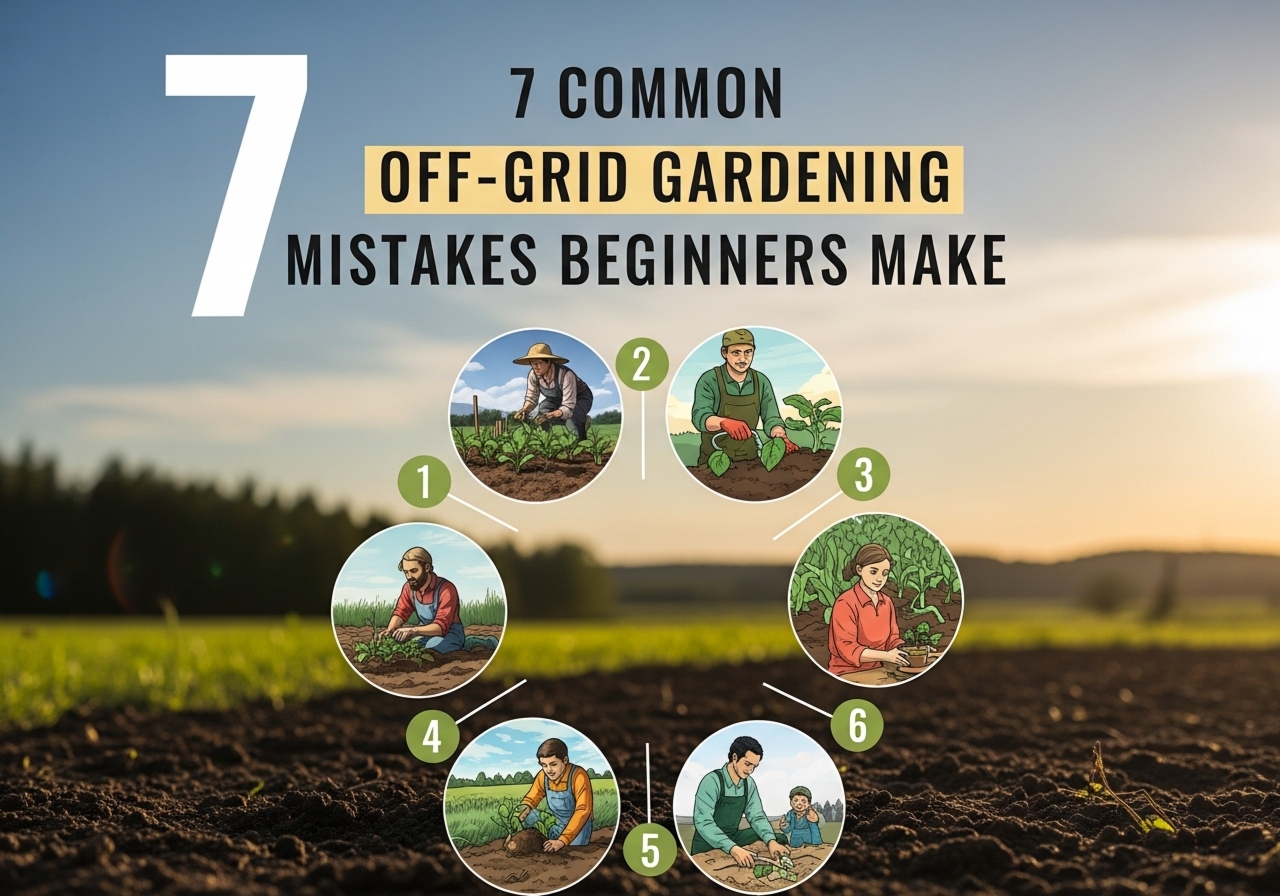
Are you feeling overwhelmed by off-grid gardening and worried your first season might be full of avoidable mistakes?

7 Beginner‑Friendly Off‑Grid Garden Mistakes (and How To Fix Them Fast)
Managing an off‑grid garden brings rewarding independence, but it also introduces unique challenges you won’t face with a conventional plot. This guide walks you through seven common mistakes new off‑grid gardeners make, explains why they happen, and gives clear, fast fixes you can implement today to keep your garden productive and resilient.
Why this matters for you
Off‑grid systems require careful planning because resources like water, electricity, and purchased amendments are limited. You’ll get practical fixes that conserve resources, reduce risk, and increase success without adding complexity. Read each section and pick the fixes that fit your setup and available tools.
Mistake 1 — Poor water management
Poor water management is the top reason off‑grid gardens fail. You’ll either waste precious water or stress plants by under‑ or over‑watering, both of which reduce yield and soil health.
Why this happens: Off‑grid gardeners often rely on limited sources (rainwater, wells, hauled water) and lack automated systems. Without consistent measures, watering becomes irregular and reactive.
How to fix it fast:
- Install a simple drip irrigation kit connected to a gravity-fed barrel or pump. Drip systems deliver water directly to roots and reduce evaporation.
- Use a moisture meter to check root zone moisture before watering. If you don’t have a meter, stick your finger into the soil to the second knuckle—if it feels dry, water.
- Mulch bare soil heavily with straw, wood chips, or leaf litter to reduce evaporation and moderate soil temperature.
Prevention tips:
- Create a watering schedule based on plant type and season rather than habit. Note time-of-day patterns; early morning is best to reduce disease pressure.
- Capture and store rainwater with gutters and barrels sized to your roof and roof runoff expectations.
- Zone your garden by water need—group thirsty plants separately from drought-tolerant species.
Tools and quick checklist:
- Drip tubing, pressure regulator, filter
- Moisture meter or simple soil probe
- Mulch material (straw, wood chips)
- Water storage (barrels, cisterns)
- Pump (solar or manual) if needed
Table: Simple water management quick reference
| Problem | Quick test | Immediate fix |
|---|---|---|
| Plants wilt mid-day | Check soil 2″ below surface | Mulch and provide deep, slow watering |
| Yellowing lower leaves | Soil stays wet 1 week | Improve drainage; reduce watering frequency |
| Dry topsoil, good lower moisture | Water not reaching roots | Deep soak or adjust drip emitter placement |
| Running out of stored water | Monitor barrel level | Prioritize crops; temporarily use greywater (safe sources) |
Mistake 2 — Ignoring soil biology and structure
Soil is an ecosystem; when you ignore its biology and structure, your plants can’t access nutrients or water efficiently. Off‑grid gardens especially benefit from healthy soil because you’ll rely less on external inputs.
Why this happens: New gardeners often focus on fertilizers or visible problems and overlook organic matter, microbial life, and compaction issues. Lightweight soils lose water and nutrients, while compacted soils prevent root growth and oxygen exchange.
How to fix it fast:
- Add lots of organic matter: compost, well-rotted manure, and leaf mold. Spread 2–4 inches of compost across beds and gently work it into the topsoil.
- Create permanent beds and avoid walking on growing areas; use paths or stepping stones to prevent compaction.
- Make a small worm bin or trench compost to speed up nutrient cycling and boost microbial activity.
Prevention tips:
- Practice crop rotation and cover cropping to keep soil active and reduce pests.
- Test your soil (pH, texture, nutrients) so you can target amendments rather than guess.
- Use mulches that break down into the soil rather than synthetic materials that hinder biology.
Table: Soil health quick remedies
| Symptom | Likely cause | Immediate action |
|---|---|---|
| Poor growth despite watering | Low organic matter | Topdress with compost; mulch |
| Hard crust on surface | Compaction | Loosen top 2–4″ with fork; avoid walking on beds |
| Nitrogen deficiency signs | Imbalanced microbes/N | Plant legumes or side-dress with compost tea |
| Water puddles on bed | Poor infiltration | Add compost and create planting trenches or swales |
Mistake 3 — Choosing the wrong plants for your microclimate
Selecting plants without matching them to your microclimate wastes effort and water. You’ll have better results when you cultivate varieties suited to your elevation, temperature swings, and available sunlight.
Why this happens: Beginners often pick plants based on desire or seed packet popularity rather than local suitability. Microclimates on your property—sun pockets, frost pockets, wind corridors—can change plant performance drastically.
How to fix it fast:
- Map sun exposure zones in your garden: mark areas that get full sun (6+ hours), partial sun, and shade. Plant accordingly.
- Choose at least one trial crop per bed with known local success. Ask nearby gardeners or check local extension resources for recommended varieties.
- Start seedlings indoors or use row covers to protect sensitive plants early in the season, giving them a head start.
Prevention tips:
- Keep a garden journal noting success and failure by variety and bed. Over time you’ll develop a local seed list that works with your system.
- Use hardy, disease-resistant varieties and consider natives or perennial vegetables (rhubarb, asparagus) for low-maintenance areas.
- Use windbreaks, shade cloth, or thermal mass (stones, barrels of water) to modify microclimates for tender plants.
Quick action plant selection table
| Microclimate | Good plant choices | Fast setup |
|---|---|---|
| Full sun, windy | Tomatoes, squash, sunflowers | Install short windbreaks; stake plants |
| Partial shade | Leafy greens, beets, herbs | Use raised beds with reflective mulch |
| Hot, dry | Drought-tolerant herbs, peppers | Mulch heavily; use drip irrigation |
| Cold nights | Root crops, brassicas | Use low tunnels or cold frames |
Mistake 4 — Overcomplicating energy and equipment needs
You may assume you need complicated pumps, solar arrays, or water treatment to garden off‑grid. Overcomplicating equipment increases cost and failure points. Keep systems simple and resilient.
Why this happens: People want convenience and automation. While tech can help, a simple manual or gravity system often serves better in remote setups because it’s repairable and uses fewer resources.
How to fix it fast:
- Prioritize passive systems first: gravity-fed water, hand pumps, rainwater capture, and thermal mass. These are low‑maintenance and easy to repair.
- If using solar pumps or panels, choose modular components that are easy to replace and keep manual backup options.
- Learn basic maintenance skills (pump seals, hoses, valve repair) so you can fix things without waiting for parts.
Prevention tips:
- Start with a minimal system and only add energy-consuming automation once you’ve proven it’s necessary.
- Keep spare parts and common tools on hand in a small dedicated repair kit.
- Document wiring and plumbing so you or someone else can troubleshoot quickly.
Table: Equipment simplicity guide
| Need | Simple solution | When to upgrade |
|---|---|---|
| Move water uphill | Manual pump or small solar pump | Large acreage or frequent transfer needs |
| Irrigation automation | Timer on gravity drip system | Multiple zones and high labor constraints |
| Refrigeration for seeds | Root cellar or cool, shaded storage | If storing perishable produce long-term |
Mistake 5 — Neglecting pest and disease prevention while relying solely on reactive treatments
You’ll face pests and diseases in any garden. In off‑grid systems, losing crops to pests is costly because you rarely have quick replacement options. Preventive strategies reduce dependence on reactive treatments that can be expensive, time-consuming, or unavailable.
Why this happens: New gardeners often notice pests only after visible damage appears. Then they scramble for chemical or quick fixes that may harm beneficials or be hard to source off‑grid.
How to fix it fast:
- Plant barrier crops and companion plants that repel pests (e.g., marigolds near tomatoes, aromatic herbs to deter some insects).
- Use physical controls immediately: row covers, netting, collars around transplant stems, and sticky traps. These stop pests without chemicals.
- Handpick larger pests (slugs, beetles) in early morning and drop them into soapy water. This is fast, effective, and uses no supplies.
Prevention tips:
- Maintain garden hygiene: remove diseased foliage, rotate crops, and avoid planting the same family in the same bed year after year.
- Encourage beneficial insects by planting flowers that attract pollinators and predators (umbels, asters).
- Implement scouting: walk beds regularly, especially during morning or dusk, and keep records of what you find.
Quick pest action table
| Symptom | Likely pest | Fast non-chemical fix |
|---|---|---|
| Holes in leaves at night | Slugs/snails | Beer traps, handpick, diatomaceous earth barriers |
| Chewed seedlings | Cutworm | Collars made from paper cups |
| Sticky residue + ants | Aphids | Spray with water, introduce ladybugs, prune affected areas |
| Leaf spots or mold | Fungal disease | Improve airflow, remove infected leaves, use copper fungicide if needed |
Mistake 6 — Failing to plan for seasonal and storage needs
You might focus on growing and miss planning for harvest timing, storage, and preservation. This leads to waste and missed opportunities to maximize food security in an off‑grid system.
Why this happens: Gardening excitement centers on planting and seeing growth. Without harvest and storage planning, you can end up with a glut or spoilage, undermining the benefits of homegrown produce.
How to fix it fast:
- Stagger plantings so harvests are manageable and spaced through the season. For example, sow radishes and salads every two weeks for continuous harvest.
- Build or adapt a simple root cellar, cool box, or pantry shelf to extend storage life for root crops, squash, and apples.
- Learn a few preservation techniques—canning, drying, fermenting—and practice with small batches to scale up.
Prevention tips:
- Create a harvest calendar mapping planting dates to expected harvest windows. Use variety days-to-maturity on seed packets as a guide.
- Choose varieties bred for storage where possible (long‑keeping pumpkins, storage carrots).
- Invest in basic preservation tools: jars, a pressure canner (if you can safely use one), dehydrator, or salt/fermentation supplies.
Table: Harvest and storage primer
| Crop type | Short-term storage | Longer-term preservation |
|---|---|---|
| Leafy greens | Refrigerate 1 week or cool box | Ferment into kraut or store seed for future |
| Root vegetables | Root cellar or sand storage | Store 3–6 months in cool, humid conditions |
| Tomatoes | Refrigerate or can | Can whole or make sauces for 6–12 months |
| Squash/pumpkin | Cool, dry shelf | Store several months if cured |
Mistake 7 — Not building redundancy and community support
Off‑grid life is resilient when systems and social networks support each other. Relying solely on one method, tool, or person makes you vulnerable to single points of failure and isolation.
Why this happens: You may try to be fully self-reliant quickly and hesitate to ask for help. That leads to weak backup plans and missed opportunities to borrow knowledge, tools, or labor.
How to fix it fast:
- Create simple redundancies: keep one manual pump if your solar pump fails, duplicate important seeds, and have spare drip lines and connectors.
- Connect with local gardeners, seed swaps, and online off‑grid communities to trade labor, plants, and knowledge.
- Keep a small binder or digital file with system schematics, seed lists, and troubleshooting notes so others can help if you’re unavailable.
Prevention tips:
- Seed-saving: save seeds from reliable varieties so you’re not dependent on outside supply chains.
- Skill-sharing: barter skills (plumbing, carpentry, gardening) with neighbors to fill gaps without heavy investment.
- Build a contact list of local suppliers, extension agents, and experienced gardeners for quick advice.
Table: Redundancy checklist
| Area | Redundancy example |
|---|---|
| Water | Manual pump + solar pump + gravity-fed barrels |
| Seed | Duplicate storage in two locations (cool, dry) |
| Power | Small solar kit + battery bank + manual alternatives |
| Knowledge | Neighbor contact list + printed guides + community groups |
Tools, materials, and a simple starter kit for off‑grid gardens
You don’t need a workshop full of gear to get started. A compact kit that focuses on resilience and repairability serves you better than a lot of specialized gadgets.
Starter kit list:
- Hand tools: spade, fork, hoe, trowel, pruning shears.
- Water gear: two 55–200 gallon barrels with screens, basic drip kit, hand pump or solar pump if needed.
- Soil amendments: compost, aged manure, lime or sulfur if soil test recommends.
- Pest control basics: row cover fabric, garden twine, sticky traps, hand lens.
- Preservation basics: drying rack, jars with lids, salt for fermenting.
- Spares: extra hose, drip emitters, hose clamps, washers, a small tool kit.
Quick troubleshooting guide: common symptoms and immediate steps
This quick reference helps you act quickly to stop small problems from becoming disasters.
- Wilting midday, revived by evening: Likely heat stress or intermittent water. Mulch, water deeply at root zone in the morning.
- Yellow lower leaves: Could be nitrogen deficiency or waterlogged roots. Check moisture; add compost or plant legumes.
- New seedlings fail to take: Transplant shock, wildlife, or cutworms. Use collars and protect with cloches until established.
- Sudden insect outbreak: Isolate affected area, handpick, and use row covers. Reintroduce beneficial habitat plants.
A seasonal plan to reduce mistakes
Having a seasonal map reduces spur-of-the-moment decisions that lead to errors. Here’s a simple template you can adapt.
- Winter: Test soil, plan crop rotation, repair/prepare water systems and storage, start some seeds indoors.
- Spring: Build beds, add compost, plant cool-season crops, install irrigation and pest barriers.
- Summer: Mulch heavily, monitor water and pests, stagger plantings, begin preservation of early harvests.
- Fall: Harvest and cure storage crops, plant cover crops, topdress compost, prepare root cellar.
Final words: take small steps, build resilience
You’ll make mistakes—that’s part of learning. The goal is to recognize predictable missteps and have a few fast, practical fixes in your toolkit. Focus on soil health, thoughtful plant selection, water efficiency, simple equipment, prevention of pests, harvest planning, and building redundancy and community. Those seven areas cover the major failure points and provide the largest return on time and resources invested.
If you follow one simple rule, let it be this: prioritize systems that save time and resources over systems that seem luxurious but are hard to maintain off‑grid. Start small, test, and scale what works for your site.
Resources to learn more
These are starting points you can use to deepen knowledge and find local support:
- Local extension services and master gardener programs for soil tests and region‑specific advice.
- Books and reliable online resources about rainwater harvesting, composting, and seed saving.
- Local gardening groups and seed exchanges to get varieties adapted to your microclimate.
You’re set to reduce those early mistakes and make your off‑grid garden productive, low‑stress, and resilient. Keep notes, keep backups, and use the quick fixes above whenever you spot a problem—most small issues can be fixed quickly before they become bigger headaches.