
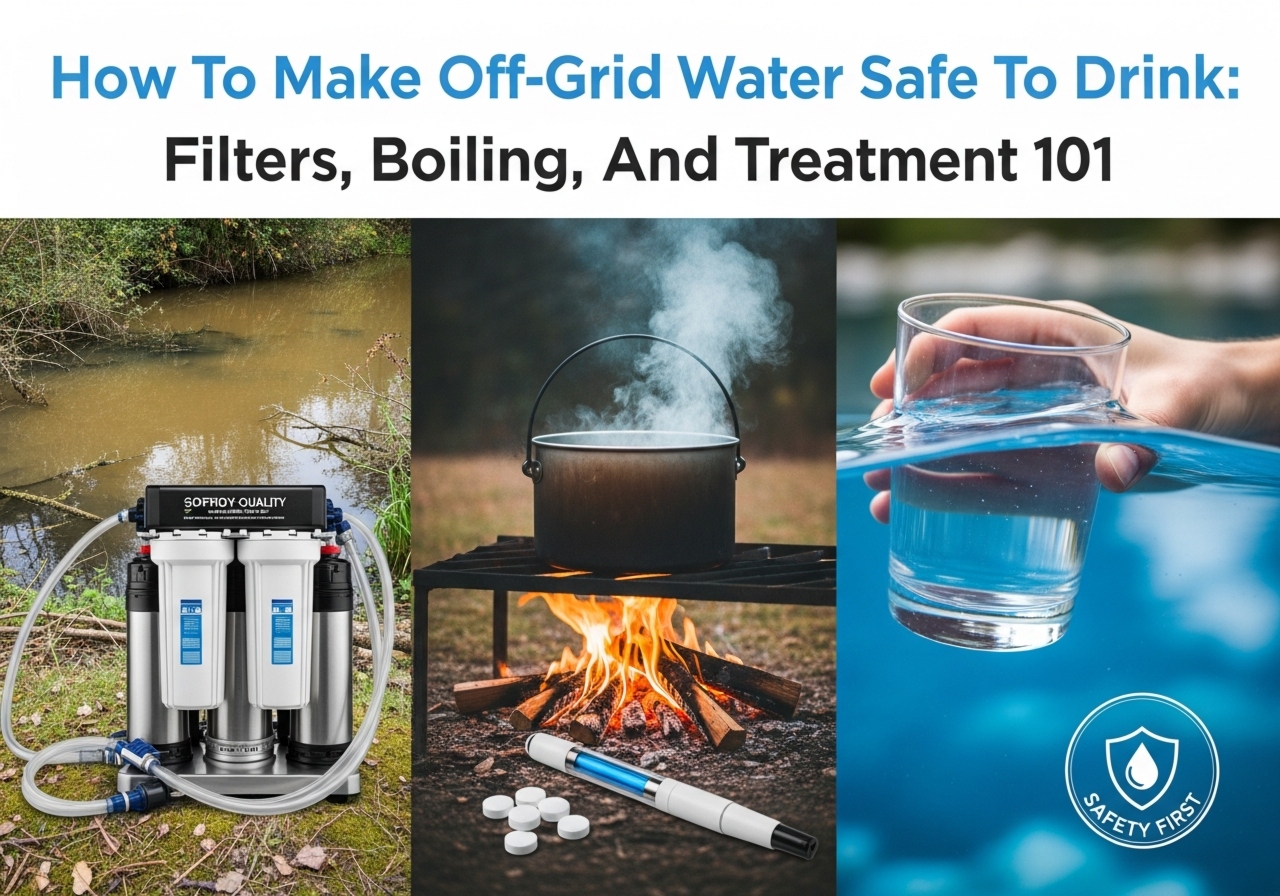
Are you trying to make sure the water you use off‑grid is safe to drink without relying on municipal treatment or constant electricity?
How To Make Off‑Grid Water Safe To Drink: Filters, Boiling, And Treatment 101
This guide walks you through everything you need to know to treat water when you’re off the grid. You’ll learn how to evaluate sources, choose appropriate filters, use boiling and chemical treatments safely, implement solar and UV methods, and build a resilient multi‑barrier system that suits your situation.
Why treating off‑grid water matters
When you’re off the grid, you can’t assume a tap is safe. Surface water, shallow wells, rainwater, and springs can carry bacteria, protozoa, viruses, sediments, and chemical contaminants. You need reliable methods to protect your health and your household. Treating water minimizes the risk of gastrointestinal illness, long‑term exposure to contaminants, and system failures that can leave you without potable water.
Understand your water sources
Identify where your water is coming from and what risks are likely to be present. Surface water (rivers, lakes, streams) often has pathogens and sediments. Shallow wells and springs can have bacteria and nitrate issues. Rainwater may carry bird droppings and airborne contaminants, while deep wells can sometimes have chemical or mineral concerns. Knowing the source helps you choose the right combination of pretreatment and disinfection.
Basic categories of contaminants
Contaminants fall into three broad categories: biological (bacteria, viruses, protozoa), physical (sediment, turbidity), and chemical (heavy metals, nitrates, pesticides). Biological hazards cause immediate illness, physical hazards can protect microbes from disinfection, and chemical hazards may require specialized treatment. Your treatment train should address all categories relevant to your source.
The multi‑barrier approach: why you should use several methods
You should combine methods rather than rely on a single technology. Pretreatment (sediment removal) + primary filtration (microfilter or cartridge) + disinfection (boiling, chemical, UV) = robust protection. A multi‑barrier approach makes the system tolerant of one method temporarily failing and gives you redundancy for emergencies.
How to assess water quality in the field
You can use a simple checklist: appearance (clear, cloudy), smell (earthy, sewage, chemical), taste (if safe), and recent events (heavy rains, animal activity). For quantitative assessment, use test strips and portable kits to check parameters such as E. coli, total coliforms, nitrates, pH, and chlorine residual. Periodically, send samples to a lab for comprehensive analysis if you rely on a private well or suspect chemical contamination.
Filtration: types and what each removes
Filtration reduces turbidity, sediment, and many pathogens depending on pore size and media. Choose filters based on the contaminants you expect.
Sediment filters
Sediment filters remove large particles like sand and silt. They protect downstream equipment and improve effectiveness of disinfection. Use 5–50 micron sediment prefilters before other treatment.
Activated carbon filters
Carbon filters reduce chlorine taste, odors, and certain organic chemicals. They do not reliably remove viruses, and their adsorption sites can become saturated. Use carbon after sediment pretreatment, and replace cartridges as recommended.
Ceramic filters
Ceramic filters use tiny pores to physically remove bacteria and protozoa. Some ceramic filters are impregnated with silver to inhibit microbial growth. They do not remove most viruses unless combined with another step.
Hollow‑fiber and ultrafiltration
Hollow‑fiber and ultrafiltration membranes have pore sizes typically between 0.01 and 0.1 micrometers, removing bacteria and protozoa and, in many cases, some viruses through adsorption. They are commonly used in portable systems and gravity filters.
Reverse osmosis (RO)
RO forces water through a semi‑permeable membrane that removes dissolved salts, many chemicals, and small particles down to ions. RO is energy intensive and produces wastewater, so it’s best for situations where chemical contaminants or high mineral content are the primary concerns.
Absolute vs nominal ratings and micron sizes
An absolute rating signifies the maximum particle size that will be retained (e.g., 0.2 µm absolute). Nominal ratings are more approximate. For microbiological safety, filters rated 0.1–0.4 µm (absolute) are effective for bacteria and protozoa; viruses require chemical disinfection or specialized membranes.
Table: Quick filter comparison
| Filter Type | Typical Pore Size / Mechanism | Removes Bacteria | Removes Protozoa | Removes Viruses | Removes Chemicals | Power Needed |
|---|---|---|---|---|---|---|
| Sediment cartridge | 5–50 µm | No | No | No | No | None |
| Carbon block | Adsorption | No | No | No | Some organics | None |
| Ceramic | ~0.2 µm | Yes | Yes | No | No | None |
| Hollow‑fiber / UF | 0.01–0.1 µm | Yes | Yes | Partial | No | None or low (manual) |
| RO | 0.0001 µm (membrane) | Yes | Yes | Yes (ions/viruses) | Yes | Pump / pressure |
| Distillation | Phase change | Yes | Yes | Yes | Some volatile chemicals may carry over | Heat source |
Boiling water: the simplest disinfection method
Boiling kills bacteria, viruses, and protozoa reliably when done properly. It’s effective and doesn’t require chemicals, but it uses fuel and doesn’t remove chemical pollutants or improve taste.
How long to boil
Bring water to a rolling boil for at least 1 minute at sea level. At elevations above 2,000 meters (about 6,562 feet), boil for 3 minutes. Let the water cool and store it in a clean container. Boiling is highly effective for microbiological contaminants but won’t remove dissolved chemicals or heavy metals.
Pros and cons of boiling
Boiling: pros — simple, reliable for pathogens, no chemicals; cons — fuel and time required, concentrates any chemical contaminants (no removal), and requires safe storage afterward to prevent recontamination.
Chemical disinfection: chlorine, chlorine dioxide, and iodine
Chemical disinfectants are lightweight and convenient for off‑grid use. They vary in effectiveness, contact time, and comfort for long‑term use. Use chemicals according to product labels and be aware of limitations.
Household bleach (sodium hypochlorite)
Use unscented household bleach (5–6% sodium hypochlorite) to disinfect clear water. Typically, add 8 drops (about 0.5 mL) per gallon (3.8 L) of clear water, mix, and let stand for 30 minutes. For cloudy water, double the dose and let stand 30 minutes; if the water is still cloudy after waiting, filter before treating again. If bleach smells strongly of chlorine after 30 minutes, it has likely worked; if not, repeat the dose. Always check the product’s concentration and the manufacturer’s guidance.
Caveats: Bleach is less effective against some protozoan cysts (e.g., Cryptosporidium) and doesn’t remove chemicals. Long‑term taste and residual chlorine may be undesirable; activated carbon can remove chlorine taste after treatment.
Chlorine dioxide
Chlorine dioxide tablets or solutions are more effective than bleach against Giardia and Cryptosporidium and work well over a range of temperatures and pH. Follow manufacturer dosing — typically one tablet per liter or per specified number of liters — and observe recommended contact times (often 30 minutes to 4 hours depending on target organisms). Chlorine dioxide is effective and compact, but expensive relative to bleach.
Iodine
Iodine is effective against bacteria and viruses and can be used in emergency situations. Typical field guidance calls for 5 drops of 2% tincture per liter for clear water, doubling for cloudy water, with a contact time of 30 minutes. Do not use iodine for prolonged periods if you are pregnant, nursing, or have thyroid conditions. Iodine leaves an aftertaste and is not ideal for long‑term use.
Table: Common chemical disinfection guidance (field summary)
| Chemical | Typical Dose for Clear Water | Contact Time | Effective Against | Notes |
|---|---|---|---|---|
| Household bleach (5–6%) | 8 drops/gal (approx. 0.5 mL/3.8 L) | 30 minutes | Bacteria, viruses; limited protozoa | Double dose for cloudy water; check label |
| Iodine (2% tincture) | 5 drops/L (double if cloudy) | 30 minutes | Bacteria, viruses; limited protozoa | Avoid long‑term use; medical cautions |
| Chlorine dioxide | Follow product directions (tablet/packet) | 30 min to several hours | Bacteria, viruses, protozoa | More effective on protozoa than bleach |
UV and solar methods
Ultraviolet light damages microbial DNA and prevents reproduction. Portable UV pens and solar disinfection are useful off‑grid options, but are sensitive to water clarity.
UV pens and electric UV units
UV devices work quickly (usually seconds to a few minutes) and are effective against bacteria, viruses, and protozoa when water is clear. Manufacturer instructions vary; you should prefilter turbid water to <5 ntu and avoid recontamination. uv requires power (batteries, solar chargers), bulbs or lamps need periodic replacement.< />>
SODIS (Solar Disinfection)
SODIS uses sunlight in clear PET bottles to disinfect water. Fill clear bottles with clear water and place them in direct sunlight for at least six hours in full sun or up to two days in overcast conditions. SODIS is inexpensive and chemical‑free but needs sunny conditions, clear bottles, and relatively clear water. It’s less reliable for very turbid water and slow compared to other methods.
Distillation and solar stills
Distillation removes most biological and many chemical contaminants by evaporating water and condensing the vapor. Solar stills work without power but are slow and produce limited volumes. Distillation is useful if chemical contaminants or salt are a concern, but it uses heat and often requires more equipment.
Building a simple solar still
A basic solar still can be made with a container for contaminated water under a clear sheet angled towards a collection container. Sunlight evaporates water that then condenses and drips into the collector. Production is limited — typically a few liters per square meter per day — so don’t rely on it as your sole source unless you have large surface area and consistent sun.
Storage, handling, and preventing recontamination
Safe treatment doesn’t end when the water is disinfected. Use clean, food‑grade containers with tight lids and a tap if possible. Store treated water in a cool, dark place and rotate stock regularly. Avoid dipping dirty cups or hands into storage containers. Consider using containers that allow dispensing without exposing contents to air and hands.
Maintenance: keep your system working
Filters clog, carbon becomes saturated, membranes foul, and disinfectant supplies run out. Create a maintenance schedule: replace sediment/carbon cartridges per manufacturer guidance or when flow drops, backflush hollow fibers when flow slows, and sanitize tanks periodically. Keep spare filters, seals, and fittings. Maintain a log of replacements and test results.
Table: Typical maintenance schedule
| Component | Frequency | Action |
|---|---|---|
| Sediment prefilter | Every 1–6 months | Replace or clean (depends on load) |
| Carbon cartridge | Every 3–12 months | Replace when taste/odor returns |
| UF / hollow fibers | As needed | Backflush; replace after manufacturer life |
| RO membrane | 1–5 years | Replace if flow or quality declines |
| Storage tanks | Every 6–12 months | Drain, scrub, sanitize |
| Chemical stock | Varies | Check expiry dates; replace as needed |
Testing and monitoring water quality
Testing gives you objective data to guide treatment choices. Use test strips for quick checks (nitrate, chlorine, pH), bacteriological field kits for E. coli/total coliforms, and portable photometers for more precise readings. For heavy metals, pesticides, or more complex chemistry, send samples to a certified lab annually or when you suspect a problem. If you detect persistent contamination, adjust your treatment train accordingly.
Troubleshooting common scenarios
- If your treated water smells of chlorine: let it aerate or run through a carbon filter to remove taste and odor.
- If flow rate drops suddenly: check for clogged prefilters, damaged seals, or frozen lines (in winter).
- If you see a sudden turbidity spike after rain: add or clean sediment prefilters and consider increasing chemical dose or boiling until clarity returns.
- If you suspect viral contamination and rely solely on filtration: add a chemical disinfectant or use UV after prefiltration.
System design for off‑grid setups
Design your off‑grid water system around source characteristics, daily demand, power availability, and redundancy needs.
Sizing and storage
Estimate daily demand (drinking, cooking, hygiene) and size storage accordingly. A household typically needs at least 3–5 liters/person/day for drinking and cooking, but total water use for hygiene increases that number substantially. Store a reserve for outages. Gravity storage tanks require elevation or pumps to deliver water; consider hand pumps for redundancy.
Power and pumps
If you use RO or UV systems that need power, size your solar panels, batteries, or generator accordingly. Prioritize low‑energy devices like gravity filters, manual pumps, and thermally driven solar stills where possible.
Redundancy and contingency planning
Keep backup treatment methods: if your UV fails, have chemical disinfectant and a way to boil water. Redundancy prevents you from going without potable water when one component fails.
Safety and health considerations
- Pregnant or breastfeeding individuals, those with thyroid issues, and people on long‑term iodine cannot use iodine for extended periods.
- Chlorine solutions should be handled with care and stored away from heat and children.
- Boil water advisories: if authorities issue them after floods or contamination events, follow local guidance if available.
- For non‑biological contamination (lead, arsenic, nitrate), use appropriate filtration such as RO or specialized adsorption media; chemical disinfection won’t remove these hazards.
Building a kit of recommended gear
You should keep a basic treatment and testing kit tailored to your situation. A practical off‑grid kit might include:
- Sediment prefilter cartridges and a holder
- A reliable microfilter (ceramic or hollow‑fiber) with spare elements
- Activated carbon cartridges
- Unscented household bleach and chlorine dioxide tablets
- A portable UV pen (with spare batteries or solar charger)
- A small water testing kit (coliform/E. coli, nitrate, pH, chlorine strips)
- Food‑grade storage containers with taps
- Spare O‑rings, seals, tubing, and a basic toolkit
DIY versus commercial systems: pros and cons
DIY systems can be customized and economical but require technical competence to ensure proper connections, flow rates, and safety. Commercial systems offer certifications and warranties but may be costly or require electricity. You can combine both approaches: use commercial cartridges in a DIY manifold or integrate proven commercial components into a custom system.
Cost considerations and budgeting
Basic chemical treatment and simple filters are inexpensive upfront, while RO systems, UV units, and long‑term testing add cost. Factor in recurring expenses: filter cartridges, chemicals, testing supplies, replacement membranes, and energy for pumps. Balance cost against the health and convenience benefits.
Long‑term management and documentation
Keep simple records: date of last filter change, test results, chemical purchases, and any maintenance performed. Documentation helps you predict replacement needs and demonstrates you’re actively managing water safety. Train household members on how to treat water, maintain equipment, and recognize signs of contamination.
Emergency and seasonal planning
Heavy rains, drought, or freezing temperatures change your water risk profile. Preemptively:
- Winterize pipes and keep freeze‑resistant storage.
- Stock additional chemical disinfectants before heavy rains or wildfire seasons.
- If river levels rise, move intakes higher or switch to deep wells if available.
- Prepare a small emergency kit with boiling fuel, chemicals, and emergency filters.
FAQs — practical answers
- Can you drink water after filtering but without disinfection? If your filter reliably removes viruses (rare for many filters) and pathogens, yes for bacteria and protozoa; otherwise add disinfection. If in doubt, disinfect.
- Does boiling remove chemicals like pesticides? No, boiling does not remove many chemical pollutants and can concentrate them; use RO or specialized adsorption media.
- How do you know when to replace a filter? When flow drops significantly, taste/odor returns, or the manufacturer recommends replacement. Keep spares on hand.
- Is rainwater safe? Rainwater can be safe if properly captured and treated; it may carry bird or roof contaminants, so filtration and disinfection are recommended.
Putting it together: sample off‑grid treatment trains
Here are practical configurations you can adapt:
- Basic low‑resource (manual, minimal power)
- Source: spring or stream
- Pretreatment: 20 µm sediment bag or cloth
- Primary: ceramic or hollow‑fiber gravity filter
- Disinfection: household bleach if clarity is low, otherwise UV pen or SODIS for small volumes
- Storage: sealed food‑grade barrels with tap
- Mid‑range family system (moderate power)
- Source: well or rainwater tank
- Pretreatment: sediment cartridge (5 µm)
- Primary: carbon block + UF membrane
- Secondary: small UV chamber powered by solar with battery backup
- Storage: pressurized tank with pump driven by solar/battery
- Chemical contamination concern (high treatment need)
- Source: well with nitrates or agricultural runoff
- Pretreatment: sediment and carbon
- Primary: RO system with booster pump and prefilters
- Post‑treatment: remineralization filter (if desired) and storage
- Testing: periodic lab tests for nitrates, pesticides, heavy metals
Final checklist before you rely on any system
- Have you identified the source and likely contaminants?
- Do you have pretreatment for turbidity and sediment?
- Is your filtration rated appropriately for expected pathogens?
- Do you have a disinfection method (boiling, chemical, or UV)?
- Are storage and dispensing safe from recontamination?
- Do you have maintenance supplies and spares?
- Do you test periodically and keep records?
Final thoughts
When you’re off the grid, safe drinking water is a high priority that affects every aspect of daily life. By combining pretreatment, appropriate filtration, and reliable disinfection, and by building redundancy into your system, you’ll reduce the risk of illness and ensure a steady supply of safe water. Take a pragmatic approach: start with source assessment, then select the simplest effective methods you can maintain reliably. Keep supplies, test periodically, and adjust your system as conditions change.
If you’d like, tell me what water source you’re working with (rainwater, spring, well, river, or something else) and how many people you need to serve. I can recommend a specific system layout, equipment list, and maintenance plan tailored to your situation.