
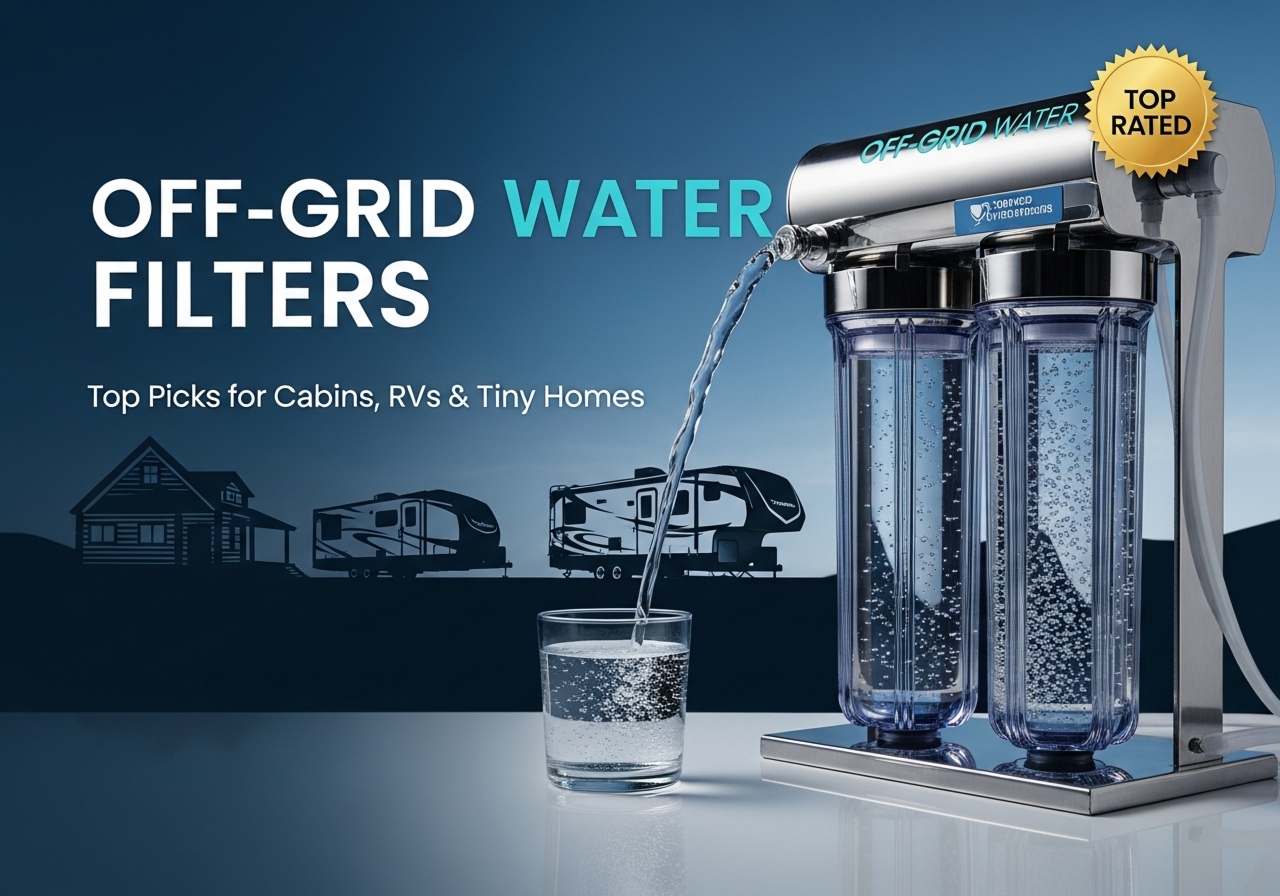
Are you living off-grid in a cabin, RV, or tiny home and trying to figure out which water filter will keep your drinking water safe, palatable, and reliable?
The Best Types Of Water Filters For Cabins, RVs, And Tiny Homes Off‑Grid
You’ll find that choosing the right water filter for off-grid living depends on your water source, the contaminants you’re dealing with, your power availability, space constraints, and how hands-on you want to be with maintenance. This article walks you through the common filter types, how they work, when to use them, and practical tips for installation and upkeep.
Why water filtration matters off‑grid
When you live off-grid, you’re often relying on non-municipal water sources such as wells, springs, streams, lakes, rainwater, or hauled water. Those sources can contain sediment, bacteria, viruses, protozoa, chemicals, heavy metals, and organic matter. Filtration isn’t only about removing bad tastes and odors — it’s about protecting your health and extending the life of plumbing and appliances in a situation where professional support may be far away.
Common off‑grid water sources and their typical issues
Knowing your water source helps you pick filters more efficiently. Each source carries typical issues that are predictable when you understand the environment.
- Wells: Often have minerals, iron, manganese, sometimes bacteria if shallow, and occasional sediment.
- Springs: Usually cleaner biologically but can carry sediment and dissolved minerals depending on geology and surface contamination.
- Surface water (lakes, rivers, streams): Frequently contaminated with pathogens (bacteria, protozoa), sediment, organic material, and agrochemical runoff.
- Rainwater: Usually low in pathogens at collection but can pick up bacteria, pollen, debris, and roof-related contaminants (metals, bird droppings).
- Hauled water: Varies — municipal-supplied water is typically safe, but storage tanks can introduce bacteria or taste issues.
How to test your water before choosing a filter
You should test your water to know what to remove. Basic tests are inexpensive and informative.
- Start with a basic home test kit for pH, hardness, chlorine, nitrate/nitrite, iron, and bacteria presence.
- For detailed analysis (heavy metals, VOCs, pesticides, specific pathogens), send a sample to a certified lab.
- Repeat testing seasonally or after heavy storms, construction, or changes in nearby land use.
Key filter selection factors you should consider
Think about these points before buying:
- Contaminants present (biological vs chemical vs particulate)
- Flow rate you need (gallons per minute)
- Filtration capacity and lifespan (gallons or months)
- Space and mounting options (under-sink, inline, countertop, portable)
- Power availability (non-powered gravity/inline vs RO or UV with pump/electric)
- Freeze risk and winterization needs
- Maintenance access and spare parts availability
- Certification (NSF/ANSI where applicable)
- Budget: initial cost and ongoing replacement filter costs
Overview of filtration technologies
Each technology targets different contaminants and has unique pros and cons. Below is a practical comparison to help you match technology to need.
Sediment filters (mechanical filtration)
Sediment filters trap sand, silt, rust, and other particulates. They’re typically rated by micron size (e.g., 5 µm, 1 µm).
- Use them as prefilters to protect other systems.
- They don’t remove bacteria, viruses, or dissolved chemicals.
- They are inexpensive and easy to replace or clean (spin-down filters, pleated cartridges).
Activated carbon filters (GAC and carbon block)
Activated carbon is excellent for improving taste and odor and removing chlorine, many VOCs, and some pesticides. Carbon block filters have finer filtration and better mechanical removal than granular activated carbon (GAC).
- Not reliable alone for biological contaminants.
- Great as a mid-stage filter in multi-stage systems.
- Replace cartridges regularly because saturated carbon can release adsorbed compounds back into the water.
Ceramic filters
Ceramic filters have tiny pores (often 0.2–0.5 µm) that remove bacteria and protozoa. They can be cleaned and reused until the pore size enlarges from wear.
- Do not remove viruses effectively (too small for many ceramic pores).
- Often used in portable gravity systems and home setups where bacteria/protozoa are main concerns.
- Pair with activated carbon for chemical and taste removal.
Reverse osmosis (RO)
RO systems force water through a semi-permeable membrane, removing dissolved salts, heavy metals, nitrates, many VOCs, and microorganisms if paired with sufficient prefiltration.
- Requires pressure (pump) and can waste 3–5+ gallons of water per gallon produced unless you use a high-efficiency system or recapture reject water.
- Produces very clean, low-TDS water that often tastes flat; post-filter remineralization is common.
- Good for wells with heavy dissolved minerals or when you need near-pure water.
Ultraviolet (UV) disinfection
UV systems use UV-C light to inactivate bacteria, viruses, and protozoa by damaging their DNA. They are fast and effective when water clarity is good.
- Requires power and clear prefiltered water (low turbidity) for effectiveness.
- Does not remove chemicals, heavy metals, or particulates.
- Commonly paired with sediment + carbon prefilters.
Ion exchange and water-softening filters
Ion exchange swaps calcium and magnesium for sodium or potassium to soften water, and specific resins can remove nitrate, arsenic, and other ions.
- Useful for hardness and specific contaminants.
- Requires regeneration with salt (sodium) or potassium; regeneration water and salt supplies are ongoing needs.
- Not a standalone disinfectant.
KDF (Kinetic Degradation Fluxion) media
KDF uses redox reactions to reduce chlorine, control bacterial growth inside filters, and remove some heavy metals.
- Often combined with carbon to extend cartridge life and enhance performance.
- Benefits include antimicrobial properties and longer service life in certain setups.
Distillation
Distillation boils water and re-condenses the steam, leaving many contaminants behind. It removes salts, metals, and many chemicals but can be energy-intensive.
- Good for small-volume, high-purity needs if you have reliable energy.
- Not suitable for real-time high-flow needs.
Gravity-fed systems and portable filters
Gravity systems allow water to pass through filters using gravity alone. Portable filters (straws, pump filters) use mechanical/carbon/ceramic media.
- Excellent for off-grid because they require no power.
- Gravity systems can be multi-stage with sediment, ceramic, and carbon.
- Portable filters are great for travel, emergency backup, or small household needs.
Which filters remove which contaminants
Here’s a quick reference table so you can match filter type to contaminant removal.
| Contaminant / Concern | Sediment | Activated Carbon | Carbon Block | Ceramic | RO Membrane | UV | Ion Exchange | KDF |
|---|---|---|---|---|---|---|---|---|
| Sediment/Particulates | Yes | No | Some | Yes | Prefilter needed | Prefilter needed | No | Some |
| Bacteria | No | No | No | Yes (larger bacteria) | Yes (if proper prefiltration) | Yes (inactivates) | No | Helps control growth |
| Protozoa (Giardia/Cryptosporidium) | No | No | No | Yes | Yes | Yes | No | Helps control growth |
| Viruses | No | No | No | No (often) | Mostly yes (small viruses may pass IRL) | Yes | No | No |
| Chlorine & taste/odor | No | Yes | Yes | Some | No | No | No | Yes |
| VOCs & solvents | No | Yes | Yes | Some | Yes | No | No | Some |
| Heavy metals (lead, arsenic) | No | Some (depends) | Some | No | Yes (most) | No | Yes (some resins) | Yes (reduces some) |
| Dissolved salts/hardness | No | No | No | No | Yes | No | Yes (softening) | No |
Note: Real-world performance depends on system configuration, prefiltration, and flow rates.
Recommended systems for common off‑grid scenarios
Based on your water source and constraints, these system suggestions balance performance and practicality.
Remote cabin on a shallow well with iron and bacteria risk
- Stage 1: Sediment/iron filter (spin-down + air eliminator for iron)
- Stage 2: Activated carbon (reduces tastes, VOCs)
- Stage 3: UV disinfection (for bacteria/viruses) — will need power or a solar setup with battery
- Optional: RO for drinking water if hardness or dissolved solids are high
Why this works: The sediment and carbon protect the UV and improve its efficiency while addressing taste and iron staining.
Tiny home on hauled water (municipal water stored in tanks)
- Inline sediment filter at tank outlet
- Carbon block filter for taste and chlorine removal
- Optional UV if storage tanks are prone to bacterial growth
Why this works: Hauled municipal water likely contains chlorine; carbon improves taste. Storage can grow bacteria, so UV or tank cleaning helps.
RV drawing from campgrounds and springs
- Onboard 5 µm sediment prefilter
- Compact activated carbon inline filter for chlorine/taste
- Portable ceramic or pump filter in your emergency kit if you’re drawing from untreated sources
Why this works: You’ll need compact, light filters with reasonable flow; prefiltration protects plumbing and improves taste.
Off-grid home relying on surface water (lake/river)
- Prefilter: 50–100 µm intake screen to keep out large debris
- Sediment stage: multi-stage sediment/clarifier (backwashable)
- Microfiltration: 0.1–0.5 µm ceramic or membrane filter for bacteria/protozoa
- Carbon stage: to remove organics and taste
- UV polish: to inactivate viruses
Why this works: Surface water can be turbid and biologically active. Multi-stage addressing turbidity first is essential for downstream media efficiency.
Minimalist tiny home with no power and low water usage
- Gravity-fed ceramic + carbon combo pitcher or countertop gravity system
- Maintain a small backup supply of replacement ceramic candles
Why this works: You get bacteria/protozoa removal and taste improvement without pumps or electricity. Capacity is lower but reliable.
Combining filters: staged systems and sequencing
Staging filters properly is crucial. A typical order looks like:
- Intake screen/strainer (50–100 µm) — stops big debris
- Sediment filter (1–10 µm) — protects finer media and mechanical systems
- Carbon/adsorption stage — removes chlorine, organics, VOCs
- Fine filtration (ceramic, ultrafiltration) — removes bacteria/protozoa
- UV disinfection or RO membrane — polishes water and removes microbes/ dissolved solids
- Post-carbon/removal of taste and remineralization (for RO)
Always place sediment filters before carbon and membranes; solids wear out finer media fast. If using UV, ensure water is clear to maximize UV penetration.
Power and off‑grid considerations
Some effective filters require electricity — UV, RO pumps, and some electronic controllers. When planning:
- Consider a small solar setup with battery storage for UV and RO pumps. UV typically needs <20–40 w depending on flow, which is manageable for modest solar arrays.< />i>
- If power is limited, favor gravity systems, ceramic, carbon, and pump-driven manual filters (hand or foot pumps).
- Factor in freeze protection: drain systems or keep filter elements indoors in cold months.
Sizing filters: flow rates and household needs
Estimate daily water needs: drinking/cooking (~1–2 gal/day per person), minimal washing and hygiene increases needs. For cabins and tiny homes, flows are often low but peak demand can occur when washing or filling containers.
- Choose filters that can handle peak flow (e.g., countertop uses <1 gpm for drinking; whole-house requires 5–10+ showers />ixtures).
- RO systems usually have low production rates (0.5–2 GPD for small units; larger can produce tens of gallons per day with pressurization).
- For point-of-entry systems serving the entire dwelling, consider sediment + carbon whole-house systems sized for your flow rate.
Filtration maintenance: schedule and tips
Filters only work if you maintain them. Here’s a practical schedule you can adapt.
Maintenance schedule (example)
| Component | Frequency | Action |
|---|---|---|
| Intake screen/strainer | Monthly | Clean debris |
| Sediment cartridge | Every 3–12 months (depends on turbidity) | Replace or clean pleated cartridges |
| Carbon cartridge | Every 6–12 months | Replace (shorter if heavy VOCs) |
| Ceramic candles | Clean every 1–3 months; replace every 1–3 years | Scrub exterior; replace when pores enlarge |
| UV lamp | Annually | Replace UV bulb; clean sleeve monthly |
| RO membrane | 1–3 years | Replace depending on feed water and prefiltration |
| Storage tanks | Annually | Sanitize and drain/clean |
- Always keep spare cartridges, seals, and O-rings. Off-grid delivery of parts can take time.
- Log maintenance tasks and dates in a notebook or digital reminder.

Winterizing and freeze protection
If you’re in a seasonally cold location, freeze protection is critical.
- Drain systems when not in use or insulate and heat key components with thermostatically controlled heaters.
- Keep filters and cartridges in heated spaces if feasible.
- Consider placing critical filtration components in a small insulated cabinet with a low-wattage heater or thermal wrap.
Troubleshooting common problems
- Low flow: Check for clogged sediment or carbon cartridges; check for blocked intake screens.
- Bad taste after filter change: Flush new carbon cartridges thoroughly (run several gallons).
- Cloudy water: Possible air in lines or biological growth — rinse filters, check storage tanks, and consider UV.
- Frequent clogging: Add a coarser prefilter or clean intake screen; investigate source turbidity.
- Strange odors: Replace carbon stage; check tanks and lines for biofilm.
Certifications and standards
Look for NSF/ANSI certifications where applicable:
- NSF/ANSI 42: Aesthetic effects (taste, odor, chlorine)
- NSF/ANSI 53: Health effects (specific contaminants like lead)
- NSF/ANSI 55: UV microbiological systems
- NSF/ANSI 58: Reverse osmosis systems
Certification helps confirm manufacturer claims, though many off-grid, portable, or DIY systems won’t always have these labels. Use lab testing to verify performance when certification is lacking.
Cost considerations and ongoing expenses
Initial costs vary widely: a simple sediment + carbon under-sink system can be $100–500, while a whole-house system with UV and RO can be several thousand dollars. Remember ongoing costs:
- Replacement filters
- UV bulbs
- RO membranes and storage tanks
- Salt or regeneration materials for water softeners
- Power for UV/pumps (if not solar)
Budget for roughly 5–20% of your original system cost per year for consumables and maintenance, though this varies by use and source water quality.
Emergency and backup strategies
Always plan for redundancy:
- Keep a gravity-fed ceramic or portable pump filter as a backup if electric systems fail.
- Store a supply of replacement cartridges and UV bulbs.
- Maintain a small emergency water reserve of treated potable water.
- Sanitize tanks and lines before storage; rotate stored water every 6–12 months.
Practical installation tips for limited spaces
- Use compact inline filters under sinks for drinking water and a single point-of-use RO or carbon system for taste.
- For whole-house needs in tiny homes, install a compact point-of-entry system in an accessible closet or utility compartment near the incoming water line.
- Label lines and isolation valves so you can bypass or shut down stages for maintenance without stopping all water access.
DIY and low-cost options
If you’re on a tight budget or like tinkering:
- Build a gravity system using food-grade barrels and commercially available ceramic or carbon candles.
- Use a sand/sediment settling tank ahead of filters to reduce cartridge load when drawing from turbid sources.
- Make a simple activated carbon filter by repacking a cartridge with potable-grade coconut-shell carbon (observe proper plumbing safety).
- Always ensure materials are certified safe for drinking water contact and use proper fittings to prevent leaks.
Environmental considerations
Off-grid living often prioritizes conservation. Some considerations:
- RO systems produce wastewater; consider recapturing reject water for toilets, laundry, or irrigation.
- Use backwashable sediment filters to minimize disposable cartridges.
- Choose long-lasting, renewable media where possible (cleanable ceramics, KDF with long life).
Final selection checklist you can use
Before purchasing, run through this checklist:
- Have you tested your water for the main contaminants?
- Do you know your daily and peak flow needs?
- Is power available for any electrically powered system?
- Can you get replacement parts regularly?
- Can you install and maintain the system in your space and climate?
- Does the system address biological, chemical, and particulate concerns relevant to your water source?
- Have you budgeted for consumables and potential energy systems (solar, battery)?
Conclusion: matching technology to lifestyle
There’s no single “best” water filter for every off-grid cabin, RV, or tiny home. Your best choice balances water quality needs, energy availability, space, maintenance willingness, and budget. For many off-grid setups, a staged approach using a sediment prefilter, activated carbon, and a microbial control stage (ceramic + gravity or UV with prefiltration) provides robust, practical protection. Add RO or ion exchange when dissolved solids, hardness, or specific contaminants are a concern.
If you begin with a clear understanding of your water source and basic contaminants, choose a staged system that matches your daily needs, and keep spares on hand, you’ll maintain safe and pleasant water for years while living off-grid.