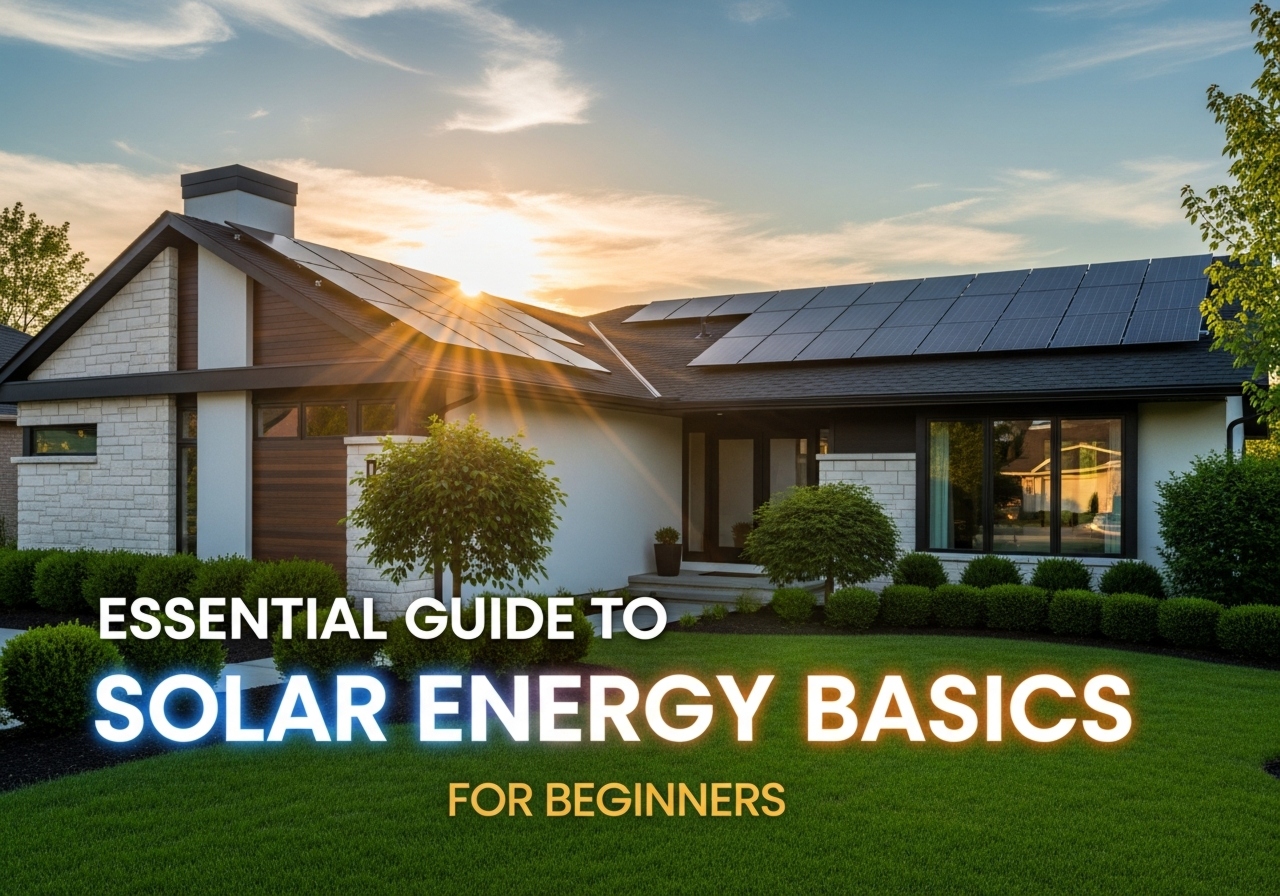
Have you ever stood in your yard and felt the sun on your face and wondered how you might capture that quiet power for your own home?
Essential Guide To Solar Energy Basics For Beginners
You are about to read a gentle, practical guide. It will hold your hand through the basics of solar energy. It will tell you what matters and what is only noise. You will find facts, small stories of choices, and clear steps you can take.
Why solar matters
You might think of solar as technology for someone else. But sunlight is patient and widely available. Turning it into electricity can lower your bills, reduce your carbon footprint, and give you more control over your energy.
There is something steady about this idea: panels on a roof catching light. It is not always dramatic. It is often reliable.
How solar works — the essentials
Solar electricity is simple in idea and layered in detail. At the heart of it, silicon and sunlight meet, and electrons move. From there, equipment guides that flow so your toaster can run.
Photovoltaic effect
When sunlight hits certain materials, it frees electrons. Those electrons create a flow — electricity. The device that does most of this work is the solar panel.
You do not need to memorize the physics. You need to know that panels turn light into DC (direct current) power. That power then needs to be managed.
Main components of a solar system
A solar system is more than panels. It is panels, an inverter, mounting hardware, wiring, and often a battery. Each part plays a role.
- Panels: make the electricity.
- Inverter: converts DC electricity to AC (the kind used in your house).
- Racking: secures panels to the roof or ground.
- Battery: stores energy for use at night or during outages.
- Charge controller and safety equipment: protect the system.
Inverter types
String inverters, microinverters, and power optimizers all do similar work with different trade-offs. String inverters are common and cost-effective. Microinverters attach under each panel and help when shading is a problem.
You will want to match inverter type to your roof and shading situation. They determine how much of your panel output becomes usable power.
Types of solar systems
There are several system types. The right one depends on your needs, budget, and how independent you want to be from the grid.
| System type | What it does | Best for |
|---|---|---|
| Grid-tied | Works with the utility grid; excess power can be sent back | Homes wanting lower costs, simple systems |
| Off-grid | Fully independent, needs battery storage and backup | Remote homes, no grid access |
| Hybrid | Grid-connected with battery backup | Those wanting outages protection and storage |
| Community solar | You subscribe to a shared array | Renters or those with unsuitable roofs |
Each model has consequences. Grid-tied systems are the most common because they are economical and simple. If the grid goes down, most grid-tied systems shut off for safety unless paired with storage.
Solar panel types
Panels look similar from a distance. Up close, there are distinctions in materials, efficiency, and cost.
| Panel type | Pros | Cons | Typical efficiency |
|---|---|---|---|
| Monocrystalline | High efficiency, sleek black look | Higher cost | 18–22% |
| Polycrystalline | Lower cost | Lower efficiency, blueish look | 15–17% |
| Thin-film (CdTe, CIGS) | Flexible, better performance in heat | Lower efficiency, larger area needed | 10–13% |
| BIPV (Building-integrated) | Attractive, replaces roof materials | Expensive, lower efficiency | Varies |
Monocrystalline panels dominate residential rooftops because they deliver more power per square foot. If your roof is small, efficiency matters. If you have a large yard or install ground-mounted arrays, you may weigh cost per watt more.
Key performance metrics you should know
When you read about systems, numbers will follow. Here is how you can interpret them.
Watt (W) and kilowatt (kW)
A watt is a unit of power. A 300 W panel can produce 300 watts under ideal sunlight. Kilowatts are 1,000 watts. Your home’s usage is often discussed in kilowatts or kilowatt-hours.
Kilowatt-hour (kWh)
Electricity usage on your utility bill is shown in kWh. One kWh equals using 1,000 watts for one hour. Your monthly bill shows how many kWh you used.
You will size a system to cover a portion or all of your yearly kWh consumption.
Efficiency
Efficiency tells you how much of the sunlight that hits a panel becomes electricity. Higher efficiency means more output for the same area.
This matters if your roof space is limited. If you have plenty of space, efficiency is less pressing.
Temperature coefficient
Panels perform less well as they heat. The temperature coefficient tells you how much output falls with rising temperature. If you live someplace very hot, pick panels with lower temperature-related losses.
Degradation rate
Panels slowly lose output over time. Typical degradation is about 0.5% to 1% per year. Many manufacturers warrant performance over 25 years.
Inverter efficiency
Not all DC power becomes AC perfectly. Inverter efficiency reduces that slightly. Modern inverters are usually above 95% efficient.
Capacity factor
This is the fraction of total possible output a system produces averaged over time. It reflects night, weather, and seasons.
Assessing your home for solar
You can be practical and gentle with this step. Look up, move slowly, and take notes.
Roof condition and age
If your roof needs replacement soon, address that first. Solar panels are long-term. You will not want to remove panels to replace shingles a few years after installation.
A new roof and a new solar array often make sense together.
Roof orientation and tilt
South-facing roofs work best in the northern hemisphere. East and west faces can work well too. The tilt matters, but many systems perform well at typical roof slopes.
If you have a flat roof, racking can tilt panels toward the sun.
Shading
A single shaded tile or pipe shadow can reduce a whole string’s output. Consider trees, chimneys, and nearby buildings. Shade analysis tools used by installers can help.
If shading is present, microinverters or power optimizers can protect production.
Local climate and sun hours
Solar works in cold places too. It needs light more than heat. You will want to know average sun hours and the seasonal patterns in your area.
Regulations, permits, and HOA rules
Check local building codes and homeowner association rules. Some places have restrictions on panel visibility or require permits.
Your installer often handles permits, but it is wise to ask what they will file and what you must approve.
Sizing a solar system for your needs
Sizing is a mix of math and choice. You can be practical and aim for a system to meet a percentage of your annual use.
Step-by-step sizing
- Gather your electricity bills for the past 12 months. Find the total kWh used.
- Decide what percentage of that use you want to offset with solar (50%, 75%, 100%).
- Estimate the average sun hours per day for your location (system designers use site-specific data).
- Use the formula: Required kW = (Annual kWh target) / (365 × average sun hours × system performance ratio)
- Adjust for roof space and budget.
A performance ratio accounts for system losses (inverter loss, temperature effects, wiring). A typical value is 0.75–0.85.
Example calculation
If you use 10,000 kWh/year and want to offset 80%:
- Target annual kWh = 8,000 kWh
- Average sun hours/day = 4.5
- Performance ratio = 0.8
Required kW = 8,000 / (365 × 4.5 × 0.8) ≈ 6.07 kW
You then divide by panel wattage to get the number of panels (e.g., 6.07 kW / 0.350 kW per panel ≈ 17 panels of 350 W).
Space considerations
A typical 1 kW of solar takes about 100 sq ft (varies by panel efficiency). Multiply that by your required kW to estimate roof space needed.
Batteries and energy storage basics
Batteries change how you use solar. They store midday energy for the evening. They cost extra but add resilience.
Why add batteries?
- Backup power during outages
- Maximize self-consumption (use more of your solar rather than exporting)
- Time-of-use optimization (store when cheap, use when rates are high)
- Independence from the grid when desired
Not everyone needs a battery. Many people start with a grid-tied system and add storage later.
Battery types
| Battery type | Pros | Cons | Typical use |
|---|---|---|---|
| Lithium-ion (Li-ion) | High energy density, long life, high efficiency | Higher upfront cost | Most modern home systems |
| Lead-acid | Lower cost | Shorter life, lower depth of discharge | Older systems, budget projects |
| Flow batteries | Scalable, long life | Large footprint, still emerging | Large-scale storage |
Lithium-ion batteries are the most used in homes today because they balance cost, performance, and lifecycle.
Sizing batteries
To size a battery, decide how many hours of backup you want and what loads are essential. Multiply expected kW of load by hours to get kWh.
Factor in depth of discharge (DoD) and round-trip efficiency:
Usable capacity = Nominal capacity × DoD × round-trip efficiency
For example, a 10 kWh battery with 90% DoD and 90% round-trip yields about 8.1 kWh usable.
Costs, incentives, and economics
Money matters. The numbers will shape your decisions.
Typical costs
Costs vary by location, system size, equipment quality, and labor. A rooftop residential system usually is quoted in $/W. As of my last update, many U.S. residential systems ranged widely; local market conditions affect price.
Ask for itemized quotes. Panels, inverters, racking, labor, permits, and electrical upgrades can all appear on the bill.
Incentives and rebates
In many countries, there are incentives that change economics. In the U.S., the federal solar tax credit (ITC) has been significant for many years, though rates have changed over time. States, utilities, and municipalities often add further rebates, performance payments, or net metering policies.
You should check current local and national incentives before you finalize plans. An installer often helps with paperwork.
Payback and returns
Calculate payback by dividing net system cost (after incentives) by annual savings. Savings depend on your electricity rates and how much solar you use versus export.
Consider the lifetime of the system. Panels often warrant 25 years of output, and many continue producing beyond that with gradual loss.
Example cost table
| Item | Typical range (example) |
|---|---|
| Panels (per watt) | $0.20 – $0.70 |
| Inverter (string) | $0.06 – $0.15 per watt |
| Installation/labor | Varies widely by region |
| Battery storage (per kWh) | $300 – $800 (battery cost only) |
These are broad ranges. Your local quotes will be more accurate.
Installation process and choosing an installer
You will meet people doing work on your roof. You will sign contracts. Choose carefully.
What a good installer will do
- Provide a detailed, itemized quote
- Conduct a site visit and shade analysis
- Pull permits and handle inspections
- Coordinate with your utility for interconnection
- Provide warranties and explain maintenance
Questions to ask potential installers
- Are you licensed and insured locally?
- Do you use subcontractors?
- What warranties do you offer for labor?
- What are the panel and inverter manufacturers and their warranties?
- Who handles permitting and utility interconnection?
- What happens if the system underperforms?
You are paying for workmanship as much as equipment. A careful installer can save headaches later.
Warranties you should read
- Performance warranty: panel output over years
- Product warranty: defects in panels or inverters
- Workmanship warranty from the installer
Keep paperwork in a safe place. If you sell your house, warranty transfers can be valuable.
Operation and maintenance
Solar systems are quiet. They still need occasional attention.
Regular checks
- Visual inspection twice a year: look for debris, animal nests, or loose mounts.
- Clean panels if dust or bird droppings reduce output noticeably.
- Monitor performance through your inverter app or monitoring portal.
Many modern systems report output and alert you to faults. If production falls, contact your installer.
Maintenance schedule table
| Frequency | Task |
|---|---|
| Monthly | Check monitoring app for unexpected drops |
| Twice a year | Visual roof and panel inspection |
| Every 3–5 years | Check wiring, clamps, and grounding (by a pro) |
| As needed | Clean panels if dirty or obstructed |
| Batteries | Follow manufacturer guidance for maintenance and firmware updates |
Most systems are low-maintenance. Batteries may require more attention than panels.
Safety and regulations
Electricity and roofs carry risk. Safety is non-negotiable.
- Work with licensed electricians and installers.
- Ensure the installer follows local electrical codes and uses proper safety disconnects.
- For battery systems, understand fire-safety measures and ventilation when required.
- Notify your homeowner’s insurance. Some insurers require policies to be updated for solar.
If you ever perform inspections yourself, avoid climbing on the roof alone and do not touch electrical components.
Environmental impact
Solar greatly reduces the carbon emissions associated with electricity generation. Panels have an environmental cost in manufacturing, but that cost is usually paid back in a few years of clean electricity.
Consider end-of-life plans. Recyclers and take-back programs for panels are growing. Batteries, too, need responsible recycling.
You will reduce emissions by choosing solar, but you will also join a system that requires thoughtful disposal and recycling solutions in the years to come.
Common myths and questions
You will hear many confident statements about solar. Here are gentle corrections.
Myth: Solar only works in hot, sunny places
Solar needs light, not heat. It can be very effective in cool, sunny climates. Cloudy days reduce output but do not stop it entirely.
Myth: Solar panels require constant cleaning
Most panels perform well with occasional rain cleaning. Heavy dust or soot may need cleaning, but it is not usually daily work.
Myth: Solar will always power my home during blackouts
Grid-tied systems typically shut off during outages for safety. Without battery storage or a specific backup inverter, you will not have power in a blackout.
Myth: Solar is too expensive
Upfront costs have fallen and incentives can help. Economics vary by location. For many homeowners, solar is now cost-competitive and can pay back over time.
Choosing equipment — practical notes
You will see brand names and ratings. Look for balanced decisions.
- Panels: favor long warranties and a reputable manufacturer.
- Inverters: choose reputable brands and consider monitoring features.
- Batteries: pay attention to usable capacity, cycle life, and manufacturer support.
- Racking: ensure wind and snow load ratings suit your location.
Do not choose the cheapest equipment without considering warranties and local support.
Solar and your home value
Adding solar can increase your home’s resale value. Buyers often appreciate lower operating costs and the presence of a well-documented, warrantied system. If you lease a system or have a third-party ownership, this complicates sale logistics, so disclose and document clearly.
Questions to ask yourself before committing
- How long do you plan to stay in this home?
- How much of your electricity do you want to offset?
- Do you need backup power?
- Is your roof in good condition?
- Are there incentives that make now the right time?
Answering these will guide sizing, financing, and whether to add a battery.
Financing options
You have options beyond paying cash.
- Solar loans: let you pay over time; some are structured to be cash-flow positive.
- Leases and power purchase agreements (PPAs): you pay for the electricity produced but do not own the system.
- Cash purchase: yields the best long-term returns if you can afford it.
Weigh the benefits and limitations of ownership versus lease models. Ownership usually yields the most financial benefit, but financing can make adoption practical sooner.
Net metering and exporting power
Many utilities allow you to export excess solar to the grid and get credit. Net metering policies differ. Some credit at full retail rate, some at lower rates. These differences materially affect your savings.
If net metering is generous where you live, you may size your system to export. If credits are low, you may want to pair storage to maximize self-consumption.
Legal and paperwork you will see
- Interconnection agreement: lets your system connect to the grid.
- Permit documents: local building and electrical permits.
- Utility approval: final permission to operate.
- Incentive paperwork: tax forms or rebate applications.
Keep copies and track deadlines for any paperwork you must file.
Troubleshooting low performance
If your system is underperforming, take a calm approach.
- Check the monitoring portal for error messages.
- Confirm inverter status lights.
- Look for visible shading or debris.
- Ask your installer to run diagnostics.
Many issues are minor and fixable. If production drops after a storm, check mounting and wiring loose points.
Environmental and social considerations
You might worry about the landscape, supply chains, and materials. These are valid concerns.
- Mining for materials like silicon and lithium has impacts; companies are improving sourcing and recycling.
- Consider local labor practices and installer reputation.
- Encourage recyclers and programs that handle end-of-life panels and batteries responsibly.
If you care about these issues, ask installers and manufacturers about supply chain transparency and recycling options.
Next steps checklist
- Gather 12 months of electricity bills.
- Inspect roof condition and note shading obstacles.
- Get 3 quotes from reputable installers with itemized proposals.
- Ask about warranties, certifications, and maintenance.
- Check local incentives, net metering rules, and permits.
- Decide on battery storage only after weighing outage needs and economics.
- Review financing options and calculate payback under conservative estimates.
Write down your priorities and let them guide your choices. You will feel calmer with a list.
Glossary — words you will see often
- AC (Alternating Current): The form of electricity used by household appliances.
- DC (Direct Current): What solar panels produce initially.
- Inverter: Converts DC to AC.
- kW (kilowatt): 1,000 watts; a measure of power.
- kWh (kilowatt-hour): Energy used over time.
- Net metering: Credit for exported electricity to the grid.
- Performance ratio: Factor accounting for system losses.
- Peak sun hours: Equivalent hours of full solar intensity.
If the industry speaks a language unfamiliar to you, this glossary will help translate it.
Final thoughts
You do not need to become an engineer to put solar on your roof. You need curiosity, a few bills, and a willingness to ask questions. The sun does not rush. Your decisions can be careful and measured.
Solar can be intimate in a way. It sits on your roof and listens to your habits. It changes the rhythm of your bills and, sometimes, your peace of mind during storms. Make choices that fit your life and your values.
If you take one step today, let it be collecting your past year’s power use. From there, the rest becomes orderable: numbers, quotes, decisions. You will find that each piece falls into place, slowly, like light across a morning table.