
Are you planning a small off‑grid system and wondering which battery type will give you the best balance of cost, reliability, and longevity?
How To Choose The Right Battery Type For A Small Off‑Grid System
This guide walks you through the practical steps and trade-offs so you can choose the right battery for your setup. You’ll get clear explanations, comparisons, sizing guidance, and installation considerations to help you make a confident decision.
Understanding Your Off‑Grid Needs
Before choosing a battery chemistry or size, you need a clear picture of how you’ll use your system. Batteries are chosen to match real loads, charging availability, desired autonomy, and environmental constraints.
Assess Your Load
Start by listing every appliance and device you plan to run off the system. You should quantify each device’s power draw (watts) and estimated daily runtime so you know the real energy demand.
Daily Energy Consumption and Autonomy Days
Calculate total daily energy use in watt‑hours (Wh) or kilowatt‑hours (kWh). Decide how many days of autonomy you want — the number of cloudy or generator‑free days the battery bank should cover — because that drives battery capacity.
Peak & Surge Power Requirements
Identify starting currents and surge power for motors, pumps, or compressors. Batteries must deliver both continuous power and short-term high currents without voltage collapse, so you’ll need to size inverter and battery C‑rate accordingly.
Battery Basics You Should Know
Understanding a few key battery parameters will help you compare options and avoid costly mistakes. These include capacity, depth of discharge, cycle life, and round‑trip efficiency.
Capacity and Amp‑Hours
Battery capacity is commonly quoted in amp‑hours (Ah) at a nominal voltage. To convert Ah to usable energy, multiply Ah by nominal voltage and factor in depth of discharge (DoD). For example, a 100 Ah 12 V battery stores about 1,200 Wh raw; usable energy depends on DoD.
Depth of Discharge (DoD)
Depth of discharge is how much of the battery’s capacity you can safely use before recharging. A higher usable DoD reduces required bank size but often shortens battery life for some chemistries. Always plan based on usable capacity, not total capacity.
Cycle Life
Cycle life tells you how many charge/discharge cycles a battery can provide at a specified DoD before capacity falls to a defined threshold (often 80%). Cycle life differs hugely across chemistries and is one of the main determinants of lifecycle cost.
State of Charge (SoC) and Peukert’s Law
State of charge is the battery’s current energy level expressed as a percentage. Be aware of Peukert’s effect for lead‑acid batteries: higher discharge rates reduce effective capacity, so short high loads can reduce runtime compared to steady lower draws.
Common Battery Chemistries
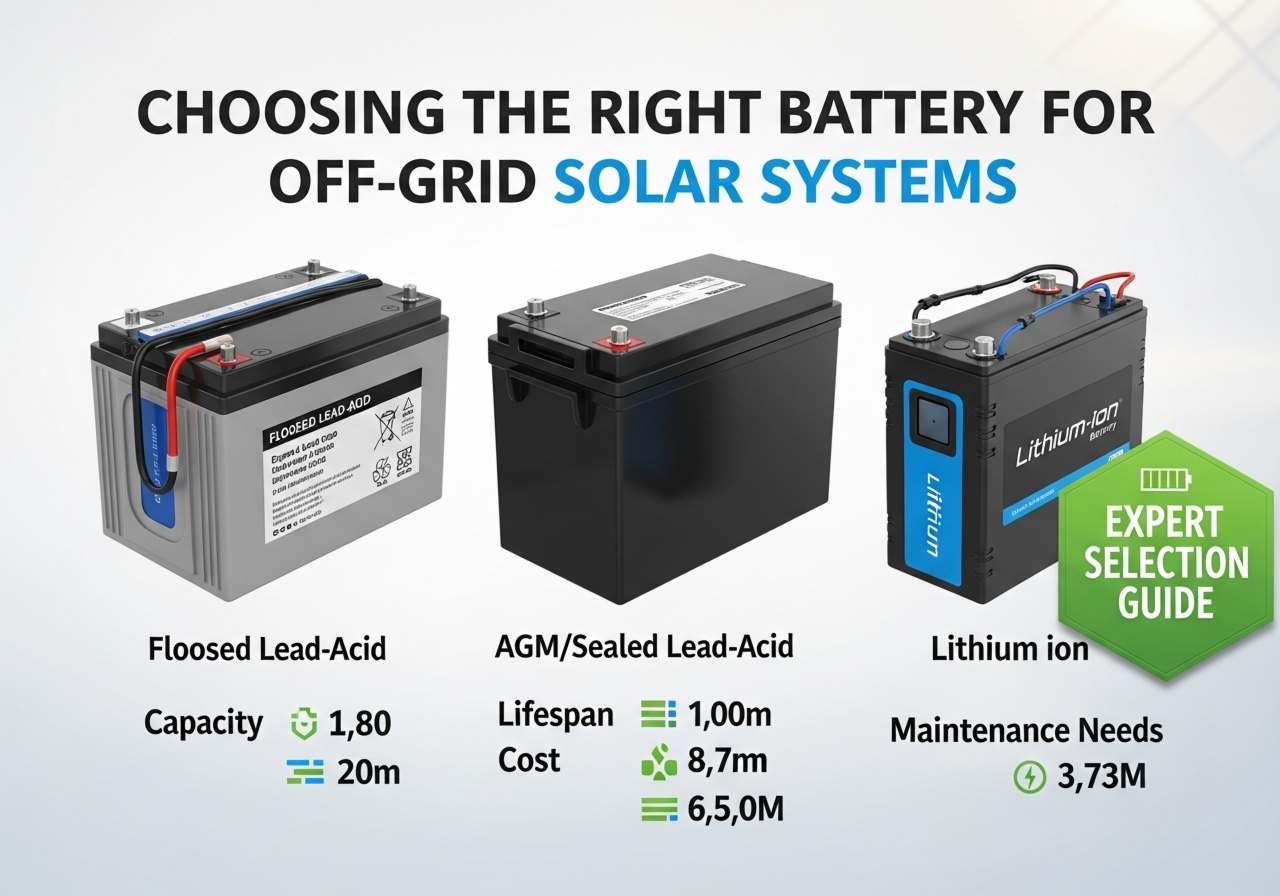
Different battery chemistries have distinct trade‑offs for cost, maintenance, efficiency, safety, and lifetime. For small off‑grid systems, you’ll usually choose between lead‑acid variants and lithium options.
Flooded Lead‑Acid (FLA)
Flooded lead‑acid batteries are the traditional choice and are relatively inexpensive per kWh. They require regular maintenance (water topping, equalization) and good ventilation due to off‑gassing during charging.
Sealed Lead‑Acid: AGM and Gel
Absorbent Glass Mat (AGM) and gel batteries are sealed and require less maintenance than flooded batteries. They’re better for confined spaces and moderate cycles but typically offer fewer cycles and lower usable DoD compared to lithium.
Lithium Iron Phosphate (LiFePO4 / LFP)
LiFePO4 is the most popular lithium chemistry for off‑grid battery banks. It offers high cycle life, deep usable DoD, high efficiency, low maintenance, and good thermal stability. Upfront cost is higher, but lifecycle cost can be lower.
Other Lithium Chemistries (NMC, etc.)
Other lithium chemistries like NMC (nickel manganese cobalt) are used in EVs and some energy storage systems, but they tend to have different trade‑offs in safety, cycle life, and cost. For small off‑grid systems, LiFePO4 is usually the preferred lithium option.
Comparison Table: Common Battery Types
This table summarizes key attributes to help you compare options quickly. Values are general ranges and will vary by manufacturer and model.
| Chemistry | Typical Upfront Cost (USD/kWh) | Typical DoD | Cycle Life (cycles @ rated DoD) | Round‑Trip Efficiency | Maintenance | Pros | Cons |
|---|---|---|---|---|---|---|---|
| Flooded Lead‑Acid | 80–150 | 30–50% recommended | 300–1,000 | 70–85% | Requires watering, equalization | Low upfront cost, well understood | Ventilation, heavy, short life |
| AGM (Sealed Lead‑Acid) | 120–200 | 40–60% | 500–1,200 | 75–85% | Minimal | Sealed, less maintenance | Higher cost than flooded, shorter life than lithium |
| Gel | 130–220 | 40–60% | 500–1,200 | 70–85% | Minimal but sensitive to charging | Sealed, low maintenance | Sensitive to charge voltages |
| LiFePO4 (LFP) | 300–900 | 80–95% | 2,000–8,000+ | 90–98% | Very low | Long life, high DoD, lightweight | Higher upfront cost, requires BMS |
| Other Li (NMC, LCO) | 200–600 | 70–90% | 1,000–5,000 | 85–95% | Low | Higher energy density | Varying safety and lifecycle |
Sizing Your Battery Bank
Sizing is more than picking a larger battery to be safe. Properly sized banks meet your autonomy needs, handle peak loads, and work efficiently with your charging source.
Choosing System Voltage: 12V, 24V, 48V
Higher system voltages reduce current for the same power, lowering wiring losses and enabling smaller, lighter cables. For small systems under about 1–2 kW, 12 V may be adequate, but for any moderately larger system it’s usually better to move to 24 V or 48 V.
Calculating Required Battery Capacity
To size your bank:
- Calculate daily energy use in Wh.
- Multiply by days of autonomy.
- Divide by usable DoD (as a decimal).
- Divide by system voltage to get required Ah. Example: 2,000 Wh/day × 2 days autonomy = 4,000 Wh. If using LiFePO4 with 90% usable DoD, required stored energy = 4,000 / 0.9 ≈ 4,444 Wh. At 24 V, Ah = 4,444 / 24 ≈ 185 Ah.
Series and Parallel Wiring Considerations
You wire cells or batteries in series to increase voltage and in parallel to increase capacity. Mixing ages or mismatched batteries is risky and can unbalance the bank. Always use identical batteries in each string and match capacities when paralleling.
Considering Charging Sources
Your charging sources (solar panels, wind turbine, generator) determine how fast you can recharge and thus affect required bank capacity. If your solar array is small or seasonal, you’ll need more battery capacity to cover cloudy periods.
Battery Management and Charging
Batteries require correct charging profiles and management for longevity and safety. Different chemistries need different voltages, charge rates, and protection.
Charge Controllers and Charging Profiles (PWM vs MPPT)
MPPT controllers are more efficient and extract more energy from solar panels, especially in cold or low‑irradiance conditions. Ensure the charge controller supports the chosen battery type so it can apply the proper bulk, absorption, float, and equalization regimes.
Battery Management Systems (BMS) for Lithium
Lithium batteries require a BMS to protect against overcharge, overdischarge, overcurrent, and cell imbalance. The BMS also handles cell balancing and thermal protections. Make sure the BMS’s current ratings match your inverter and charging equipment.
Equalization and Maintenance for Lead‑Acid
Flooded lead‑acid batteries benefit from periodic equalization charging to reduce sulfation and balance cells, but this process produces hydrogen gas and must be done in a ventilated space. AGM and gel batteries generally should not be equalized at high voltages.
Environmental and Installation Considerations
Where you install batteries matters. Temperature, ventilation, and mounting affect performance, safety, and lifetime.
Temperature Effects and Temperature Compensation
Battery performance and life depend strongly on temperature. Cold reduces usable capacity and charging acceptance, while heat accelerates degradation. Lead‑acid batteries often require temperature‑compensated charge voltages to avoid under‑ or overcharging.
Ventilation, Location, and Safety
Flooded batteries off‑gas hydrogen during charging and must be installed in ventilated areas away from sparks. Lithium batteries generally have lower off‑gassing but still need safe mounting and fire‑safe placement if possible. Keep batteries off the ground, in a stable location, and away from combustible materials.
Mounting, Wiring, Fusing, and Disconnects
Use appropriately sized cables, lugs, and terminal protections. Fuse or circuit‑break between batteries and inverter/charger to protect against short circuits. Include a DC disconnect for maintenance and emergency shutdown.
Cost, Lifespan, and Payback
Looking only at upfront cost can be misleading. Consider lifecycle cost, maintenance, and replacement cycles to understand long‑term value.
Upfront Costs vs Life‑Cycle Costs
Lithium batteries cost more upfront but often provide more usable cycles and higher DoD, reducing cost per usable kWh over life. Lead‑acid may be cheaper now but can require replacement sooner and need more maintenance, which adds cost and downtime.
Replacement, Recycling, and Disposal
Battery recycling infrastructure varies by chemistry and region. Lead‑acid recycling is well established and nearly universal, whereas lithium recycling is improving but can be more limited and costly. Plan for end‑of‑life management when you choose a chemistry.
Choosing the Right Battery for Different Use Cases
Your use case determines which battery chemistry and configuration make the most sense financially and practically.
Small Weekend Cabin with Solar
If you visit rarely and charging opportunities are limited, you may prefer a rugged chemistry with low self‑discharge and low maintenance. A smaller LiFePO4 bank can be ideal for frequent deep cycles and minimal maintenance, but a properly sized AGM can be cost‑effective for very light use.
Tiny Home / Full‑Time Off‑Grid
If you live full‑time off‑grid, prioritize long cycle life, deep usable DoD, and minimal maintenance — all qualities of LiFePO4. A larger lithium bank with a good BMS and MPPT charger will typically give the best reliability and lowest long‑term cost.
Backup for Occasional Outages
For occasional backup, you might choose lower upfront cost options like sealed lead‑acid if replacements are acceptable. However, if you expect frequent outages or want a long service life with low maintenance, lithium may pay off despite higher initial cost.
Troubleshooting and Common Mistakes
Many installation problems stem from mismatched equipment, improper charging, or incorrect wiring. Avoid mixing old and new batteries, incorrect charge voltages, undersized cabling, and inadequate ventilation.
- Using the wrong charging profile can permanently damage batteries. Always set the charge controller to the chemistry type and nominal voltage you have.
- Undersized cables cause voltage drops and heating, reducing performance and safety. Use proper cable sizing charts and double‑check connections.
- Mixing cells or batteries of different ages or capacities leads to imbalance and premature failure. Keep strings matched and avoid paralleling different types.
Checklist Before You Buy
Before making a purchase, run through this checklist to avoid surprises and ensure compatibility.
- Confirm daily energy use in Wh/kWh and desired autonomy days.
- Choose system voltage (12/24/48 V) suitable for your power level and inverter.
- Select battery chemistry based on DoD, cycle life, maintenance capability, and budget.
- Verify inverter and charge controller compatibility with battery voltage and chemistry.
- Ensure BMS is rated for expected charge/discharge currents and includes necessary protections.
- Plan ventilation, mounting location, and access for maintenance or replacement.
- Size cables, fuses, and disconnects according to maximum current and safety standards.
- Check supplier warranty terms, expected lifetime, and local recycling options.
Frequently Asked Questions
Here are concise answers to common questions you’ll likely have.
Q: How many battery cycles do I really need? A: Estimate lifetime cycles by multiplying expected cycles per year by desired years of service. For example, if you cycle daily and want 10 years, aim for >3,500 cycles. Choose chemistry accordingly.
Q: Can I mix battery types or old and new batteries? A: No. Mixing different chemistries, ages, or capacities causes imbalance and accelerates failure. Always use matched batteries and replace entire banks when necessary.
Q: Is lithium safe for off‑grid use? A: Modern LiFePO4 batteries are very safe thermally and electrically, especially with a proper BMS. Still follow installation guidelines, avoid mechanical damage, and locate batteries sensibly.
Q: How much maintenance will I need? A: Flooded lead‑acid requires the most maintenance (watering, equalization). AGM and gel require little maintenance. LiFePO4 requires minimal maintenance beyond BMS monitoring and keeping terminals clean.
Q: Do I need a generator if I have solar and batteries? A: It depends on your energy use, location, and tolerance for long cloudy periods. A generator can be a cost‑effective backup if solar input is seasonal or limited.
Q: How do I choose battery capacity for a 1,000 Wh/day load? A: Decide autonomy (e.g., 2 days = 2,000 Wh). If using LiFePO4 with 90% DoD and a 24 V system: required Ah = (2000 / 0.9) / 24 ≈ 93 Ah. Add margins for inefficiencies and charging limits.
Final Recommendation and Decision Flow
If you want a practical recommendation, start by defining your daily load and autonomy needs. If you need low maintenance, high usable capacity, and long life — and can afford higher upfront cost — LiFePO4 is usually the best choice for small off‑grid systems. For extremely tight budgets and simple, infrequent use, sealed lead‑acid (AGM) or flooded lead‑acid may be acceptable if you’re prepared for maintenance and shorter replacement cycles.
Decision flow (textual):
- Determine daily Wh and desired autonomy.
- Select system voltage based on power and wiring constraints.
- Compare chemistries: If budget allows and you want long life, choose LiFePO4. If not, choose lead‑acid and plan maintenance.
- Size Ah using usable DoD and include inefficiencies.
- Verify charge controllers, BMS, inverter, and cabling are compatible.
- Install with proper ventilation, fuses, and monitoring.
Notes on Brands, Warranties, and Buying Tips
Choose reputable manufacturers and dealers who provide detailed specs and support. Warranty terms vary in length and coverage; look for warranties that specify cycle life and capacity retention. Avoid bargain batteries with vague specs, and ask for datasheets showing cycle life at different DoDs and temperatures.
- Ask about actual usable capacity at rated discharge rates.
- Confirm BMS features and whether it’s user‑configurable.
- Check shipping, return policies, and local technical support for installation questions.
Safety and Legal Considerations
Follow local electrical codes, and if you’re not confident, hire a licensed electrician familiar with battery systems. Batteries can present fire, chemical, and electric shock hazards if installed incorrectly, and improper installations can void warranties and insurance coverage.
- Ensure compliance with building codes for battery installations.
- Use certified components rated for off‑grid use.
- Label battery systems and switches clearly.
Summary
Choosing the right battery type for a small off‑grid system comes down to matching your energy needs, budget, maintenance willingness, and safety requirements. By calculating your daily energy, deciding on autonomy, selecting suitable system voltage, and comparing chemistry trade‑offs — you’ll arrive at a choice that balances cost and performance. For most small off‑grid setups where budget permits, LiFePO4 offers the best mix of long life, deep DoD, and low maintenance. For constrained budgets or very infrequent use, lead‑acid options remain viable with careful maintenance planning.
If you’d like, provide your estimated daily loads, preferred autonomy days, and budget, and you’ll get a tailored battery recommendation and a simple capacity calculation to move forward.