
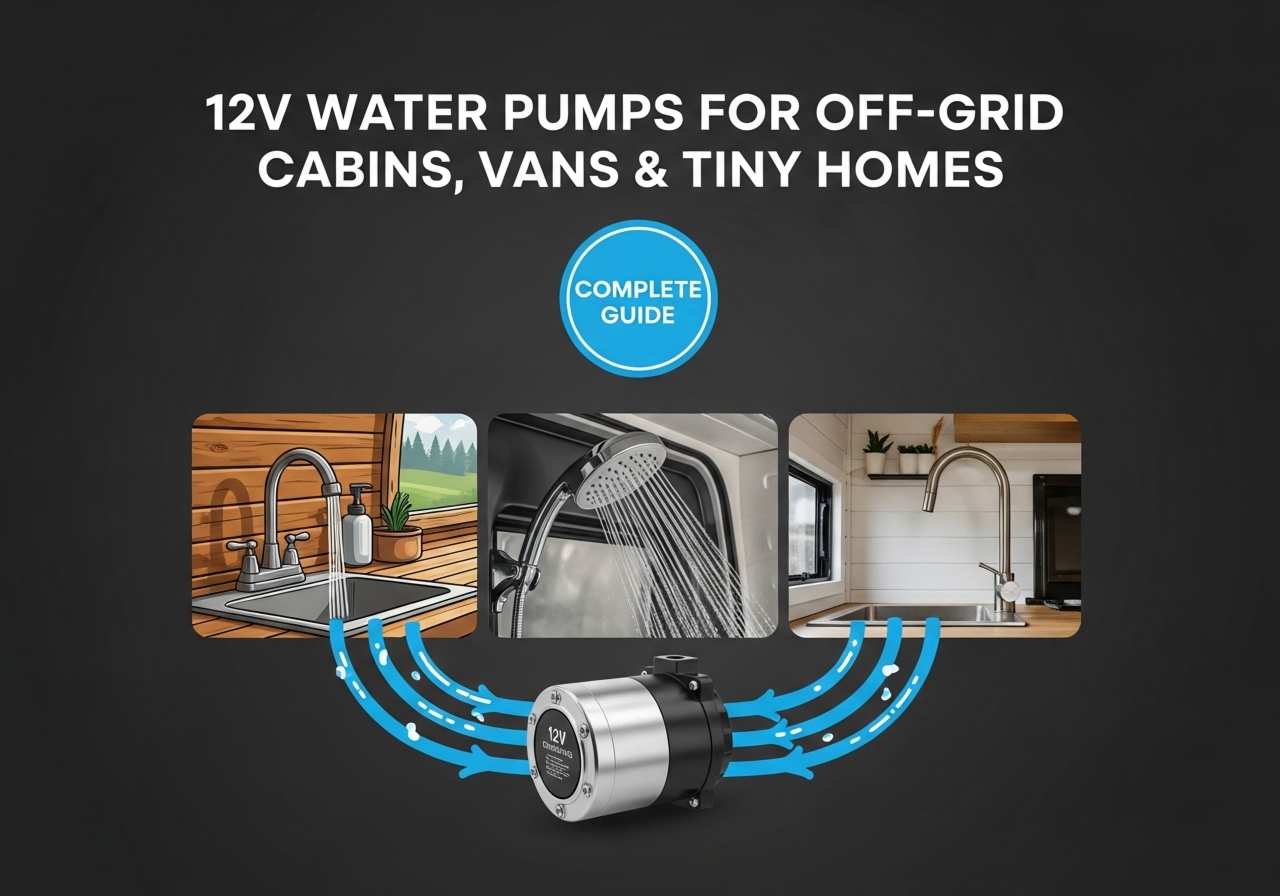
Are you planning to install a 12V water pump in your cabin, van, or tiny home and want a clear, practical guide to choose, size, install, and maintain one?
Beginner’s Guide To 12V Water Pumps For Cabins, Vans, And Tiny Homes
You’ll find that 12V water pumps are a popular choice for off-grid and mobile living because they’re simple to wire to batteries, efficient for small systems, and available in a variety of sizes and styles. This guide walks you through the fundamentals, selection criteria, installation steps, maintenance tips, and troubleshooting so you can confidently set up a reliable water system.
What is a 12V water pump?
A 12V water pump is an electric pump designed to run on a 12-volt DC power supply, typically from a battery bank or vehicle electrical system. These pumps move water for uses like sinks, showers, toilets, and outdoor taps in systems where AC mains power isn’t available or desired.
You’ll see 12V pumps used in campers, boats, tiny homes, off-grid cabins, and similar setups because they’re compact, relatively quiet, and can be run directly from a battery or solar system.
Basic types of 12V water pumps
Knowing the types helps you match the pump to your needs. Each type has pros and cons depending on flow requirements, head (pressure), and how quiet or durable you need the system to be.
- Diaphragm (positive displacement): Often used for intermittent use in RVs and boats. They provide consistent pressure and self-priming capability.
- Centrifugal (impeller): Good for continuous flow applications like showers and gravity-fed tanks; typically quieter at steady flow.
- Submersible: Designed to sit inside the water source; useful for shallow wells, tanks, or rainwater barrels.
- Inline: Sits inline with plumbing and is versatile for under-sink or under-counter installations.
Quick comparison table: pump types
| Pump Type | Best For | Self-priming? | Noise | Typical Use |
|---|---|---|---|---|
| Diaphragm | Intermittent, pressure-sensitive systems | Yes | Moderate | RV sinks, toilets |
| Centrifugal | Continuous flow (showers) | Some are | Low to moderate | Showers, general water transfer |
| Submersible | Tanks, barrels, shallow wells | Yes | Low (underwater) | Tank pumps, rainwater systems |
| Inline | Tight installations, under-sinks | Some models | Low | Under-sink pumps, point-of-use |
How 12V pumps work (simple overview)
You’ll want a basic idea of what happens inside the pump so you can pick the right one and diagnose problems.
Diaphragm pumps use a flexible diaphragm that moves back and forth to pull water in and push it out through one-way valves. Centrifugal pumps rely on an impeller spinning to create a pressure difference and move water. Submersible pumps combine features depending on design but are optimized to stay submerged and push water upward.
Key specifications you must understand
Choosing the wrong pump often comes down to misunderstanding specifications. Focus on these parameters:
- GPM (gallons per minute) or L/min: Measures flow rate. Higher GPM means more water delivered per minute.
- PSI (pounds per square inch): Pressure delivered to fixtures. Showers typically need at least 30–50 PSI for a comfortable flow.
- Head (feet or meters): The vertical distance the pump can lift water. Total dynamic head includes vertical lift and friction losses in pipes.
- Amps and power draw: Determines battery sizing and wiring needs.
- Duty cycle: Continuous or intermittent operation. Showers need continuous duty pumps.
- Self-priming and dry-run protection: Important for reliability and protection if the pump runs without water.
Understanding head vs pressure
Head is often given in feet or meters of water; you can convert head to approximate PSI using a simple relation: 2.31 feet of water = 1 PSI. If a pump is rated for 50 feet of head, that’s roughly 21.6 PSI maximum (but real-world performance will be lower once flow is considered). You’ll need to account for both vertical lift and friction losses in your plumbing when calculating required head.
Sizing the pump for your needs
Sizing impacts performance and battery consumption. Think about your usage patterns and fixtures.
- Point-of-use (single sink or tap): 0.5–2.0 GPM may suffice.
- Small kitchenette with sink and occasional shower: 2–4 GPM.
- Full shower and a couple of taps running: 4–6+ GPM.
Also consider simultaneous use — if you want to run a shower and a tap at the same time, size for combined flow.
Quick sizing reference
| Use Case | Typical GPM Needed | Recommended Pump Type | Duty |
|---|---|---|---|
| Single sink/faucet | 0.5–1.5 GPM | Diaphragm or inline | Intermittent |
| Kitchenette + occasional shower | 2–3 GPM | Centrifugal or higher-flow diaphragm | Intermittent to continuous |
| Shower + 1–2 taps simultaneously | 3–6 GPM | Continuous-duty centrifugal/submersible | Continuous |
| Pressurized whole-system for small cabin | 4–6 GPM, 40–60 PSI | Pressure-switch diaphragm + accumulator | Intermittent with buffer |
Power and battery considerations
You’ll need to match pump draw to your battery capacity and charging system. Pumps can draw anywhere from a couple of amps to 15–20A or more at 12V depending on size and load.
- Measure pump amps at expected operating pressure and flow.
- Calculate run time: Battery amp-hours (Ah) ÷ pump amps = hours of run time (before discharge).
- Factor Peukert loss and avoid deep discharging lead-acid batteries; try to use only 50% of capacity or more conservative limits depending on battery chemistry.
- Consider using a DC-DC charger or solar charge controller if charging from solar panels.
Example battery calculation
If a pump draws 8A and you have a 100Ah battery:
- Theoretical run time = 100Ah ÷ 8A = 12.5 hours.
- Using 50% usable capacity (lead-acid) gives 6.25 hours usable runtime between charges. That’s simplified; real-world figures will vary with battery age, temperature, and other loads.
Wiring and electrical safety
Proper wiring prevents voltage drop, overheating, and fire hazards. Follow these essentials:
- Use the appropriate wire gauge: thicker cables reduce voltage drop. For runs under 10 feet and up to 10A, 14 AWG might be okay; for 10–20A, use 12 or 10 AWG. Always check pump manual and local codes.
- Install an inline fuse or circuit breaker close to the battery sized for the pump’s maximum current draw.
- Use secure battery terminals and good-quality ring terminals or connectors.
- Consider a relay or switch capable of the pump’s current; use a waterproof switch if exposed to moisture.
- Keep wiring tidy and protected from chafing.
Voltage drop guideline table
| Wire Gauge (AWG) | Max Safe Current (approx) | Max Run Length for <3% voltage drop at 12v< />h> |
|---|---|---|
| 14 | 15A | ~4–5 ft |
| 12 | 20A | ~6–8 ft |
| 10 | 30A | ~10–12 ft |
| 8 | 40A | ~15–18 ft |
Note: These are approximate. Use a voltage drop calculator for precise planning.
Plumbing basics and fitting the pump
Plumbing choices influence performance and noise. You’ll plan tank connection, inlet hose, outlet hose, check valves, and filters.
- Use proper hose diameter: undersized hoses restrict flow and increase pump load. Match hose ID to pump inlet/outlet specs.
- Install a pre-filter on the pump inlet to prevent debris from damaging the pump.
- Add a check valve on the outlet if your system requires preventing backflow into the tank or lines.
- Use flexible hoses with vibration-damping clamps to reduce noise transmission.
- Avoid long runs with many bends; reduce friction losses with straighter, larger-diameter piping.
Typical plumbing components
- Strainer or sediment filter at intake
- Shut-off valve for maintenance
- Check valve to prevent reverse flow
- Accumulator tank (optional) to reduce cycling
- Pressure switch for automatic operation (if applicable)
Pressure systems: pressure switch vs. demand pumps
There are two common approaches to automating water delivery:
- Pressure switch + diaphragm pump: The pump cycles on when pressure drops below a set point and off when pressure rises, giving consistent pressure. Often used in cabins and tiny homes.
- Demand-sensing or automatic pumps: Some diaphragm pumps are built with internal pressure sensing and run only when a tap is opened, stopping when it’s closed.
You’ll want to know pump cycling behavior because frequent cycling shortens pump life. An accumulator tank reduces cycling.
Accumulator tanks: why they help
An accumulator (pressure) tank stores a small volume of pressurized water so that minor draws (a quick rinse, washing hands) don’t require the pump to start. This reduces start-stop cycles, extends pump life, and smooths water flow.
Noise and vibration control
Noise is a common concern in small spaces. You can reduce pump noise by:
- Mounting the pump on rubber isolators or pads.
- Using flexible hoses rather than hard pipe to avoid transmitting vibration.
- Locating the pump away from sleeping areas if possible.
- Choosing a pump with lower dBA spec for quieter operation.
Installation step-by-step (basic procedure)
You’ll find installation straightforward if you follow a safe, logical process.
- Plan the layout: Determine pump location, battery access, and plumbing route.
- Secure the pump: Use appropriate mounts and vibration isolators.
- Install inlet filter/strainer: Prevents debris from entering the pump.
- Connect inlet hose: Keep it as short and straight as possible.
- Connect outlet hose and check valve if needed.
- Run wiring from the battery, install fuse/CB at battery positive, then connect pump through switch or relay.
- Prime and test the system: Fill the source or tank, open taps, and check for leaks and proper pressure.
- Adjust pressure switch or regulator if your pump system has one.
Maintenance tips
Routine maintenance keeps your pump running longer and prevents failures.
- Check hoses and clamps for leaks or wear every few months.
- Clean or replace inlet filters regularly.
- Run the pump periodically if it sits unused to prevent seals from drying out.
- Inspect electrical connections for corrosion and tightness.
- Winterize if temperatures drop below freezing: drain the pump and lines or use antifreeze where appropriate.
Winterizing and freeze protection
If you expect freezing temps, protect your pump and lines:
- Drain tanks and lines completely.
- Store removable pumps indoors.
- Use insulating wraps around exposed piping and the pump body if it must remain installed.
- Consider heat tape for critical runs, powered through a thermostat.
Troubleshooting common problems
When issues arise, simple checks will often restore operation.
Troubleshooting table
| Symptom | Likely Cause | What You Should Do |
|---|---|---|
| Pump won’t start | No power, blown fuse, bad switch | Check battery voltage, fuse, and switch; test pump with jumper leads |
| Pump runs but no water | Airlock, clogged inlet filter, dry tank | Check tank level, clean inlet filter, bleed air from inlet |
| Pump cycles rapidly | Leak in system, check valve failure, small accumulator | Inspect for leaks, test/replace check valve, add/replace accumulator |
| Low flow | Clogged filter, small inlet hose, low battery voltage | Clean filter, increase hose diameter, charge battery |
| Excessive noise | Mounting vibration, cavitation, low water level | Add isolate mounts, ensure adequate inlet flow, check for air in line |
| Overheating | Running dry, blocked flow, high ambient temp | Stop, allow to cool, correct source issue, check for obstructions |
Common mistakes to avoid
You’ll have better results if you steer clear of typical errors:
- Undersizing wiring leading to voltage drop and poor pump performance.
- Using pumps intended for intermittent use in continuous-duty applications.
- Forgetting to install a pre-filter on the intake.
- Ignoring pump amperage for battery and fuse sizing.
- Mounting the pump directly to a rigid surface without vibration isolation.
Choosing between branded models and budgets
You’ll find cheap pumps and premium pumps. Budget models may save money upfront but can fail sooner. Branded or well-reviewed pumps often include better materials, better seals, longer warranties, and clearer documentation.
Consider how critical reliability is for you. If you rely on a pump for daily showers and washing, investing in a reputable pump and an accumulator tank pays off over time.
Recommended features to look for
When shopping, prioritize these features:
- Continuous duty rating if you plan to run showers or multiple fixtures.
- Built-in dry-run protection or a clear recommendation for dry-run avoidance.
- Low amp draw for the flow and pressure you need.
- Good documentation and accessible customer support.
- CORROSION-resistant materials if using in harsh or saltwater-adjacent environments.
Example pump recommendations by use-case
- Small sink-only systems: A 1–2 GPM diaphragm or compact inline pump with low amp draw.
- Shower + sink for one person: A 2–3 GPM continuous-duty centrifugal or higher-flow diaphragm pump (aim for 30–45 PSI range).
- Family or multiple fixtures: A 3–6 GPM centrifugal or submersible with pressure switch and accumulator tank, capable of 40–60 PSI.
Accessories that improve system longevity and comfort
- Accumulator tank: reduces cycling and improves flow smoothness.
- Sediment filter or strainer: protects the pump from debris.
- Pressure gauge: helps monitor system health and diagnose issues.
- Pressure relief valve: safety measure where systems may exceed design pressure.
- Inline check valve: prevents backflow and maintains prime.
Budgeting and expected costs
Costs vary widely. Typical ranges:
- Small inline/diaphragm pumps: $30–$150
- Mid-range centrifugal or submersible pumps: $100–$300
- Accumulator tanks: $40–$150
- Filters, fittings, hoses, and electrical gear: $50–$200+
Factor in installation materials, potential professional labor, and battery/charging upgrades if necessary.
Legal, environmental, and safety notes
- Use pumps and materials rated for potable water if you’re using the system for drinking water.
- Comply with local codes for electrical and plumbing work—some jurisdictions require licensed electricians or plumbers for certain installations.
- Dispose of old pumps and batteries properly; batteries especially need recycling.
Frequently asked questions (short answers)
- How long will a pump last? With good maintenance, a quality pump can last several years; diaphragms and seals may need periodic replacement.
- Can I run a 12V pump from a solar setup? Yes — pair appropriately sized panels, charge controller, and battery bank. Direct panel-to-pump operation without battery buffering is usually unreliable due to variable voltage.
- Do I need a pressure regulator? Many pumps include pressure regulation or switches; use a regulator if you need to protect fixtures or maintain a specific pressure.
- What happens if the pump runs dry? Many pumps overheat or damage internal seals when run dry. Choose a pump with dry-run protection or ensure reliable low-level cutoffs.
Final checklist before buying and installing
- Confirm pump type suits intermittent or continuous use.
- Calculate required flow (GPM) and total head (feet/meters).
- Check pump amp draw and size your battery appropriately.
- Choose appropriate wire gauge and fuse size.
- Add inlet filter and check valve as needed.
- Include an accumulator tank if you want smoother operation and less cycling.
- Plan for winterizing if you’ll experience freezing temps.
- Use potable-rated components if water will be consumed.
You’re now equipped with the core knowledge to select, size, install, and maintain a 12V water pump for your cabin, van, or tiny home. Take your time to measure needs and plan the electrical and plumbing layout carefully — a well-chosen pump and a few smart accessories will give you reliable water for years.