
Have you ever wondered how to size and maintain batteries for a reliable off‑grid solar system so your lights stay on and your appliances keep running when the grid is absent?
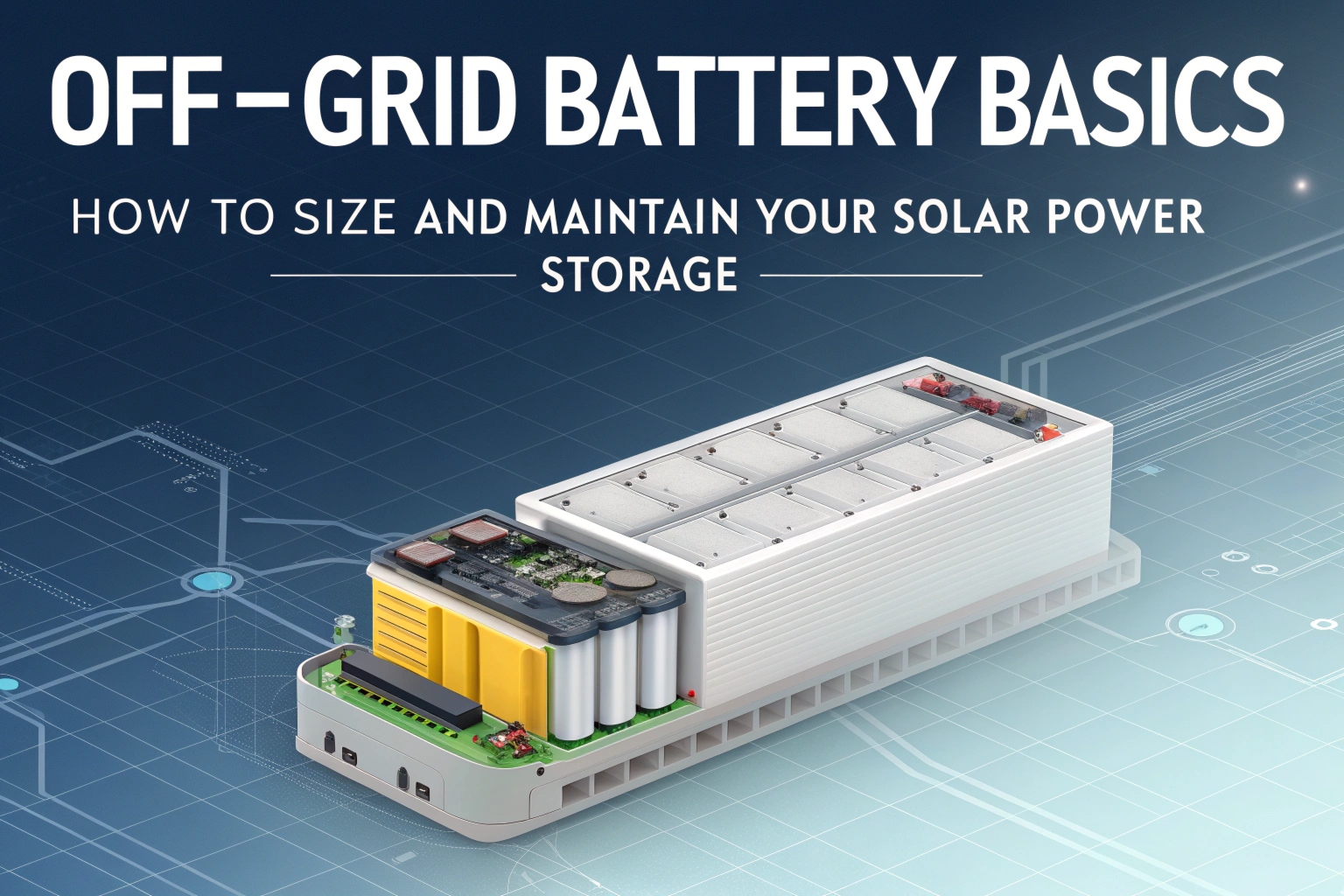
Off‑Grid Battery Basics: How To Size And Maintain Your Solar Power Storage
This guide walks you through the fundamentals of off‑grid batteries, how they work, how to size a battery bank for your needs, how to pair batteries with your solar array and inverter, and how to maintain batteries so they last as long as possible. You’ll get practical examples, formulas, and maintenance checklists you can use when planning or maintaining your system.
How batteries fit into an off‑grid system
You need batteries to store the energy your solar panels produce when the sun is shining so you have power when it is not. Batteries act as your system’s short‑term and multi‑day energy reservoir, smoothing out production and consumption and providing power after sunset or during cloudy weather.
A proper battery system design balances capacity, chemistry, charge/discharge rates, and maintenance needs to match your daily energy use and reliability goals.
Basic battery concepts you must understand
It helps to know a handful of terms that come up repeatedly: capacity (Ah and kWh), voltage, depth of discharge (DoD), round‑trip efficiency, charge/discharge rates (C‑rate), and cycle life. You’ll use these to calculate how large a battery bank must be and how it will behave over time.
Understanding these terms prevents oversizing or undersizing and helps you choose the right chemistry for your use case and budget.
Capacity: amp‑hours and kilowatt‑hours
Capacity is the total amount of energy a battery can store. You’ll see amp‑hours (Ah) and kilowatt‑hours (kWh). Amp‑hours depend on system voltage, while kWh is a direct energy measure.
To convert Ah to kWh use: kWh = Ah × Volts / 1000. This conversion will be used in sizing examples later.
Depth of Discharge (DoD)
DoD is the percentage of the battery’s usable capacity that you withdraw on a given cycle. The deeper you discharge a battery each cycle, the fewer cycles it will provide over its lifetime.
You’ll typically use conservative DoD values for lead‑acid batteries (20–50%) and more aggressive DoD for lithium batteries (80–95%).
Round‑trip efficiency
Round‑trip efficiency is how much energy you get back compared to what you put in after accounting for conversion and internal losses. If a battery has 90% round‑trip efficiency, charging with 1.0 kWh yields 0.9 kWh available for use.
You must account for efficiency losses when sizing both batteries and the PV array because you need to replace what is lost.
Battery chemistries and which you should choose
Different battery chemistries have different performance, maintenance, cost, and safety characteristics. Choosing the right chemistry is one of the most impactful decisions you’ll make.
Below is a table comparing common chemistries found in off‑grid systems.
| Chemistry | Typical Use | DoD Recommended | Cycle Life (approx) | Advantages | Disadvantages |
|---|---|---|---|---|---|
| Flooded Lead‑Acid (FLA) | Traditional off‑grid systems | 20–50% | 500–1500 | Low upfront cost, robust, easy to maintain | Needs maintenance (water), ventilation, heavy, shorter life |
| Sealed AGM | Small systems, modest maintenance | 30–50% | 400–1200 | Low maintenance, sealed, good cold performance | Lower cycle life than FLA when abused, cost higher |
| Gel | Specialty; not as common now | 40–50% | 500–1200 | Low maintenance, sealed | Sensitive to charging voltage, not ideal for high current |
| LiFePO4 (Lithium Iron Phosphate) | Modern off‑grid and hybrid systems | 80–95% | 2000–6000+ | High DoD, long life, light, fast charging, high efficiency | Higher upfront cost, needs BMS, less tolerant to abuse |
| Nickel‑iron (NiFe) | Long life specialty | 70–90% | 3000+ | Extremely long life, tolerant to abuse | Very inefficient, heavy, high maintenance, costly |
Selecting chemistry depends on your budget, weight/space constraints, willingness to perform maintenance, and desired system lifetime.
Step‑by‑step method to size your battery bank
Sizing your battery bank is a multi‑step process. You’ll estimate daily load, choose desired autonomy, pick system voltage, account for inefficiencies, and select battery capacity and configuration. Below are clear steps and formulas you can follow.
Step 1 — Calculate your daily energy load
Sum up the energy consumption of all appliances you plan to run from the off‑grid system over 24 hours. Use watts × hours for each appliance, then add them together to get daily kWh.
Example: If your total is 6,000 Wh per day, that’s 6 kWh/day.
Make a list of must‑have loads and optional loads so you can trim if battery size becomes impractical.
Step 2 — Decide on days of autonomy
Autonomy is how many days you want to rely on the battery without recharging (for example, during cloudy stretches). Typical choices are 1–3 days for well‑sited systems and 3–7 days for remote or critical systems.
More autonomy means a larger and more expensive battery bank.
Step 3 — Choose your allowableDepth of Discharge (DoD)
Select a safe DoD for your chosen chemistry. Use conservative DoD for lead‑acid and more aggressive DoD for lithium.
This choice directly affects required battery capacity: lower DoD means more capacity needed.
Step 4 — Account for system inefficiencies
Factor in round‑trip battery inefficiency, inverter losses, wiring losses, and charge controller efficiency. Typical combined losses range 10–20% depending on components.
If your inverter is 90% efficient and battery round‑trip efficiency is 90%, combined efficiency is roughly 0.9 × 0.9 = 0.81 or 81%. You’ll need more battery capacity to make up for these losses.
Step 5 — Calculate usable battery capacity and total required bank size
Use this formula:
Required battery bank size (kWh) = (Daily energy need × Days of autonomy) / (DoD × System efficiency)
Then convert kWh to Ah for your chosen system voltage:
Required Ah = (Required kWh × 1000) / System voltage
This gives you the battery bank capacity in amp‑hours at the system voltage.
Step 6 — Select battery configuration (voltage and bank arrangement)
Choose system voltage (12V, 24V, 48V are common). Higher voltage reduces current for the same power and usually improves efficiency and reduces wiring costs.
Decide how many batteries in series to reach the system voltage and how many parallel strings to reach required Ah.
Step 7 — Allow margin and round to available battery sizes
Add a safety margin (10–20%) for unexpected loads and to avoid running batteries flat. Choose battery modules available commercially and round up to the nearest practical size.
Below is a worked example to show you how these steps come together.
Worked sizing example
This example shows calculations for a 6 kWh/day household with 2 days autonomy using LiFePO4 batteries, 48V system, and realistic efficiencies.
| Parameter | Value | Notes |
|---|---|---|
| Daily energy need | 6 kWh/day | Sum of daily loads |
| Days of autonomy | 2 days | You want 2 full days without sun |
| DoD (LiFePO4) | 0.85 (85%) | Use conservative 85% usable |
| System efficiency (inverter × battery × other) | 0.85 (85%) | Example combined efficiency |
| Required kWh (before conversion) | (6 × 2) / (0.85 × 0.85) = ? | See steps below |
Step calculations:
- Raw stored energy required without losses: 6 kWh/day × 2 days = 12 kWh.
- Account for DoD and efficiency: Required battery kWh = 12 kWh / (0.85 × 0.85) = 12 / 0.7225 ≈ 16.61 kWh.
- Convert to amp‑hours at 48V: Required Ah = (16.61 kWh × 1000) / 48 V ≈ 345.9 Ah.
- Add margin (10%): 345.9 Ah × 1.1 ≈ 380.5 Ah.
So you’d select a 48 V battery bank with about 380–400 Ah usable capacity. If you buy modular LiFePO4 batteries rated 100 Ah at 48 V, you’d need four in parallel (since 4 × 100 = 400 Ah). If batteries are 12 V modules, you’d wire four in series to get 48 V, and then build parallel strings to reach 400 Ah total.
This example shows how DoD, efficiency, and autonomy multiply required capacity, so small changes in assumptions materially change battery size.

System voltage selection and why it matters
System voltage affects the current flowing through your wires and the sizing of components like inverters and charge controllers. Higher voltage systems (48V) have lower current for the same power compared to 12V or 24V systems, allowing smaller conductors and lower losses.
You should select a voltage that matches your inverter and battery options and keeps wiring manageable for your distance between panels, batteries, and loads.
Practical voltage guidance
- 12V: Good for very small systems (<1 kw) or where 12v appliances are used directly.< />i>
- 24V: Good middle ground for medium systems.
- 48V: Recommended for systems above ~3 kW. Most modern inverters and battery modules support 48V.
Battery bank arrangement: series and parallel explained
You’ll wire batteries in series to increase voltage and in parallel to increase capacity (Ah). Combining both lets you reach the desired system voltage and total energy storage.
Series wiring increases voltage while keeping Ah the same; parallel wiring increases Ah while keeping voltage the same. When creating parallel strings, ensure all batteries are identical and balanced; mismatched batteries cause uneven charging/discharging and shorten life.
Example configurations
If you need a 48V, 400 Ah bank using 12V 200 Ah batteries:
- You’d put four 12V batteries in series to make one 48V string (200 Ah).
- You’d then parallel two such strings to reach 48V at 400 Ah (because 200 Ah + 200 Ah = 400 Ah).
Always protect each string with fusing and use a battery management system (BMS) for lithium.
Charging sources and PV array sizing to replenish batteries
To recharge batteries, you need enough solar generation over the course of several days to replace used energy. Array size depends on daily load, average sun hours, battery efficiency, and desired charging window.
Use this simple formula for the PV array:
PV array required (kW) = Daily energy need (kWh) / Effective sun hours per day / System charging efficiency
System charging efficiency accounts for PV to battery conversion including MPPT controller and battery round‑trip efficiency (often 0.7–0.85 combined).
Example PV sizing
If you need to replenish 6 kWh/day and average effective sun hours are 5 hours/day and total charging efficiency is 75% (0.75):
PV kW = 6 / 5 / 0.75 = 1.6 kW of PV.
If you have limited sun or want faster charging after long outages, increase PV size or add a backup generator.
Charge controllers and battery charging stages
Your charge controller manages charging current from the PV array to the batteries. MPPT controllers are more efficient and recommended for most systems. Proper charging requires stages: bulk, absorption, and float, which ensure fast charging and full capacity without overcharging.
For lithium batteries, charging is simpler: bulk until near full and then taper, but you must respect charger voltage limits and use a BMS for cell-level protection. Lead‑acid batteries require float and occasional equalization for flooded types.
Charge controller selection
- Choose MPPT for maximum energy harvest, especially with 48V systems.
- Match the controller voltage to your array and battery bank voltage.
- Ensure charge current rating can handle your maximum PV output and any inverter charging contributions.
Battery management systems (BMS) and monitoring
A BMS is essential for lithium batteries and very helpful for any system. It protects against overcharge, overdischarge, overcurrent, and cell imbalance. Monitoring gives you state of charge (SoC), voltages, current flows, temperature, and historical performance.
Good monitoring helps you spot problems early, avoid deep discharge, and make smart decisions about load management.
Maintenance requirements by battery type
Maintenance differs significantly by chemistry. You’ll need to perform more physical maintenance on flooded lead‑acid batteries than on sealed lead‑acid or lithium. Maintenance tasks include water topping, terminal cleaning, equalization charging, capacity testing, and temperature monitoring.
Below is a compact maintenance checklist by battery type.
| Task | Flooded Lead‑Acid | AGM/Gel (Sealed Lead‑Acid) | LiFePO4 |
|---|---|---|---|
| Check and top up electrolyte | Weekly/Monthly as needed | Not applicable | Not applicable |
| Equalization charge | Monthly/As needed | Rare; consult manufacturer | Not recommended |
| Terminal cleaning | Monthly/Quarterly | Quarterly | Quarterly |
| Specific gravity check | Monthly | Not applicable | Not applicable |
| Temperature monitoring | Continuous advisable | Continuous advisable | Critical for extremes |
| BMS / cell balancing check | Not applicable | Not common | Essential |
| Load testing / capacity check | Annually | Annually | Annually or as needed |
You’ll need a proper maintenance plan tailored to the battery type you select.
Flooded lead‑acid maintenance details
Flooded batteries require distilled water to be added when electrolyte levels fall below recommended marks. You’ll also need to keep terminals clean and vents unobstructed, and perform periodic equalization charges to mix the electrolyte and prevent stratification and sulfation.
This maintenance can extend battery life significantly but requires consistent attention and proper safety precautions.
Lithium maintenance details
Lithium batteries require minimal routine maintenance, but you must ensure the BMS is functioning, avoid overheating, and protect against deep discharge and overcharging. Proper charging equipment and firmware updates (if applicable) help optimize life.
Temperature can be decisive: LiFePO4 batteries tolerate a wide range but should not be charged below freezing unless the manufacturer allows it and provides a heating strategy.
Common battery problems and troubleshooting steps
Batteries can fail prematurely for many reasons. The common issues are sulfation (lead‑acid), cell imbalance (lithium), overcharging, undercharging, deep discharge, high ambient temperature, and physical damage.
Below are troubleshooting approaches you can use.
- Low capacity: Check state of health (SoH) with a load test. For lead‑acid, check specific gravity across cells and look for sulfation. For lithium, check BMS logs for cell imbalance.
- Rapid self‑discharge: Inspect for parasitic loads, check for faulty cell or module, ensure proper isolation and disconnects.
- Uneven voltages between parallel strings: Rebalance or equalize; inspect for mismatched batteries or degraded cells and match age/brand/specs when replacing.
- Charging not reaching full: Verify charge controller settings, check wiring and connectors, check for high charge temperature or incorrect charge profile.
Keeping a log of charging voltages, temperatures, and load patterns helps you identify gradual failures before they become critical.
Safety, installation, and ventilation
Safety is critical. Batteries can release hydrogen gas (flooded lead‑acid), can overheat, and can deliver lethal currents if shorted. Follow these safety guidelines.
- Install batteries in a dedicated space with appropriate ventilation if using flooded lead‑acid. Ventilation should be passive or forced depending on size.
- Use proper fusing on each positive conductor, and place a main disconnect close to the batteries.
- Use insulated tools to prevent shorts, and maintain clear labeling for batteries and breakers.
- Secure batteries to prevent movement and intrusion by pests or moisture.
- For lithium installations, follow the manufacturer’s recommendations for charging current limits, temperature ranges, and BMS configuration.
Always obey local electrical codes and use a licensed electrician for complex installations.
Cost, lifetime, and lifecycle economics
Upfront cost and lifetime cost per kWh are crucial for your decision. Lithium has a higher upfront cost but often lower total cost of ownership due to longer cycle life and higher usable capacity. Lead‑acid has lower initial cost but needs replacement sooner.
Consider total lifecycle cost:
Total cost per useful kWh = (Total system cost over life) / (Total kWh delivered over life)
This metric will often show lithium as more economical over 8–10 years, especially in high‑use scenarios where deeper cycles are common.
End of life and recycling
Batteries must be recycled appropriately. Lead‑acid batteries have well‑established recycling streams with high recovery rates. Lithium battery recycling is improving but requires proper collection and specialized facilities.
Plan for end‑of‑life by identifying local recycling options and budgeting for replacement costs every X years depending on the chemistry chosen.
Monitoring, record keeping, and performance tuning
You get better results if you monitor system performance and keep records. Track daily energy production, battery state of charge, number of cycles, charge/discharge currents, and temperatures. Look for trends that indicate capacity loss or charging inefficiencies.
Regularly update settings on charge controllers as seasons change and adjust load schedules to preserve battery life during low‑production months.
Tools for monitoring
- Dedicated battery monitors (e.g., shunt‑based monitors) for accurate Ah and SoC tracking.
- Inverter/charger and BMS logs accessible via local display or cloud services.
- Simple data logging with voltage and current sensors if you’re building a custom monitoring solution.
Practical tips to extend battery life
- Avoid deep discharges whenever possible; keep average DoD lower than the maximum recommended.
- Charge batteries promptly after significant discharge to reduce sulfation risk in lead‑acid types.
- Avoid high temperatures; keep batteries in a cool, stable environment.
- Match battery bank components by age and capacity; don’t mix old and new batteries in the same bank.
- Use a quality MPPT charge controller and configure charge voltages to manufacturer recommendations.
- For lead‑acid, schedule regular equalization where appropriate.
- For lithium, ensure a functioning BMS and avoid charging if temperatures are outside safe ranges.
Implementing these practices can extend battery life by years and improve system reliability.
Example maintenance schedule you can adopt
Below is a suggested maintenance schedule you can apply and adapt to your system’s size and chemistry.
| Frequency | Tasks |
|---|---|
| Daily | Check system status on your monitor; ensure no alarms. |
| Weekly | Visual inspection for corrosion, leaks, or unusual odors. |
| Monthly | Record voltages, currents, and temperatures; clean terminals. |
| Quarterly | Test battery voltages under load; check equalization needs (FLA). |
| Annually | Capacity test; detailed inspection; update firmware for inverter/BMS. |
| As needed | Top up distilled water (FLA); address alarms and imbalance issues. |
Keep a simple logbook or digital file to track these activities and any corrective steps you take.
Frequently asked design questions
You’ll probably have a few recurring questions while planning. Here are quick answers to common concerns.
Q: Should I oversize the battery bank?
A: A modest oversize (10–20%) provides resilience and reduces average DoD, improving life. Oversizing excessively raises cost and idle capacity.
Q: Can I mix different battery brands or ages?
A: Avoid mixing. Batteries of different ages or chemistries will imbalance and shorten life. If you must replace, replace entire strings with matched units.
Q: How many cycles will my battery provide?
A: Cycle life depends on chemistry and DoD. LiFePO4 often provides thousands of cycles at moderate DoD. Lead‑acid provides fewer cycles and degrades faster with deep discharges.
Q: What’s better for extreme cold?
A: Lithium batteries require special attention in cold; some LiFePO4 have internal heaters or allow charging only above certain temperatures. Lead‑acid performs poorly in cold too but is more tolerant to charging while cold if properly managed.
Final checklist before you install or upgrade
Use this final checklist to confirm your system design is complete and safe:
- You’ve tallied realistic daily loads and prioritized critical loads.
- You’ve chosen days of autonomy suitable for your location and risk tolerance.
- You’ve selected a battery chemistry that matches your budget, maintenance willingness, and lifetime goals.
- You calculated battery capacity accounting for DoD, efficiency, and margin.
- You selected system voltage and configured series/parallel arrangement accordingly.
- You sized PV array and charge controller to recharge batteries within desired windows.
- You planned for proper ventilation, fusing, grounding, and disconnects.
- You included a monitoring system and maintenance plan.
- You verified recycling and replacement options for end of life.
Completing this checklist reduces surprises during commissioning and operation.
Conclusion — practical next steps you can take today
Start by making a realistic inventory of your loads and collecting climate data (average sun hours, temperature ranges) for your site. Use the sizing steps in this guide to create an initial battery bank design, then compare battery chemistries and component costs. If you’re uncertain, contact a qualified installer to review your design and local code requirements.
If you perform regular monitoring and follow the maintenance practices described here, your off‑grid battery bank will deliver reliable power and maximize lifetime value. With the right planning and upkeep, you’ll keep the lights on, protect critical loads, and make your off‑grid system a dependable part of your life.