
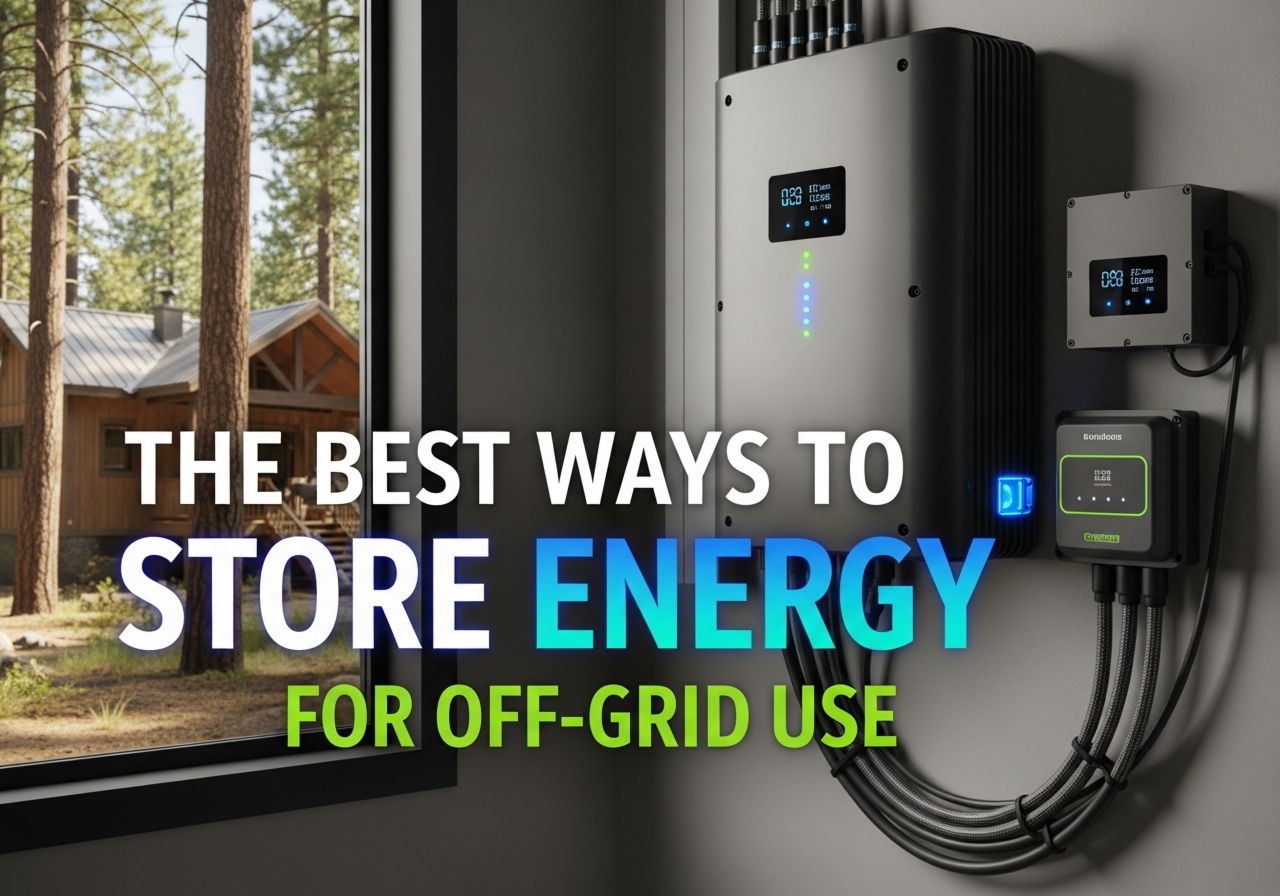
Have you ever wondered which way to store energy will feel least like a puzzle and most like a good, steady plan when you cut loose from the grid?
The Best Ways To Store Energy For Off-Grid Use
You’re standing at a modest crossroads: plenty of sunlight, a gusty ridge, or a roaring woodstove—and you want your lights, fridge, phone, and maybe a workshop to keep working when the utility lines aren’t an option. Storing energy off-grid isn’t romantic; it’s practical. But the choices you make determine how often you’ll top up batteries, how much space you’ll need, how careful you’ll be about temperature, and whether you’ll laugh about your decision or curse it in a snowstorm. This article walks you through the options, the trade-offs, and the honest calculations so you can pick what suits your life and your site.
The basics: what you really need to understand
Before you pick a technology, you should be fluent in a few small but crucial ideas. These are the rules that govern cost, performance, and how often you’ll need to tinker.
Energy vs. power
Energy (kWh) is how much you use over time; power (kW) is how fast you use it. If you want to run a microwave and a heater at once, you need sufficient power capacity. If you want to be self-reliant for several cloudy days, you need sufficient energy capacity.
Round-trip efficiency
This is the fraction of energy you get back versus what you put in. A battery with 90% round-trip efficiency loses 10% during charging and discharging; hydrogen systems can be 30–50% when you include conversion losses.
Depth of discharge (DoD) and cycle life
DoD is how much of a battery’s capacity you use per cycle. If a battery is rated 80% DoD, using more reduces life. Cycle life is how many full cycles it can do before capacity falls to a threshold (often 80%). If you run deep cycles frequently, life shortens.
C-rate (charging/discharging speed)
This tells you how fast you can safely charge or discharge relative to capacity. A 1C battery can be fully charged or discharged in an hour; 0.5C in two hours. Higher C-rates stress some chemistries.
Energy density and power density
Energy density (Wh/kg) matters where weight is a concern (trailers, boats). Power density (W/kg) matters where short bursts of high power are needed.
Self-discharge and temperature sensitivity
Some systems lose stored energy over time when idle. Batteries and many chemical systems also suffer in extremes—cold reduces capacity, heat shortens life.
Battery technologies (the most common off-grid choice)
Batteries are the default for most off-grid homes and cabins. They’re relatively simple to size and install compared with pumped hydro or hydrogen. But “battery” covers many chemistries; each behaves differently.
Flooded lead-acid (FLA)
You probably know these from cars and old solar setups. They’re heavy, inexpensive per kWh upfront, and require routine maintenance like topping up with distilled water and periodic equalization charges.
- Pros: Low initial cost, proven technology, tolerant of overcharging when properly managed.
- Cons: Low cycle life, poor deep discharge tolerance, heavy, need ventilation for hydrogen gas, maintenance required.
- Typical use: Budget-conscious setups where weight and space are not limiting and you can do maintenance.
Sealed lead-acid (AGM, Gel)
Sealed lead-acid batteries require less maintenance. AGM is common; gels are less tolerant of fast charging.
- Pros: Low maintenance, cheaper than lithium, reliable for low-cost installs.
- Cons: Lower cycle life and DoD than lithium, more expensive than flooded lead-acid per usable kWh, less tolerant of deep discharge.
- Typical use: Small cabins or backup power where you want less maintenance.
Lithium Iron Phosphate (LiFePO4 / LFP)
LFP is the most common lithium chemistry for stationary off-grid systems. It’s safer than NMC in thermal events and offers excellent cycle life.
- Pros: High usable DoD (often 80–100%), long cycle life (2,000–5,000+ cycles), compact and lightweight, high efficiency (often 90–98%), low maintenance.
- Cons: Higher upfront cost (though cost has fallen), needs a proper Battery Management System (BMS), sensitive to overcharging if not correctly managed.
- Typical use: Homes, cabins, workshops where long life and low maintenance matter.
Other lithium chemistries (NMC, LCO, etc.)
These have higher energy density (used more in EVs) but can be less thermally stable than LFP. For stationary off-grid uses, LFP is generally preferred due to safety and long life.
Flow batteries (vanadium redox, others)
Flow batteries store energy in liquid electrolyte tanks. The power output depends on the size of the stack; energy capacity depends on tank size.
- Pros: Long cycle life, easy to increase energy capacity by adding electrolyte tanks, good for daily cycling.
- Cons: Lower round-trip efficiency than lithium, higher upfront complexity, footprint and plumbing required.
- Typical use: Larger off-grid microgrids or where long-duration energy storage (many hours to days) is needed.
Mechanical and thermal storage
Not everything is chemical. Mechanical and thermal approaches can be excellent, depending on your site.
Pumped hydro
You pump water uphill to store energy, then let it flow back through turbines.
- Pros: High efficiency (70–85%), long life, large capacity for relatively low cost per kWh at scale.
- Cons: Requires specific geography (elevation difference and water availability), environmental permitting, not practical for many home sites.
- Typical use: Rural microgrids with suitable terrain.
Gravity (solid mass) storage
Newer systems use heavy weights raised and lowered to store energy. These are like miniature pumped hydro without water.
- Pros: Long life, simple concept, potentially low environmental impact.
- Cons: Low energy density, requires tall structures or heavy masses, current commercial options are less widespread.
- Typical use: Experimental or community-scale projects.
Compressed air energy storage (CAES)
Air is compressed and stored under pressure, then expanded to generate power.
- Pros: Large capacity potential, certain implementations use underground caverns.
- Cons: Low round-trip efficiency unless heat is recovered, requires special geology or bulky tanks.
- Typical use: Large-scale or clustered off-grid installations with available storage space.
Thermal storage: hot water, phase change materials (PCM)
If your primary needs include heating and hot water, thermal storage might be the most efficient way to use excess energy.
- Pros: Very efficient for housing heat needs, relatively inexpensive materials, simple systems.
- Cons: Not useful for powering electronics or appliances directly unless paired with heat engines or thermoelectrics (which reduce efficiency).
- Typical use: Off-grid homes focusing on heating, water heating, or process heat.
Chemical carriers: hydrogen and biofuels
Storing energy as a fuel instead of electricity can make sense in certain situations.
Hydrogen (electrolysis → storage → fuel cell)
You use excess electricity to split water, store hydrogen, and later use it in a fuel cell or engine.
- Pros: High energy per mass, can be stored long-term, useful when you need transportation fuel or chemical feedstock.
- Cons: Low overall round-trip efficiency (often 30–50% when converting back to electricity), requires compression or cryogenic storage, safety concerns, high capital cost for electrolysis and fuel cells.
- Typical use: Remote sites needing long-term seasonal storage, heavy transport fuel, or where you have a use for hydrogen directly.
Liquid fuels and biomass
You can store energy as diesel, propane, or biomass. Generators can then convert chemical energy to electricity on demand.
- Pros: High energy density, established generator technology, easy long-term storage.
- Cons: Fuel logistics, emissions, noise, ongoing fuel cost, generator maintenance.
- Typical use: Backup generation or remote sites where fuel resupply is feasible.
Flywheels and supercapacitors
These shine where you need quick bursts of power or smoothing of short-term fluctuations.
- Flywheels: Store rotational energy, high efficiency, long life, best for short-term power smoothing and UPS applications.
- Supercapacitors: Extremely high power density and long cycle life, but low energy density—good for bridging short outages or regenerative braking in hybrid systems.
Comparison table: quick reference
| Technology | Typical Round-Trip Efficiency | Cycle Life | Energy Density (Wh/kg) | Best Use Case | Typical Maintenance |
|---|---|---|---|---|---|
| Lead-Acid (Flooded) | 70–85% | 300–1,000 | 30–50 | Budget systems, stationary where weight isn’t a concern | Regular water topping, equalization |
| AGM/Gel | 70–85% | 300–1,200 | 30–50 | Low-maintenance small systems | Minimal maintenance |
| LiFePO4 (LFP) | 90–98% | 2,000–5,000+ | 90–160 | Domestic off-grid systems | BMS checks, minimal |
| Flow Battery | 65–85% | 5,000–10,000+ | 20–50 | Long-duration cycling, scalable storage | Electrolyte management |
| Pumped Hydro | 70–85% | 25+ years | n/a (site-dependent) | Large-scale storage with elevation | Civil works maintenance |
| Compressed Air | 40–70% | 2,000–10,000 | n/a | Large scale with suitable geology | Pressure vessel inspections |
| Hydrogen (fuel cell) | 30–50% | 5,000+ (system) | 1,200+ (H2) | Seasonal storage, fuel use | Electrolyzer & cell maintenance |
| Flywheel | 85–95% | 100,000s cycles | 10–50 | Short-term smoothing | Bearings, vacuum pumps |
| Thermal (hot water/PCM) | 80–95% (for heat) | Long | n/a | Space & water heating | Tank/insulation maintenance |
Note: These are ranges; exact numbers depend on manufacturers, system design, and operating conditions.
How to size storage for your off-grid life
You can approach sizing methodically so you don’t overbuy—or underbuy in a way that leaves you lighting candles.
Step 1: Determine daily energy use (kWh/day)
Track your usage for a week or more. Include lighting, fridge, pumps, appliances, and any tools. Be realistic about seasonal changes.
Example:
- Lighting, small electronics: 3 kWh/day
- Refrigerator: 2.5 kWh/day
- Water pump: 1 kWh/day (intermittent)
- Cooking (electric): 4 kWh/day (or substitute propane) Total = 10.5 kWh/day
Step 2: Decide autonomy days
How many days do you want to go without charging? 1–3 days is common for solar-dependent cabins; 5–14+ for remote homes or places with long cloudy seasons.
If you choose 3 days autonomy: required energy = 10.5 × 3 = 31.5 kWh
Step 3: Account for system losses and DoD
If you use LiFePO4 with 90% round-trip efficiency and you’re comfortable with 80% DoD:
- Needed battery capacity = Required energy / (DoD × efficiency)
- = 31.5 / (0.8 × 0.9) ≈ 43.75 kWh
Round up to practical module sizes; you might pick a 48 kWh battery bank.
Step 4: Size inverter and peak power
Add up simultaneous loads to pick inverter power rating. Include surge capacity for motors. If you expect 3.5 kW continuous with 7 kW motor starts, pick an inverter supporting those figures.
Step 5: Allow for growth and temperature derating
If you later add a freezer or workshop tools, factor an extra 10–30%. Cold climates reduce battery usable capacity: apply derating or plan for insulated enclosures with battery heating.
Practical example: Tiny cabin vs. family home
Tiny cabin:
- Load: 2.5 kWh/day
- Autonomy: 3 days → 7.5 kWh
- With LFP (80% DoD, 95% eff): Battery = 7.5 / (0.8 × 0.95) ≈ 9.9 kWh → choose 10–12 kWh bank
- Solar PV: 1.5 kW array might suffice depending on insolation
Family home:
- Load: 20–40 kWh/day
- Autonomy: 3–7 days → 60–210 kWh
- LFP bank and likely hybrid system with generator or additional generation (wind, micro-hydro)
System components you must consider
Batteries are only part of the system. The rest makes it safe and usable.
- Charge controller (MPPT for solar): matches PV to battery, maximizes harvest.
- Inverter/charger: converts DC to AC, handles generator charging when needed.
- Battery Management System (BMS): essential for lithium batteries for cell balancing, over/under voltage protection, and safe operation.
- Fuses, disconnects, and breakers: protect circuits and personnel.
- Monitoring & control: logs and alarms help you manage usage and detect faults early.
- Cabling and connectors sized for expected currents.
- Ventilation and thermal management: crucial for lead-acid and some other chemistries.
- Enclosure: fire-resistant where required, secure and dry.
Installation, safety and legal considerations
You’ll sleep better if your system is installed right.
- Location: batteries like moderate temperatures. Lithium prefers 10–30°C. Lead-acid prefers cool but not freezing.
- Ventilation: flooded lead-acid emits hydrogen; install in a ventilated area away from sleeping spaces.
- Fire risk: lithium can have thermal runaway if mistreated; follow manufacturer spacing and fire suppression recommendations.
- Structural: batteries and heavy equipment need proper supports and anchoring.
- Codes and permits: many places require electrical permits and inspections. Talk to local authorities before installation.
- Recycling: plan for end-of-life disposal. Many battery merchants accept old batteries for recycling.
Maintenance by technology
- Lead-acid (flooded): check water, equalize regularly, clean terminals, check specific gravity if you have a hydrometer.
- AGM/Gel: terminal cleaning and periodic capacity checks; fewer daily tasks.
- LiFePO4: minimal routine maintenance, but monitor through BMS and periodic capacity testing. Ensure firmware updates on system components as applicable.
- Flow batteries: electrolyte monitoring and occasional pump maintenance.
- Mechanical/thermal: inspect mechanical components, seals, insulation.
Costs and lifecycle thinking
Money doesn’t exist in a vacuum; cost per usable kWh over system life matters more than sticker price.
- Lead-acid: low upfront cost but shorter life—cost per kWh over life can be higher due to replacements.
- LFP: higher upfront, but longer life and lower operating cost—often the most economical over 10+ years for frequent cycling.
- Generators/fuels: lower capital but recurring fuel cost and higher emissions.
Rough ballpark (very approximate; vary by region and year):
- Lead-acid installed: $300–600 per usable kWh (depending on lifespan assumptions)
- LFP installed: $400–900 per usable kWh (falls with scale and as markets mature)
- Flow battery: higher upfront, but designed for long-duration cycling—varies widely Remember to include installation, balance-of-system, and inverter costs.
Practical tips that people miss
- Don’t oversize inverter relative to battery capacity without considering surge demands. Large inverters idle-drain can eat small batteries.
- Use DC loads where practical (12–48V appliances) to avoid inversion losses.
- Prioritize efficient appliances: an efficient fridge saves far more battery than any inverter tweak.
- Think hybrid: a small generator for long cloudy stretches plus a robust battery bank often beats oversized storage alone.
- Second-life EV batteries can be a bargain, but inspect modules carefully and ensure a proper BMS.
Choosing a system for your situation
You’ll choose based on site, budget, lifestyle, and temperament.
- If you like tinkering and don’t mind maintenance: flooded lead-acid can be economical.
- If you want low maintenance, compact size, long life, and don’t mind higher up-front cost: LiFePO4 is usually the best fit.
- If you have elevation and water: pumped hydro can be a brilliant long-term solution.
- If you need long-term or seasonal storage and have industrial-scale resources: hydrogen may be appropriate.
- If you need short, frequent bursts or UPS-level reliability: combine batteries with flywheels or supercapacitors.
Example setups by profile
- Off-grid weekend cabin (simple, low maintenance): 1–3 kW solar array, 10–12 kWh LFP battery bank, 3 kW inverter, MPPT controller.
- Family off-grid home (year-round): 6–12 kW solar, 40–100 kWh LFP bank, hybrid inverter/charger, 5–10 kW backup generator, heating system partly on wood/gas.
- Remote research station (high autonomy): Diverse generation (solar + wind + micro-hydro), 200–500 kWh storage (flow battery or large LFP bank), generator for redundancy.
- Small farm or workshop (high power tools): Focus on inverter sizing and surge capacity; 40–100 kWh LFP bank, robust wire sizing, likely a generator for belt-sander usage.
Planning for the future
As you plan, keep some forward-thinking points in mind:
- Scalability: pick systems that let you add modules as needs grow.
- Interoperability: prefer equipment that works with standard protocols and has good documentation.
- Reuse & recycling: ask suppliers about recycling programs and long-term warranties.
- Regulations: watch for changing fire codes, incentive programs, and import tariffs that can influence cost and options.
- Second-life batteries and community microgrids will change the economics—stay open to retrofitting.
Checklist before you buy or install
- Have you measured realistic daily energy use for a typical week and a peak-week scenario?
- Have you decided on target autonomy days and factored in worst-month weather?
- Did you size batteries with DoD, round-trip losses, and temperature derating in mind?
- Is your inverter sized for continuous and surge loads?
- Have you planned for ventilation, safety, and permitting?
- Do you have a maintenance plan and a path for eventual recycling or disposal?
Final guidance: balancing heart and head
When you strip away the jargon, what you want is a system that fits your life: reliable, not fiddly, and not ruinously expensive. You’ll find yourself making trade-offs—weight versus cost, upfront cost versus lifetime cost, low maintenance versus simplicity. A small, well-sized LiFePO4 bank often makes sense for most modern off-grid homes because it reduces maintenance and gives you predictable performance. But the right answer for you might be a hybrid: batteries for daily cycles, a generator for long outages, thermal storage for heating needs, and a little careful efficiency work to lower the whole system’s requirements.
Make a plan, size conservatively, buy with an eye toward warranties and support, and place batteries where they’ll be safe and last. You’ll sleep better, your lights will stay on, and your decisions will age well.
If you want, tell me the details of your likely loads, your climate, and how many days of autonomy you want, and I’ll help you sketch a concrete system and rough cost estimate.