
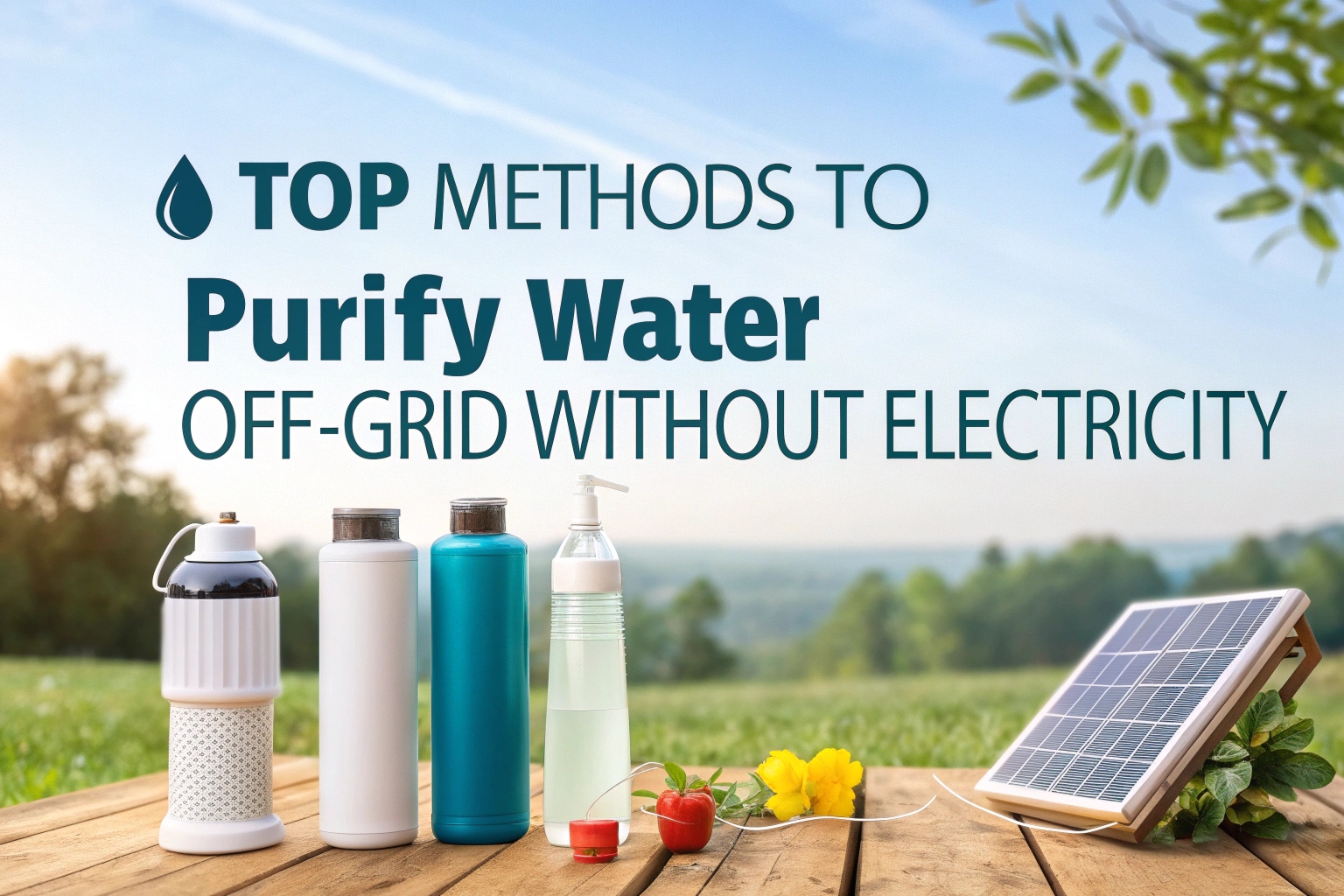
What will you do when your water source is questionable and you have no electricity to rely on?

Top Methods To Purify Water Off‑Grid Without Electricity
You can make safe drinking water without mains power if you know the right methods and follow careful steps. This guide gives you practical options, simple builds, and safety tips so you can treat water reliably while off‑grid.
Why Off‑Grid Water Purification Matters
When you’re off the grid, natural water sources can have microbes, sediment, or chemical contamination that make you sick. Being prepared with knowledge and basic gear reduces risk and keeps you healthy.
Health risks from contaminated water
Contaminated water can cause diarrheal disease, fever, and longer‑term health problems if chemicals are present. Protecting yourself means understanding the hazards and choosing the right method for the contamination type.
Common off‑grid sources and their issues
Streams, rivers, lakes, springs, wells, rainwater, and coastal sources each carry different risks—microbes in surface water, nitrates in some wells, and salts in seawater. Assessing the source helps you pick the most effective treatment.
Know Your Contaminants
Identifying whether your main problem is biological, physical, or chemical influences which purification method will work best. You’ll use prefiltration, disinfection, or distillation depending on the contaminant.
Biological contaminants: bacteria, viruses, protozoa
Bacteria and protozoa are common in surface water, and some treatments remove them easily while others don’t. Viruses are smaller and require either chemical disinfection, boiling, or specific fine filtration to remove.
Chemical and heavy metal contaminants
Chemicals, pesticides, and heavy metals won’t be neutralized by boiling or simple filtration. You need activated carbon, ion exchange, distillation, or reverse osmosis to remove many chemical contaminants.
Sediments and turbidity
Turbid water reduces the effectiveness of disinfection by shielding microbes and consuming disinfectant. Prefiltration with cloth, sedimentation, or sand filters improves the performance of subsequent treatment.
How to Test and Assess Your Water Source
Quick checks and basic test kits tell you if the water is visibly contaminated or if you need more advanced treatment. Visual and smell tests are the first step before committing to a method.
Visual, smell and basic field tests
Look for color, floating debris, oil sheen, or unusual odors before treating water. If water is cloudy or has an off smell, you should prefilter and consider chemical tests before drinking.
Field test kits and portable meters
You can buy portable kits for chlorine residual, pH, nitrates, coliforms, and turbidity that are practical off‑grid. Keep one kit with your gear so you can make informed choices about long‑term water use.
Key Principles for Off‑Grid Purification
A reliable approach separates removal of solids from disinfection and addresses persistent chemical contaminants independently. Always use redundancy when possible.
Remove solids first, then disinfect
Start with cloth strainers or settling to remove debris and reduce turbidity. That makes boiling, chemical disinfection, or filters far more effective.
Contact time, concentration and temperature
Chemical disinfectants need correct concentration and time to work; heat kills microbes faster at higher temperatures. Know the contact times and adjust for cloudy water or cold conditions.
Redundancy and storage
Combining methods — for example prefilter + disinfection + activated carbon polishing — gives extra safety. Store treated water in clean, sealed containers to prevent recontamination.
Top Methods (Overview)
Below are proven off‑grid methods you can use without electricity, with practical notes on strengths and limitations. Use them alone or combine for added safety.
Boiling (over fire, wood stove, or camp stove)
Boiling is simple and kills bacteria, viruses, and protozoa reliably. You should bring the water to a rolling boil for at least 1 minute (3 minutes at elevations above 2,000 meters) and let it cool in a covered container.
Solar Disinfection (SODIS)
SODIS uses sunlight to inactivate microbes in clear PET bottles and works best in strong sun. Place 1–2 liter PET bottles on a reflective surface for at least 6 hours in full sun, or up to 2 days in cloudy conditions; water must be low turbidity for best results.
Solar Pasteurization and Solar Cookers
Solar cookers can heat water to pasteurization temperatures (about 65°C / 149°F) where most pathogens are killed. Pasteurization uses less energy than boiling and is suitable for larger volumes when you have a cooker or parabolic reflector.
Solar Stills (distillation)
A solar still evaporates water from soil or contaminated sources and condenses it as pure water, removing salts, microbes, and many chemicals. Yields are small but the water is high quality; set a still properly and expect low daily volumes unless you build a larger array.
Distillation by Heat (stove or campfire)
Distillation (boil then condense steam) removes salts and many contaminants by phase change. You can rig a pot with a lid and cooling coil to collect condensate — this is energy‑intensive but effective against chemical contamination and seawater.
Sand and Biosand Filters
Slow sand and biosand filters use layers of sand and a biological layer (schmutzdecke) to remove bacteria and protozoa and reduce turbidity. They’re low maintenance once established and good for household scale off‑grid systems.
Ceramic Candle and Pot Filters
Ceramic filters trap microbes in micropores while allowing flow by gravity and can be combined with activated carbon to improve taste. They remove bacteria and protozoa well but typically don’t remove viruses unless the ceramic has silver impregnation and pore size supports virus reduction.
Gravity Bag Filters (e.g., Sawyer, other membrane filters)
Lightweight gravity filters use hollow fiber membranes to remove bacteria and protozoa. They’re suitable for camping or short‑term off‑grid use and require no power — just hang a contaminated water bag and let gravity push water through the membrane.
Hand Pump Filters
Manual pump filters let you force water through fine membranes and often include carbon polishing. They remove microbes and improve taste, but pumps require physical effort and occasional maintenance.
Activated Carbon / Charcoal Filtration
Activated carbon adsorbs chlorine, organics, and improves taste and odor; it does not reliably remove microbes or salts. Use carbon as a final polishing stage after disinfection for better flavor and chemical reduction.
Chemical Disinfection: Chlorine (bleach) and Chlorine Dioxide
Chlorine (sodium hypochlorite) is effective against bacteria and most viruses and some protozoa, given sufficient contact time and proper dose. Chlorine dioxide tablets and solutions are more effective against protozoan cysts and in cloudy water, and they produce fewer by‑products, but you must follow manufacturer dosing carefully.
Iodine Disinfection
Iodine tablets or tinctures disinfect water by killing microbes and viruses, but iodine is not recommended for long‑term use, pregnant women, or people with thyroid conditions. Use only as an emergency short‑term measure and follow product instructions.
Water Purification Tablets (mixed compounds)
Tablet formulations often contain chlorine, chlorine dioxide, or iodine and are compact and easy to carry. They’re convenient for travel and emergency kits and include instructions for contact times and water clarity limits.
Coagulation and Flocculation (alum, natural coagulants)
Flocculants let solids settle and reduce turbidity, making disinfection more effective. You can use alum or natural agents (e.g., crushed moringa seeds) to clarify highly turbid water before filtration or disinfection.
Cloth, Mesh, and Sedimentation
Simple cloth or mesh removes large particles quickly and helps your other methods work better. Use multiple layers of clean cloth to prefilter, and allow turbid water to sit so sediment settles before decanting clear water.
Comparative Table of Methods
| Method | Removes Bacteria | Removes Viruses | Removes Protozoa (cysts) | Removes Chemicals/Heavy Metals | Reduces Turbidity | Requires Fuel/Tools | Typical Flow / Yield | Maintenance |
|---|---|---|---|---|---|---|---|---|
| Boiling (fire/stove) | Yes | Yes | Yes | No | No | Fuel (wood, gas) | Batch (liters/hour) | Low |
| SODIS (PET bottles) | Yes (solar‑sensitive) | Partially | Partially | No | Requires low turbidity | Sunlight, bottles | Small (liters/day) | Low |
| Solar still | Yes | Yes | Yes | Removes many volatiles partially | Yes | Plastic sheeting, pit | Very low (liters/day) | Low |
| Distillation (condensing steam) | Yes | Yes | Yes | Good | Yes | Heat source, tubing | Moderate (depends on fuel) | Moderate |
| Biosand filter | Yes | No/limited | Yes | Some organic reduction | Good | Sand, container | Household rate | Periodic cleaning |
| Ceramic filter | Yes | Limited | Yes | Some (with carbon) | Good | Candle element | Moderate | Clean, replace |
| Gravity membrane | Yes | Limited | Yes | No | Good | Bag, membrane | Moderate | Backwash |
| Hand pump filter | Yes | Limited | Yes | Some with carbon | Good | Pump, filter | Moderate | Cartridge change |
| Activated carbon | No | No | No | Yes (organics) | No | Carbon vessel | Depends | Replace carbon |
| Chlorine (bleach) | Yes | Yes | Limited | No | No | Bleach, measuring | Quick | Store bleach |
| Chlorine dioxide | Yes | Yes | Better vs cysts | Some | No | Tablets/solution | Quick | Store tablets |
| Iodine | Yes | Yes | Limited | No | No | Tablets/tincture | Quick | Not for long-term |
| Coagulation/flocculation | No | No | No | No | Yes | Chemicals, settling | Batch | Clean sludge |
(Notes: “Limited” indicates partial effectiveness; specific product specs and contact times change performance. Combine methods for best results.)
How to Build Key Off‑Grid Systems
These step‑by‑step instructions give you practical ways to make water safer without electricity.
How to set up SODIS (solar disinfection)
Use clean, clear 1–2 liter PET bottles without labels; rinse them and fill with relatively clear water. Place bottles on a roof or reflective surface in full sun for at least 6 hours; if it’s cloudy, extend to 24–48 hours and ensure turbidity is low (under ~30 NTU) by prefiltering through cloth.
How to construct a DIY biosand filter
Use a 60–200 cm tall container (food‑grade drum or large bucket). Layer coarse gravel at the bottom for drainage, then finer gravel, then washed fine sand on top; run water slowly through the sand so a biological layer forms over 2–4 weeks, and maintain by scraping the top few centimeters when flow declines.
How to build a simple solar still
Dig a pit and put a collection container in the center; fill the surrounding area with contaminated water or damp material. Cover the pit with clear plastic, secure the edges with rocks, and place a small stone in the center so condensed water drips into the container. The still yields low volumes but produces distilled water free of salts and microbes.
How to distill water with a pot and coil
Boil water in a covered pot and channel steam through a metal or copper coil cooled by running water or immersion in cool water. Collect condensate in a clean container. This removes salts and many dissolved contaminants but requires an efficient setup and fuel.
DIY activated carbon filter (polishing stage)
Crush charcoal to small granules, rinse thoroughly to remove dust, then fill a container layer above sand or a ceramic element. Pass chlorinated or filtered water through carbon to reduce taste and organic compounds; replace carbon periodically when flow slows or taste returns.
Combining Methods Effectively
You get the best results when you combine filtration, disinfection, and polishing. For example, use cloth and sedimentation, then a sand or ceramic filter, then chemical disinfection or carbon polishing to address taste and residual organics.
Example combinations for common scenarios
- Camping creek water: Cloth prefilter → gravity membrane or pump filter → carbon polishing if taste is bad.
- Rainwater storage: First‑flush diverter → storage tank with cover → occasional chlorination or UV (if solar battery available) to guard against contamination.
- Coastal or brackish water: Solar still or distillation for desalination → carbon polish for taste.
Maintenance, Cleaning and Replacement
Every system needs care to function long term. Plan a maintenance schedule and replace consumables before they fail.
Filter cleaning and backwashing
Ceramic and membrane filters need periodic cleaning or backwashing according to manufacturer guidance. Scrub ceramic elements gently and follow backflush steps for hollow fiber membranes; avoid harsh detergents on filtration surfaces.
Replacing consumables
Activated carbon, filter cartridges, and disinfection tablets have finite life spans; store spares and keep track of usage. Replace carbon when taste/odor returns and change cartridges according to throughput or time.
Storing treated water
Use clean, opaque, food‑grade containers with tight seals to prevent recontamination and algal growth. Keep treated water in a cool shaded place and use within recommended time frames; if you chlorinate, maintain a residual free chlorine of ~0.2–0.5 mg/L for short‑term storage.
Dosage and Safety Notes for Chemical Disinfection
Chemicals are powerful but require correct dosing and contact times. Always read labels and, when in doubt, follow public health guidance.
Using household bleach (sodium hypochlorite)
If you use household bleach (typically 5–6% sodium hypochlorite), a commonly recommended emergency dose is approximately 8 drops (about 0.4 mL) per gallon (~3.8 L) of clear water — roughly 2 drops per liter — and double the dose for cloudy water. After adding bleach, mix well and let the water stand for at least 30 minutes; if the water still smells strongly of chlorine, let it off‑gas or aerate it. Check product labeling and, when possible, use a test strip to confirm residual chlorine.
Chlorine dioxide and tablets
Chlorine dioxide tablets provide broader disinfection including some protozoan cysts and work at lower contact times compared with bleach; follow manufacturer instructions for dose and wait time. They are convenient and stable for travel packs.
Iodine precautions
Iodine is effective for short‑term use but should not be used for weeks at a time, and it’s not recommended for certain populations (pregnant people, people with thyroid issues). Use only as an emergency option and follow tablet or tincture instructions.
Troubleshooting Common Problems
Problems happen; here’s how to respond quickly.
Taste or odor after treatment
Activated carbon makes a big difference for chlorine taste and organics. If water smells like bleach, aerate it by pouring between containers or letting it sit covered until the smell diminishes.
Cloudy water after filtration or disinfection
If water remains turbid after treatment, repeat sedimentation and refine your prefilter. Very cloudy water can protect microbes from disinfection; use coagulation/flocculation plus sand filtration before disinfecting.
Slow flow or clogging
Slow flow often signals a blocked element. Backflush membrane filters, gently clean ceramic elements, or replace cartridges as needed to maintain flow.
Special Cases: Seawater and Industrial Contamination
Seawater and water contaminated with industrial chemicals need specific approaches. Desalination by distillation or reverse osmosis is necessary for seawater; heavy metals and many industrial organics often require distillation, specialized adsorption media, or ion exchange.
Desalination options off‑grid
Solar stills and distillation remove salts but yield small volumes; manual or pedal‑driven reverse osmosis setups exist but are rare and require careful maintenance. If you rely on desalination, plan for the energy and water requirements.
Industrial pollution and chemical spills
If you suspect pesticides, solvents, or heavy metals, avoid drinking local surface water unless you can distill or use certified industrial‑grade treatment. Seek alternate sources or bottled water if chemicals are likely.
Emergency Gear Checklist for Off‑Grid Water Safety
Keep a compact kit ready so you can treat water reliably without electricity.
- Stainless pot with lid for boiling and distillation
- Several PET bottles for SODIS
- Solar cooker or reflective panel (if practical)
- Cloth and mesh strainers (different grades)
- Portable gravity membrane filter or ceramic filter
- Activated carbon cartridges or loose carbon for polishing
- Bleach (household, unscented) and chemical disinfectant tablets (chlorine dioxide)
- Field test kit (turbidity, chlorine residual, basic coliform test)
- Clean storage containers with lids and spouts
- Basic tools: tubing, tubing clamps, fittings for DIY distillation
Choosing the Right Method for Your Situation
Assess water source, required volume, available materials, and skill level. For quick, reliable results use boiling for microbes, and use distillation or carbon + filtration for chemicals. Combine methods to address multiple contamination types.
Quick decision guide
- Microbial contamination, small volume: Boiling or chemical disinfection.
- Camping, lightweight: Gravity membrane or pump filter.
- Household off‑grid supply: Biosand + chlorination or ceramic + carbon.
- Saline water: Distillation or solar still.
- Very cloudy water: Coagulation/flocculation then filtration and disinfection.
Final Safety Reminders
Be precise with chemical dosing and observe contact times for effective disinfection. Do not drink untreated surface water — treat it first, and keep treated water in clean containers to avoid recontamination.
When to seek lab testing
If you rely on a water source long term or suspect chemical contamination, have the water tested by a certified lab for comprehensive results. Lab testing will guide whether you need specialized treatment for metals or organics.
Conclusion: Practical Preparedness Off‑Grid
You can secure safe water off‑grid without electricity by using practical, proven methods and combining them for redundancy. Prepare a kit, practice building simple systems, and choose methods that match the contaminants you face so you’ll have confident access to drinkable water when you need it most.